IGCSE Physics\The Earth & The Solar System\Important Concepts
IGCSE PHYSICS
THE EARTH AND THE SOLAR SYSTEM: IMPORTANT CONCEPTS
ROTATION AND REVOLUTION OF THE EARTH
Rotation refers to the spinning motion of an object about its own axis, while
revolution refers to the orbital motion of an object around another object.
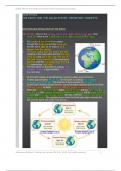
The rotational axis of the Earth passes 23.5°
through the North pole and the South pole, N-pole
and the axis is tilted at an angle of 23.5
degrees from the vertical.
The Earth rotates from the west to the east,
resulting in the observation that the Sun rises
west
in the east and sets in the west. The side of
the Earth facing towards the Sun experiences
daytime, while the side facing away from the
Sun experiences night time. east
The time taken for the Earth to undergo one
complete rotation is approximately 24 hours
S-pole
(i.e. one day).
As the Earth rotates, it simultaneously revolves (orbits) around the Sun.
It takes approximately 365.25 days for the Earth to undergo one complete
revolution around the Sun. This duration of time is known as one year.
As the Earth revolves around the Sun, due to the tilted rotational axis of the Earth,
different regions on Earth experience different lengths of daylight.
When the North pole of the Earth aligns towards the Sun and the South pole away
from the Sun, the northern hemisphere experiences summer due to longer hours of
sunlight and more solar energy received per day, while the southern hemisphere
experiences winter. The opposite occurs when the South pole aligns towards the
Sun and the North pole away from the Sun.
___________________________________________________________________________
Nakazawa EduServ. Created by Jackson Tik, B.Sc. (NUS). ©All rights reserved. 1
, IGCSE Physics\The Earth & The Solar System\Important Concepts
During summer solstice, the northern hemisphere observes the longest daytime and
shortest night time of the year, while the southern hemisphere observes the longest
night time and shortest daytime. The North pole receives 24 hours of continuous
daylight, while the South pole experiences 24 hours of continuous night time. The
opposite occurs during winter solstice.
During spring and autumn equinoxes, the Sun is equidistant from the poles, hence
most regions on Earth observe approximately 12 hours each of daytime and night
time. The exception occurs at the poles, where the Sun rises and sets only once a
year, during the equinoxes.
As the Earth revolves around the Sun, the average orbital speed, v, of the Earth can
be determined using the formula:
r: orbital radius of the Earth around the Sun, T = orbital period of the Earth
Test Yourself:
Knowing the orbital period of the Earth and given that the Earth travels at a speed of
29.78 km s-1 along its orbit, determine its distance from the Sun in km.
ROTATION AND REVOLUTION OF THE MOON
Similar to the Earth, the Moon rotates about its own axis while revolving around the
Earth. Both the Earth and the Moon revolve around the Sun.
The orbital period of the Moon is 27.3 days. However, as observed from the Earth,
it takes 29.5 days for the phase of the Moon to change from a new moon to the
next new moon.
(a) New moon: occurs
when the Moon is
directly between the
Sun and the Earth; not
visible as the unlit half
of the Moon faces the
Earth
(b) Full moon: occurs
when the Moon is at
the opposite side of the
Earth from the Sun;
the entire lit portion of
the Moon faces the
Earth
___________________________________________________________________________
Nakazawa EduServ. Created by Jackson Tik, B.Sc. (NUS). ©All rights reserved. 2
IGCSE PHYSICS
THE EARTH AND THE SOLAR SYSTEM: IMPORTANT CONCEPTS
ROTATION AND REVOLUTION OF THE EARTH
Rotation refers to the spinning motion of an object about its own axis, while
revolution refers to the orbital motion of an object around another object.
The rotational axis of the Earth passes 23.5°
through the North pole and the South pole, N-pole
and the axis is tilted at an angle of 23.5
degrees from the vertical.
The Earth rotates from the west to the east,
resulting in the observation that the Sun rises
west
in the east and sets in the west. The side of
the Earth facing towards the Sun experiences
daytime, while the side facing away from the
Sun experiences night time. east
The time taken for the Earth to undergo one
complete rotation is approximately 24 hours
S-pole
(i.e. one day).
As the Earth rotates, it simultaneously revolves (orbits) around the Sun.
It takes approximately 365.25 days for the Earth to undergo one complete
revolution around the Sun. This duration of time is known as one year.
As the Earth revolves around the Sun, due to the tilted rotational axis of the Earth,
different regions on Earth experience different lengths of daylight.
When the North pole of the Earth aligns towards the Sun and the South pole away
from the Sun, the northern hemisphere experiences summer due to longer hours of
sunlight and more solar energy received per day, while the southern hemisphere
experiences winter. The opposite occurs when the South pole aligns towards the
Sun and the North pole away from the Sun.
___________________________________________________________________________
Nakazawa EduServ. Created by Jackson Tik, B.Sc. (NUS). ©All rights reserved. 1
, IGCSE Physics\The Earth & The Solar System\Important Concepts
During summer solstice, the northern hemisphere observes the longest daytime and
shortest night time of the year, while the southern hemisphere observes the longest
night time and shortest daytime. The North pole receives 24 hours of continuous
daylight, while the South pole experiences 24 hours of continuous night time. The
opposite occurs during winter solstice.
During spring and autumn equinoxes, the Sun is equidistant from the poles, hence
most regions on Earth observe approximately 12 hours each of daytime and night
time. The exception occurs at the poles, where the Sun rises and sets only once a
year, during the equinoxes.
As the Earth revolves around the Sun, the average orbital speed, v, of the Earth can
be determined using the formula:
r: orbital radius of the Earth around the Sun, T = orbital period of the Earth
Test Yourself:
Knowing the orbital period of the Earth and given that the Earth travels at a speed of
29.78 km s-1 along its orbit, determine its distance from the Sun in km.
ROTATION AND REVOLUTION OF THE MOON
Similar to the Earth, the Moon rotates about its own axis while revolving around the
Earth. Both the Earth and the Moon revolve around the Sun.
The orbital period of the Moon is 27.3 days. However, as observed from the Earth,
it takes 29.5 days for the phase of the Moon to change from a new moon to the
next new moon.
(a) New moon: occurs
when the Moon is
directly between the
Sun and the Earth; not
visible as the unlit half
of the Moon faces the
Earth
(b) Full moon: occurs
when the Moon is at
the opposite side of the
Earth from the Sun;
the entire lit portion of
the Moon faces the
Earth
___________________________________________________________________________
Nakazawa EduServ. Created by Jackson Tik, B.Sc. (NUS). ©All rights reserved. 2