100% satisfaction guarantee Immediately available after payment Both online and in PDF No strings attached 4.2 TrustPilot
logo-home
Exam (elaborations)

FBLA: Learning Strategies Questions and Answers

Rating
-
Sold
-
Pages
6
Grade
A+
Uploaded on
04-05-2025
Written in
2024/2025

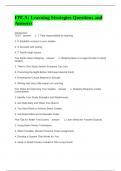
FBLA: Learning Strategies Questions and Answers Introduction TEST 1. T Take responsibility for learning. 2. E Establish success in your studies. 3. S Succeed with writing. 4. T Tackle tough issues. Five Myths About Studying: 1. Studying More or Longer Results In Good Grades. 2. There's One Study System Everyone Can Use. 3. Cramming the Night Before Will Keep Material Fresh. 4. Knowing the Course Material Is Enough. 5. Writing Has Very Little Impact on Learning. Five Rules for Improving Your Grades: 1. Studying Requires a Daily Commitment. 2. Identify Your Study Strengths and Weaknesses. 3. Get Help Early and When You Need It. 4. You Must Want to Achieve Better Grades. 5. Set Reasonable and Achievable Goals. Five Tips for Better Test Scores: 1. Learn What the Teacher Expects. 2. Using Brain Fitness Techniques. 3. When Possible, Review Previous Tests/ Assignment. 4. Develop a System That Works for You. 5. Study in Small Chunks Instead of One Long Period. Techniques for Overcoming Procrastination: 1. Tiny Chunks of Time. 2. Motivation by doing it. 3. Committed Self-Talk. Tackling Time Management: 1. Get the hardest tasks-or the easiest-out of the way first 2. Avoid procrastination with an easy-to-remember system 3. Multiply time estimates for work completion by 3x 4. Break tasks into smaller components 5. Set realistic Goals 6. Stay as busy as possible 7. Track your time Time-Management and Project-Management Systems 1. Use a daily planner. 2. Make a to-do list. 3. Add color coding. Making the Most of Your Time 1. Determine your concentration span. 2. Identify your most productive times. 3. Capitalize on 'waiting' times. 4. Explore the amount of available time and allot a portion to schoolwork. 5. Conduct weekly reviews of course material Visual Learners Prefer to take in information by sight and like to learn through reading, diagrams, charts, graphs, maps and pictures. They can easily mentally "see" facts and concepts, and are said to be able to recall 75% of material read or observed. Study Strategies for visual learners 1. Type written notes 2. Use Flash Cards 3. Use Mind Maps 4. Develop Outlines 5. Create mental pictures of reading assignments 6. Use Color Coding in your time management system 7. Annotate as you read by using symbols and pictures 8. Make diagrams of all steps Auditory Learners Prefer to take in information through their sense of hearing. They tend to be fond of speaking out loud, talking to themselves, and listening to themselves talk. They have difficulty with distracting noise. They are said to be able to recall 75% of material they hear. Strategies for Auditory Learners 1. Ask others to explain 2. Join Study Groups 3. Teach Material to others 4. Recite notes aloud 5. Use Mnemonics 6. Create a story anecdote 6. Record notes/playback 7. Make jingles to remember 8. Look for podcast on the topic Kinaesthetic /Tactile Learners Prefer to take in information through movement, manipulation, and touch. They tend to be able to operate equipment without reading instructions. They can easily learn dance steps and athletic manoeuvres. Kinaesthetic /Tactile Learners 1. Move around while studying 2. Study in relaxed position 3. Active reading strategies 4. Use whiteboards 5. Identify with characters 6. Be the instructor 7. Create 3D Models 8. Use Sticky Notes 9. Study in short Segments 10. Keep your hands busy 11. Visit Real Life Examples Global vs. Analytical/Sequential Learners The learning styles of global and analytical/sequential learners overlap with visual, auditory, kinesthetic/tactical learners. In other words you can be a visual learner. Global Learners They like to learn through stories and anecdotes and can often imagine what happens next. They tend to see the big picture and overlook details. Global Learners Study Strategies: 1. Surveying reading material before you read it. 2. Long study blocks devoted to one subject. 3. You can multitask and tolerate noise while studying. 4. You will be comfortable studying in dim light. 5. Study groups suit your style. 6. You will be tempted to skip steps, don't. 7. Be careful with time management, you take your time. Analytical/Sequential Learners These learners prefer linear steps that logically follow each other. Analytical/Sequential Learners prefer working on projects in small chunks. They can discern details but often have trouble seeing the big picture. Analytical/Sequential Learners Study Strategies: 1. Study in a quite well-lit environment. 2. Highlight or underline key points in your reading. 3. See the big picture. 4. Create outlines, timelines and diagrams. 5. Turn study materials into puzzles or games. Successful Intelligence A person's overall intelligence comprises three distinct elements: 1. Analytical 2. Creative 3. Practical thinking skills Successful Intelligence Successful intelligence is the kind of intelligence you need to succeed both in school and in the real world. It is the translation of underlying skills and abilities into routines that lead to highly competent everyday performance-on the job, and in the classroom. Analytical Intelligence: It is the ability to overcome obstacles to find solutions. Being analytically intelligent is having the ability to solve problems effectively. Creative Intelligence: Is the ability to come up with new ideas. with creative intelligence, a person can generate innovative solutions to solve problems. Practical Intelligence: Is common sense and deals mostly with social situations. Some might refer to this aspect of intelligence as street smarts. Improving Analytical Thinking Skills: 1. Seek out more information about the situation. 2. Separate information into fact and opinion. 3. Evaluate and decide the importance of each piece. 4. Breakdown larger concepts into smaller easier pieces. 5. Dedicate time to gathering, reading and evaluating information. Improving Creative Thinking Skills: 1. Take risks by pushing yourself out of your comfort zone. 2. Seek out examples of the creative solutions of others to similar situations. 3. Examine the situation you face from multiple perspectives. 4. Go beyond obvious and conventional solutions. 5. Free yourself to brainstorm. Improving Practical Thinking Skills: 1. Try to observe how others work and make decisions 2. Examine how others have successfully accomplished things. 3. Look for patterns in past decisions to help in the future. 4. Read common sense tips for everyday problems. 5. Apply what you have learned from the past to the present day.

Show more Read less
Institution
FBLA
Course
FBLA


Whoops! We can’t load your doc right now. Try again or contact support.

Written for

Institution
FBLA
Course
FBLA

Document information

Uploaded on
May 4, 2025
Number of pages
6
Written in
2024/2025
Type
Exam (elaborations)
Contains
Questions & answers

Subjects

Content preview

FBLA: Learning Strategies Questions and
Answers
Introduction
TEST - answer 1. T Take responsibility for learning.

2. E Establish success in your studies.

3. S Succeed with writing.

4. T Tackle tough issues.

Five Myths About Studying: - answer 1. Studying More or Longer Results In Good
Grades.

2. There's One Study System Everyone Can Use.

3. Cramming the Night Before Will Keep Material Fresh.

4. Knowing the Course Material Is Enough.

5. Writing Has Very Little Impact on Learning.

Five Rules for Improving Your Grades: - answer 1. Studying Requires a Daily
Commitment.

2. Identify Your Study Strengths and Weaknesses.

3. Get Help Early and When You Need It.

4. You Must Want to Achieve Better Grades.

5. Set Reasonable and Achievable Goals.

Five Tips for Better Test Scores: - answer 1. Learn What the Teacher Expects.

2. Using Brain Fitness Techniques.

3. When Possible, Review Previous Tests/ Assignment.

4. Develop a System That Works for You.

5. Study in Small Chunks Instead of One Long Period.

, Techniques for Overcoming Procrastination: - answer 1. Tiny Chunks of Time.

2. Motivation by doing it.

3. Committed Self-Talk.

Tackling Time Management: - answer 1. Get the hardest tasks-or the easiest-out of
the way first

2. Avoid procrastination with an easy-to-remember system

3. Multiply time estimates for work completion by 3x

4. Break tasks into smaller components

5. Set realistic Goals

6. Stay as busy as possible

7. Track your time

Time-Management and Project-Management Systems - answer 1. Use a daily
planner.

2. Make a to-do list.

3. Add color coding.

Making the Most of Your Time - answer 1. Determine your concentration span.

2. Identify your most productive times.

3. Capitalize on 'waiting' times.

4. Explore the amount of available time and allot a portion to schoolwork.

5. Conduct weekly reviews of course material

Visual Learners - answer Prefer to take in information by sight and like to learn
through reading, diagrams, charts, graphs, maps and pictures. They can easily mentally
"see" facts and concepts, and are said to be able to recall 75% of material read or
observed.

Study Strategies for visual learners - answer 1. Type written notes 2. Use Flash
Cards

Get to know the seller

Seller avatar
Reputation scores are based on the amount of documents a seller has sold for a fee and the reviews they have received for those documents. There are three levels: Bronze, Silver and Gold. The better the reputation, the more your can rely on the quality of the sellers work.
Pogba119 Harvard University
View profile
Follow You need to be logged in order to follow users or courses
Sold
48
Member since
1 year
Number of followers
2
Documents
4898
Last sold
1 month ago
NURSING TEST

BEST EDUCATIONAL RESOURCES FOR STUDENTS

3.9

9 reviews

5
4
4
2
3
2
2
0
1
1

Recently viewed by you

Why students choose Stuvia

Created by fellow students, verified by reviews

Quality you can trust: written by students who passed their tests and reviewed by others who've used these notes.

Didn't get what you expected? Choose another document

No worries! You can instantly pick a different document that better fits what you're looking for.

Pay as you like, start learning right away

No subscription, no commitments. Pay the way you're used to via credit card and download your PDF document instantly.

Student with book image

“Bought, downloaded, and aced it. It really can be that simple.”

Alisha Student

Frequently asked questions