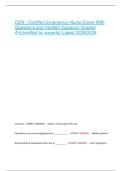
CEN CErtifiCatioN Exam 2025/2026 – LatEst
ExpErt-VErifiEd study GuidE with 100% aCCuratE
QuEstioNs &. aNswErs for GuaraNtEEd suCCEss.
◉ A patient presents with a sore throat and difficulty swallowing. Assessment
reveals fever, muffled voice, and cervical lymphadenitis. What is the highest
priority?
Airway protection
Pain management
Preparation for incision and drainage
Intravenous access for fluid resuscitation. Answer: Airway protection
◉ A 42-year-old female patient presents to the emergency department with
complaints of having right upper quadrant cramping pain that radiates to the
right scapula and shoulder areas. She also complains of being "bloated and
passing gas." With her history, which gastrointestinal disorder is she at risk
for?
Cholecystitis
Hepatitis
Pancreatitis
Diverticulitis. Answer: Cholecystitis
◉ A patient presents to the ED with chest pain. The nurse assesses the pain
and determines that rest relieves the pain. What does the nurse determine this
indicates?
,Stable angina
Unstable angina
Non-ST elevation myocardial infarction
ST elevation myocardial infarction. Answer: Stable angina
◉ A 32-year-old female patient is brought to the emergency department via
emergency medical services with a complaint of coughing for the past two
weeks. The patient is now complaining of severe epigastric pain and is
violently retching and vomiting blood. She has a history of alcohol abuse and
bulimia. Which type of gastrointestinal disorder is the most likely cause of
these symptoms?
Diverticulitis
Mallory-Weiss syndrome
Pancreatitis
Gastric ulcer. Answer: Mallory-Weiss syndrome
◉ Which stage pressure ulcer includes partial thickness skin loss?
Stage 2
Stage 1
Stage 3
Stage 4. Answer: Stage 2
◉ The Frank-Starling law applies to which component of cardiac output?
Stroke volume
Preload
,Heart rate
Afterload. Answer: Preload
◉ Which of the following is an early sign of increasing intracranial pressure in
a patient with a head injury?
Bradycardia
Widening pulse pressure
Extension of upper extremities with stimuli
Nausea and vomiting. Answer: Nausea and vomiting
◉ A patient arrives via emergency medical services and is unresponsive, pale,
and with involuntary movement of the head and right side of the body.
Symptoms continue despite midazolam having been administered in the field.
Which medication should be administered next?
Thiamine
Fosphenytoin
Phenobarbital
Lorazepam. Answer: Lorazepam
◉ A 23-year-old patient with a stable ectopic pregnancy is being cared for by
an emergency nurse. The emergency physician ordered methotrexate to be
administered intramuscularly. Which statement by the nurse indicates an
understanding of the medication?
I'll instruct the patient to follow up in two weeks.
I can give this medication because there is only scant vaginal bleeding.
I'll give this medication because there is fetal cardiac activity.
, I can't administer this medication. I'm pregnant.. Answer: I can't administer
this medication. I'm pregnant.
◉ The nurse is giving discharge instructions to a patient with Bell's palsy.
Which of the following will be included?
Avoid sleeping on the affected side
Instill artificial tears during the day
Take antibiotics as prescribed
Use a mouth guard at night. Answer: Instill artificial tears during the day
◉ Meningeal irritation in a 26-year-old patient is considered after which one
of the following assessment findings?
Positive Babinski
Nuchal rigidity
Abnormal flexion
Negative Brudzinski sign. Answer: Nuchal rigidity
◉ A mass casualty incident occurred near a level one trauma center. There
were several deaths ranging from ages 3 months to 42 years old. The nurses
working that night were emotionally drained and physically stressed. A critical
incident process was arranged within 24 hours. Which component of the
critical incident stress management process took place?
Debriefing
Defusing
Crisis intervention
Follow-up. Answer: Debriefing
ExpErt-VErifiEd study GuidE with 100% aCCuratE
QuEstioNs &. aNswErs for GuaraNtEEd suCCEss.
◉ A patient presents with a sore throat and difficulty swallowing. Assessment
reveals fever, muffled voice, and cervical lymphadenitis. What is the highest
priority?
Airway protection
Pain management
Preparation for incision and drainage
Intravenous access for fluid resuscitation. Answer: Airway protection
◉ A 42-year-old female patient presents to the emergency department with
complaints of having right upper quadrant cramping pain that radiates to the
right scapula and shoulder areas. She also complains of being "bloated and
passing gas." With her history, which gastrointestinal disorder is she at risk
for?
Cholecystitis
Hepatitis
Pancreatitis
Diverticulitis. Answer: Cholecystitis
◉ A patient presents to the ED with chest pain. The nurse assesses the pain
and determines that rest relieves the pain. What does the nurse determine this
indicates?
,Stable angina
Unstable angina
Non-ST elevation myocardial infarction
ST elevation myocardial infarction. Answer: Stable angina
◉ A 32-year-old female patient is brought to the emergency department via
emergency medical services with a complaint of coughing for the past two
weeks. The patient is now complaining of severe epigastric pain and is
violently retching and vomiting blood. She has a history of alcohol abuse and
bulimia. Which type of gastrointestinal disorder is the most likely cause of
these symptoms?
Diverticulitis
Mallory-Weiss syndrome
Pancreatitis
Gastric ulcer. Answer: Mallory-Weiss syndrome
◉ Which stage pressure ulcer includes partial thickness skin loss?
Stage 2
Stage 1
Stage 3
Stage 4. Answer: Stage 2
◉ The Frank-Starling law applies to which component of cardiac output?
Stroke volume
Preload
,Heart rate
Afterload. Answer: Preload
◉ Which of the following is an early sign of increasing intracranial pressure in
a patient with a head injury?
Bradycardia
Widening pulse pressure
Extension of upper extremities with stimuli
Nausea and vomiting. Answer: Nausea and vomiting
◉ A patient arrives via emergency medical services and is unresponsive, pale,
and with involuntary movement of the head and right side of the body.
Symptoms continue despite midazolam having been administered in the field.
Which medication should be administered next?
Thiamine
Fosphenytoin
Phenobarbital
Lorazepam. Answer: Lorazepam
◉ A 23-year-old patient with a stable ectopic pregnancy is being cared for by
an emergency nurse. The emergency physician ordered methotrexate to be
administered intramuscularly. Which statement by the nurse indicates an
understanding of the medication?
I'll instruct the patient to follow up in two weeks.
I can give this medication because there is only scant vaginal bleeding.
I'll give this medication because there is fetal cardiac activity.
, I can't administer this medication. I'm pregnant.. Answer: I can't administer
this medication. I'm pregnant.
◉ The nurse is giving discharge instructions to a patient with Bell's palsy.
Which of the following will be included?
Avoid sleeping on the affected side
Instill artificial tears during the day
Take antibiotics as prescribed
Use a mouth guard at night. Answer: Instill artificial tears during the day
◉ Meningeal irritation in a 26-year-old patient is considered after which one
of the following assessment findings?
Positive Babinski
Nuchal rigidity
Abnormal flexion
Negative Brudzinski sign. Answer: Nuchal rigidity
◉ A mass casualty incident occurred near a level one trauma center. There
were several deaths ranging from ages 3 months to 42 years old. The nurses
working that night were emotionally drained and physically stressed. A critical
incident process was arranged within 24 hours. Which component of the
critical incident stress management process took place?
Debriefing
Defusing
Crisis intervention
Follow-up. Answer: Debriefing