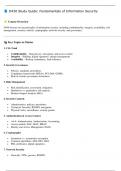
D430 Study Guide: Fundamentals of Information Security
Course Overview
D430 focuses on core principles of information security, including confidentiality, integrity, availability, risk
management, security controls, cryptography, network security, and governance.
Key Topics to Master
1. CIA Triad
• Confidentiality – Data privacy, encryption, and access control.
• Integrity – Hashing, digital signatures, change management.
• Availability – Backup, redundancy, fault tolerance.
2. Security Governance
• Policies, standards, procedures.
• Compliance frameworks (HIPAA, PCI-DSS, GDPR).
• Role of security governance in business.
3. Risk Management
• Risk identification, assessment, mitigation.
• Qualitative vs. quantitative risk analysis.
• Business Impact Analysis (BIA).
4. Security Controls
• Administrative: policies, procedures.
• Technical: firewalls, IDS/IPS, encryption.
• Physical: locks, surveillance, security guards.
5. Authentication & Access Control
• AAA: Authentication, Authorization, Accounting.
• Access models: DAC, MAC, RBAC.
• Identity and Access Management (IAM).
6. Cryptography
• Symmetric vs. asymmetric encryption.
• Common algorithms: AES, RSA, SHA.
• PKI, certificates, digital signatures.
7. Network Security
• Firewalls, VPNs, proxies, IDS/IPS.
, • Common threats: DoS, MITM, sniffing.
• Secure protocols (HTTPS, SSH, SFTP).
8. Security Architecture & Design
• Defense in depth.
• Security zones (DMZ, intranet).
• Secure system lifecycle and hardening.
9. Incident Response
• Phases: Preparation, Detection, Containment, Eradication, Recovery, Lessons Learned.
• Incident response team roles.
10. Business Continuity & Disaster Recovery
• DRP vs. BCP.
• RTO, RPO metrics.
• Backup strategies.
D430 Study Planner (4-Week Plan)
Week 1: Foundation & Governance
• Day 1-2: CIA Triad, Intro to Information Security.
• Day 3: Policies, Standards, Compliance.
• Day 4: Risk Management Basics.
• Day 5: Review flashcards/Quizlet + practice quiz.
• Weekend: Write summary notes + concept map.
Week 2: Controls & Cryptography
• Day 1: Administrative/Technical/Physical Controls.
• Day 2-3: Cryptographic Principles, Symmetric vs. Asymmetric.
• Day 4: PKI and Hashing.
• Day 5: Practice questions + flashcards.
• Weekend: Watch cybersecurity YouTube tutorials + revise.
Week 3: Networks & Security Design
• Day 1: Network Security Devices & Threats.
• Day 2: Secure Protocols & VPN.
• Day 3: Defense in Depth, DMZ, Secure Architecture.
• Day 4: Access Control Models & IAM.
• Day 5: Quiz review + practice exam.
• Weekend: Mock test & review results.
Week 4: Response & Continuity
• Day 1: Incident Response Phases.
• Day 2: BCP vs. DRP, RTO/RPO.
,• Day 3: Final notes & high-yield review.
• Day 4: Flashcards, weak topics revision.
• Day 5: Final Practice Exam.
• Weekend: Relax, light review, prepare for OA.
Tips for Success
• Use the Course of Study (CoS) and PA tasks as your blueprint.
• Take notes in your own words.
• Review OA practice exams twice: once early, once before the test.
• Course Overview
• D430 focuses on core principles of information security, including confidentiality, integrity, availability, risk
management, security controls, cryptography, network security, and governance.
• ________________________________________
• Key Topics to Master
• 1. CIA Triad
• Confidentiality – Data privacy, encryption, and access control.
• Integrity – Hashing, digital signatures, change management.
• Availability – Backup, redundancy, fault tolerance.
• 2. Security Governance
• Policies, standards, procedures.
• Compliance frameworks (HIPAA, PCI-DSS, GDPR).
• Role of security governance in business.
• 3. Risk Management
• Risk identification, assessment, mitigation.
• Qualitative vs. quantitative risk analysis.
• Business Impact Analysis (BIA).
• 4. Security Controls
• Administrative: policies, procedures.
• Technical: firewalls, IDS/IPS, encryption.
• Physical: locks, surveillance, security guards.
• 5. Authentication & Access Control
• AAA: Authentication, Authorization, Accounting.
• Access models: DAC, MAC, RBAC.
• Identity and Access Management (IAM).
• 6. Cryptography
• Symmetric vs. asymmetric encryption.
• Common algorithms: AES, RSA, SHA.
• PKI, certificates, digital signatures.
• 7. Network Security
• Firewalls, VPNs, proxies, IDS/IPS.
• Common threats: DoS, MITM, sniffing.
• Secure protocols (HTTPS, SSH, SFTP).
• 8. Security Architecture & Design
• Defense in depth.
• Security zones (DMZ, intranet).
• Secure system lifecycle and hardening.
• 9. Incident Response
• Phases: Preparation, Detection, Containment, Eradication, Recovery, Lessons Learned.
• Incident response team roles.
• 10. Business Continuity & Disaster Recovery
, • DRP vs. BCP.
• RTO, RPO metrics.
• Backup strategies.
• ________________________________________
• D430 Study Planner (4-Week Plan)
• Week 1: Foundation & Governance
• Day 1-2: CIA Triad, Intro to Information Security.
• Day 3: Policies, Standards, Compliance.
• Day 4: Risk Management Basics.
• Day 5: Review flashcards/Quizlet + practice quiz.
• Weekend: Write summary notes + concept map.
• Week 2: Controls & Cryptography
• Day 1: Administrative/Technical/Physical Controls.
• Day 2-3: Cryptographic Principles, Symmetric vs. Asymmetric.
• Day 4: PKI and Hashing.
• Day 5: Practice questions + flashcards.
• Weekend: Watch cybersecurity YouTube tutorials + revise.
• Week 3: Networks & Security Design
• Day 1: Network Security Devices & Threats.
• Day 2: Secure Protocols & VPN.
• Day 3: Defense in Depth, DMZ, Secure Architecture.
• Day 4: Access Control Models & IAM.
• Day 5: Quiz review + practice exam.
• Weekend: Mock test & review results.
• Week 4: Response & Continuity
• Day 1: Incident Response Phases.
• Day 2: BCP vs. DRP, RTO/RPO.
• Day 3: Final notes & high-yield review.
• Day 4: Flashcards, weak topics revision.
• Day 5: Final Practice Exam.
• Weekend: Relax, light review, prepare for OA.
• ________________________________________
• Tips for Success
• Use the Course of Study (CoS) and PA tasks as your blueprint.
• Take notes in your own words.
• Review OA practice exams twice: once early, once before the test.
• Use MindTap or TestOut if provided for simulations and quizzes.
Course Overview
D430 focuses on core principles of information security, including confidentiality, integrity, availability, risk
management, security controls, cryptography, network security, and governance.
Key Topics to Master
1. CIA Triad
• Confidentiality – Data privacy, encryption, and access control.
• Integrity – Hashing, digital signatures, change management.
• Availability – Backup, redundancy, fault tolerance.
2. Security Governance
• Policies, standards, procedures.
• Compliance frameworks (HIPAA, PCI-DSS, GDPR).
• Role of security governance in business.
3. Risk Management
• Risk identification, assessment, mitigation.
• Qualitative vs. quantitative risk analysis.
• Business Impact Analysis (BIA).
4. Security Controls
• Administrative: policies, procedures.
• Technical: firewalls, IDS/IPS, encryption.
• Physical: locks, surveillance, security guards.
5. Authentication & Access Control
• AAA: Authentication, Authorization, Accounting.
• Access models: DAC, MAC, RBAC.
• Identity and Access Management (IAM).
6. Cryptography
• Symmetric vs. asymmetric encryption.
• Common algorithms: AES, RSA, SHA.
• PKI, certificates, digital signatures.
7. Network Security
• Firewalls, VPNs, proxies, IDS/IPS.
, • Common threats: DoS, MITM, sniffing.
• Secure protocols (HTTPS, SSH, SFTP).
8. Security Architecture & Design
• Defense in depth.
• Security zones (DMZ, intranet).
• Secure system lifecycle and hardening.
9. Incident Response
• Phases: Preparation, Detection, Containment, Eradication, Recovery, Lessons Learned.
• Incident response team roles.
10. Business Continuity & Disaster Recovery
• DRP vs. BCP.
• RTO, RPO metrics.
• Backup strategies.
D430 Study Planner (4-Week Plan)
Week 1: Foundation & Governance
• Day 1-2: CIA Triad, Intro to Information Security.
• Day 3: Policies, Standards, Compliance.
• Day 4: Risk Management Basics.
• Day 5: Review flashcards/Quizlet + practice quiz.
• Weekend: Write summary notes + concept map.
Week 2: Controls & Cryptography
• Day 1: Administrative/Technical/Physical Controls.
• Day 2-3: Cryptographic Principles, Symmetric vs. Asymmetric.
• Day 4: PKI and Hashing.
• Day 5: Practice questions + flashcards.
• Weekend: Watch cybersecurity YouTube tutorials + revise.
Week 3: Networks & Security Design
• Day 1: Network Security Devices & Threats.
• Day 2: Secure Protocols & VPN.
• Day 3: Defense in Depth, DMZ, Secure Architecture.
• Day 4: Access Control Models & IAM.
• Day 5: Quiz review + practice exam.
• Weekend: Mock test & review results.
Week 4: Response & Continuity
• Day 1: Incident Response Phases.
• Day 2: BCP vs. DRP, RTO/RPO.
,• Day 3: Final notes & high-yield review.
• Day 4: Flashcards, weak topics revision.
• Day 5: Final Practice Exam.
• Weekend: Relax, light review, prepare for OA.
Tips for Success
• Use the Course of Study (CoS) and PA tasks as your blueprint.
• Take notes in your own words.
• Review OA practice exams twice: once early, once before the test.
• Course Overview
• D430 focuses on core principles of information security, including confidentiality, integrity, availability, risk
management, security controls, cryptography, network security, and governance.
• ________________________________________
• Key Topics to Master
• 1. CIA Triad
• Confidentiality – Data privacy, encryption, and access control.
• Integrity – Hashing, digital signatures, change management.
• Availability – Backup, redundancy, fault tolerance.
• 2. Security Governance
• Policies, standards, procedures.
• Compliance frameworks (HIPAA, PCI-DSS, GDPR).
• Role of security governance in business.
• 3. Risk Management
• Risk identification, assessment, mitigation.
• Qualitative vs. quantitative risk analysis.
• Business Impact Analysis (BIA).
• 4. Security Controls
• Administrative: policies, procedures.
• Technical: firewalls, IDS/IPS, encryption.
• Physical: locks, surveillance, security guards.
• 5. Authentication & Access Control
• AAA: Authentication, Authorization, Accounting.
• Access models: DAC, MAC, RBAC.
• Identity and Access Management (IAM).
• 6. Cryptography
• Symmetric vs. asymmetric encryption.
• Common algorithms: AES, RSA, SHA.
• PKI, certificates, digital signatures.
• 7. Network Security
• Firewalls, VPNs, proxies, IDS/IPS.
• Common threats: DoS, MITM, sniffing.
• Secure protocols (HTTPS, SSH, SFTP).
• 8. Security Architecture & Design
• Defense in depth.
• Security zones (DMZ, intranet).
• Secure system lifecycle and hardening.
• 9. Incident Response
• Phases: Preparation, Detection, Containment, Eradication, Recovery, Lessons Learned.
• Incident response team roles.
• 10. Business Continuity & Disaster Recovery
, • DRP vs. BCP.
• RTO, RPO metrics.
• Backup strategies.
• ________________________________________
• D430 Study Planner (4-Week Plan)
• Week 1: Foundation & Governance
• Day 1-2: CIA Triad, Intro to Information Security.
• Day 3: Policies, Standards, Compliance.
• Day 4: Risk Management Basics.
• Day 5: Review flashcards/Quizlet + practice quiz.
• Weekend: Write summary notes + concept map.
• Week 2: Controls & Cryptography
• Day 1: Administrative/Technical/Physical Controls.
• Day 2-3: Cryptographic Principles, Symmetric vs. Asymmetric.
• Day 4: PKI and Hashing.
• Day 5: Practice questions + flashcards.
• Weekend: Watch cybersecurity YouTube tutorials + revise.
• Week 3: Networks & Security Design
• Day 1: Network Security Devices & Threats.
• Day 2: Secure Protocols & VPN.
• Day 3: Defense in Depth, DMZ, Secure Architecture.
• Day 4: Access Control Models & IAM.
• Day 5: Quiz review + practice exam.
• Weekend: Mock test & review results.
• Week 4: Response & Continuity
• Day 1: Incident Response Phases.
• Day 2: BCP vs. DRP, RTO/RPO.
• Day 3: Final notes & high-yield review.
• Day 4: Flashcards, weak topics revision.
• Day 5: Final Practice Exam.
• Weekend: Relax, light review, prepare for OA.
• ________________________________________
• Tips for Success
• Use the Course of Study (CoS) and PA tasks as your blueprint.
• Take notes in your own words.
• Review OA practice exams twice: once early, once before the test.
• Use MindTap or TestOut if provided for simulations and quizzes.