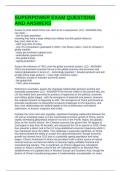
SUPERPOWER EXAM QUESTIONS
AND ANSWERS
Assess to what extent China can claim to be a superpower. (12) - ANSWER-they
can claim....
- due to large population
meaning they have a large military but military has little global influence
they can't claim to be....
- GDP only 10% of USAs
- only 2% of population graduated in 2009 = low literacy rates = hard to compete in
global markets
- rarely get involved in global crisis
- authoritarian government
- few global brands
- ageing population
Assess the influence of TNCs over the global economic system. (12) - ANSWER-
TNCs are dominant economic forces in the global economy and economic and
cultural globalisation in terms of.... technology (patents) = develop products and sell
at high prices trade patterns. = have high economic output
- influence socially to maintain economic power
- the global shift
- TNCs drive innovation
Referring to examples, assess the changing relationships between existing and
emerging superpowers (12) - ANSWER-From the late 1980s to the present day, the
US has widely been perceived to possess a hegemony on the political, economic
and military global stages - with the emergence of potential rival powers, however,
this unipolar dynamic is beginning to shift. The emergence of China and Russia as
potential superpowers is presenting increasing challenges to US hegemony, and
thus, their relationships are shifting rapidly to one of dominance and relative
submission, to tension, suspicion and rivalry.
Perhaps the most overt and, arguably, significant changing relationship between the
US and an emerging power is in the exponential economic growth of China, and its
rapidly developing geopolitical influence not only in the Pacific region, but globally.
Seen as the 'world's factory', the Chinese economy has grown from 7th largest to
2nd largest in less than 40 decades, and surpassed the US in exports in 2010; China
thus presents a direct rival to the US' long-established economic hegemony which it
has maintained since the 1980s. This challenge is especially significant, as China
has demonstrated the ability to sustain this rapid development: though economic
growth has slowed since 2013 due to a gradually ageing population and rising
wages, China's investment in Africa has provided it with a direct source of natural
mineral reserves and land and labour to develop highly profitable financial and
manufacturing industry. This is significant, as China's alleged neo-colonialism
actions in Africa is similar to that of the US' following WW2 in its Marshall Plan
establishment of a capitalist bloc in Western Europe and Southern Asia; though the
decline of China's manufacturing power is fundamentally unsustainable, its smart
AND ANSWERS
Assess to what extent China can claim to be a superpower. (12) - ANSWER-they
can claim....
- due to large population
meaning they have a large military but military has little global influence
they can't claim to be....
- GDP only 10% of USAs
- only 2% of population graduated in 2009 = low literacy rates = hard to compete in
global markets
- rarely get involved in global crisis
- authoritarian government
- few global brands
- ageing population
Assess the influence of TNCs over the global economic system. (12) - ANSWER-
TNCs are dominant economic forces in the global economy and economic and
cultural globalisation in terms of.... technology (patents) = develop products and sell
at high prices trade patterns. = have high economic output
- influence socially to maintain economic power
- the global shift
- TNCs drive innovation
Referring to examples, assess the changing relationships between existing and
emerging superpowers (12) - ANSWER-From the late 1980s to the present day, the
US has widely been perceived to possess a hegemony on the political, economic
and military global stages - with the emergence of potential rival powers, however,
this unipolar dynamic is beginning to shift. The emergence of China and Russia as
potential superpowers is presenting increasing challenges to US hegemony, and
thus, their relationships are shifting rapidly to one of dominance and relative
submission, to tension, suspicion and rivalry.
Perhaps the most overt and, arguably, significant changing relationship between the
US and an emerging power is in the exponential economic growth of China, and its
rapidly developing geopolitical influence not only in the Pacific region, but globally.
Seen as the 'world's factory', the Chinese economy has grown from 7th largest to
2nd largest in less than 40 decades, and surpassed the US in exports in 2010; China
thus presents a direct rival to the US' long-established economic hegemony which it
has maintained since the 1980s. This challenge is especially significant, as China
has demonstrated the ability to sustain this rapid development: though economic
growth has slowed since 2013 due to a gradually ageing population and rising
wages, China's investment in Africa has provided it with a direct source of natural
mineral reserves and land and labour to develop highly profitable financial and
manufacturing industry. This is significant, as China's alleged neo-colonialism
actions in Africa is similar to that of the US' following WW2 in its Marshall Plan
establishment of a capitalist bloc in Western Europe and Southern Asia; though the
decline of China's manufacturing power is fundamentally unsustainable, its smart