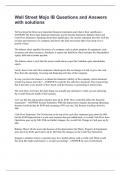
Wall Street Mojo IB Questions and Answers
with solutions
Tell me about the three most important financial statements and what is their significance -
ANSWER The three main financial statements are the Income Statement, Balance Sheet and
Cash Flow Statement. Speaking about their significance, the income statement provides with the
revenue and expenses of a company and shows the final net income that it has made over a
period of time.
The balance sheet signifies the assets of a company such as plant, property & equipment, cash,
inventory and other resources. Similarly, it reports the liabilities which includes the Shareholders
equity, debt and accounts payable.
The balance sheet is such that the assets would always equal the Liabilities plus shareholders
equity.
Lastly, there is the cash flow statement which reports the net change in Cash. It gives the cash
flow from the operating, investing and financing activities of the company.
In case you have the chance to evaluate the financial viability of the company which statement
would you choose and why? - ANSWER It would be the cash flow statement. The reason being
that it provides a true picture of how much cash the business is generating in actual terms.
The cash flows are hence the main thing you actually pay attention to while you are analyzing
the overall financial health of the business.
Let's say that the depreciation expense goes up by $100. How would this affect the financial
statements? - ANSWER Income Statement: With the depreciation expense decreasing Operating
Income would decline by $100 and assuming a 40% tax rate, Net Income would go down by
$60.
Cash Flow Statement: The Net Income at the top of the cash flow statement goes down by $60,
but the $100 Depreciation is a non-cash expense that gets added back, so overall Cash Flow from
Operations goes up by $40. With no further changes, the overall Net Change in Cash goes up by
$40.
Balance Sheet: On the asset side because of the depreciation the Plants, Property & Equipment
goes down by $100, and Cash is up by $40 from the changes on the Cash Flow Statement.
Imagine a situation where a customer pays for a mobile phone with a credit card. What would
this look like under cash-based vs. accrual accounting? - ANSWER In case of cash-based
, accounting, the revenue would not be accounted for until the company charges the customer's
credit card, obtains an authorization and deposits the funds in its bank account.
After this entry would be showed as revenue in the income statement and also as cash in the
balance sheet.
As against in accrual accounting, it would be shown as Revenue right away. But it would yet not
appear as Cash in the Balance Sheet, rather it will be shown as Accounts Receivable.
Only after the amount is deposited in the company's bank account, it would be reported as cash.
What is the formula for calculating WACC? - ANSWER WACC = Cost of Equity * Proportion of
Equity + Cost of debt * Proportion of debt (1-tax rate). Where, The cost of equity calculated
using the Capital Asset Pricing Model (CAPM).
The formula is Cost of Equity = Risk free rate + Beta* Equity risk premium
Cost of Debt = The risk-free rate is basically the yield of a 10-year or 20-year US Treasury
Beta is calculated based on how risky are the comparable companies and equity
Risk Premium is the percent by which stocks are expected to out-perform "risk-less" assets.
The proportion is basically the percentage of how much of the company's capital structure is
taken up by each of the components.
There are two companies P and Q which are exactly the same, but one P has debt whereas Q
doesn't have any. In this case, which of the two companies would have a higher WACC? -
ANSWER In this scenario company, Q would have a higher WACC, because debt is less
expensive than equity.
The interviewer at this juncture might ask you the reasons why debt is considered to be less
expensive? - ANSWER The answer is as follows; Interest on debt is tax-deductible (hence the (1
- Tax Rate) multiplication in the WACC formula).
Debt holders would be paid first in a liquidation or bankruptcy.
Instinctively, interest rates on debt are usually lower than the Cost of Equity numbers you see.
As a result, the Cost of Debt portion of WACC will contribute less to the total figure than the
Cost of Equity portion will.
Describe the ways in which a company is valued. - ANSWER Precedent transaction analysis
This is also called as Transaction Multiple Valuation
This is when you look at how much others have paid for similar companies to determine how
much the company is worth.
with solutions
Tell me about the three most important financial statements and what is their significance -
ANSWER The three main financial statements are the Income Statement, Balance Sheet and
Cash Flow Statement. Speaking about their significance, the income statement provides with the
revenue and expenses of a company and shows the final net income that it has made over a
period of time.
The balance sheet signifies the assets of a company such as plant, property & equipment, cash,
inventory and other resources. Similarly, it reports the liabilities which includes the Shareholders
equity, debt and accounts payable.
The balance sheet is such that the assets would always equal the Liabilities plus shareholders
equity.
Lastly, there is the cash flow statement which reports the net change in Cash. It gives the cash
flow from the operating, investing and financing activities of the company.
In case you have the chance to evaluate the financial viability of the company which statement
would you choose and why? - ANSWER It would be the cash flow statement. The reason being
that it provides a true picture of how much cash the business is generating in actual terms.
The cash flows are hence the main thing you actually pay attention to while you are analyzing
the overall financial health of the business.
Let's say that the depreciation expense goes up by $100. How would this affect the financial
statements? - ANSWER Income Statement: With the depreciation expense decreasing Operating
Income would decline by $100 and assuming a 40% tax rate, Net Income would go down by
$60.
Cash Flow Statement: The Net Income at the top of the cash flow statement goes down by $60,
but the $100 Depreciation is a non-cash expense that gets added back, so overall Cash Flow from
Operations goes up by $40. With no further changes, the overall Net Change in Cash goes up by
$40.
Balance Sheet: On the asset side because of the depreciation the Plants, Property & Equipment
goes down by $100, and Cash is up by $40 from the changes on the Cash Flow Statement.
Imagine a situation where a customer pays for a mobile phone with a credit card. What would
this look like under cash-based vs. accrual accounting? - ANSWER In case of cash-based
, accounting, the revenue would not be accounted for until the company charges the customer's
credit card, obtains an authorization and deposits the funds in its bank account.
After this entry would be showed as revenue in the income statement and also as cash in the
balance sheet.
As against in accrual accounting, it would be shown as Revenue right away. But it would yet not
appear as Cash in the Balance Sheet, rather it will be shown as Accounts Receivable.
Only after the amount is deposited in the company's bank account, it would be reported as cash.
What is the formula for calculating WACC? - ANSWER WACC = Cost of Equity * Proportion of
Equity + Cost of debt * Proportion of debt (1-tax rate). Where, The cost of equity calculated
using the Capital Asset Pricing Model (CAPM).
The formula is Cost of Equity = Risk free rate + Beta* Equity risk premium
Cost of Debt = The risk-free rate is basically the yield of a 10-year or 20-year US Treasury
Beta is calculated based on how risky are the comparable companies and equity
Risk Premium is the percent by which stocks are expected to out-perform "risk-less" assets.
The proportion is basically the percentage of how much of the company's capital structure is
taken up by each of the components.
There are two companies P and Q which are exactly the same, but one P has debt whereas Q
doesn't have any. In this case, which of the two companies would have a higher WACC? -
ANSWER In this scenario company, Q would have a higher WACC, because debt is less
expensive than equity.
The interviewer at this juncture might ask you the reasons why debt is considered to be less
expensive? - ANSWER The answer is as follows; Interest on debt is tax-deductible (hence the (1
- Tax Rate) multiplication in the WACC formula).
Debt holders would be paid first in a liquidation or bankruptcy.
Instinctively, interest rates on debt are usually lower than the Cost of Equity numbers you see.
As a result, the Cost of Debt portion of WACC will contribute less to the total figure than the
Cost of Equity portion will.
Describe the ways in which a company is valued. - ANSWER Precedent transaction analysis
This is also called as Transaction Multiple Valuation
This is when you look at how much others have paid for similar companies to determine how
much the company is worth.