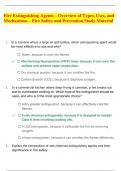
Fire Extinguishing Agents – Overview of Types, Uses, and
Mechanisms – Fire Safety and Prevention Study Material
1. In a scenario where a large oil spill ignites, which extinguishing agent would
be most effective to use and why?
Water, because it cools the flames.
Film-forming fluoroprotein (FFFP) foam, because it can cover the
surface and prevent vapor production.
Dry chemical powder, because it can smother the fire.
Carbon dioxide (CO2), because it displaces oxygen.
2. In a commercial kitchen where deep-frying is common, a fire breaks out
due to overheated cooking oil. Which type of fire extinguisher should be
used, and why is it the most appropriate choice?
A dry powder extinguisher, because it can effectively cool the
flames.
A wet-chemical extinguisher, because it is designed to combat
Class K fires involving cooking oils.
A CO2 extinguisher, because it suffocates the fire by removing
oxygen.
A foam extinguisher, because it can smother the flames effectively.
3. Explain the composition of wet-chemical extinguishing agents and their
significance in fire safety.
,They are primarily made of water and sodium bicarbonate, used for
Class B fires.
, They consist of water and potassium-based compounds,
specifically designed for Class K fires.
They are composed of foam and water, effective for Class A fires.
They contain only dry powder agents, suitable for Class D fires.
4. If a fire involves a polar solvent such as alcohol, which type of fire
extinguishing agent would be most appropriate to use, and why?
Water, because it can cool the flames.
CO2, because it displaces oxygen.
AFFF, because it forms a film that suppresses vapors.
Dry powder, because it is effective on all classes of fire.
5. In a laboratory setting, a small electrical fire occurs. Which type of fire
extinguisher would be most appropriate to use, and why?
Water extinguisher, because it cools the fire.
Foam extinguisher, because it creates a barrier.
Carbon dioxide (CO2) extinguisher, because it does not conduct
electricity.
Dry powder extinguisher, because it can handle multiple fire classes.
6. What is the term of water-soluble flammable liquids such as alcohols,
acetone, and others?
Polar solvents
Volatile fuels
Three-dimensional liquids
Mechanisms – Fire Safety and Prevention Study Material
1. In a scenario where a large oil spill ignites, which extinguishing agent would
be most effective to use and why?
Water, because it cools the flames.
Film-forming fluoroprotein (FFFP) foam, because it can cover the
surface and prevent vapor production.
Dry chemical powder, because it can smother the fire.
Carbon dioxide (CO2), because it displaces oxygen.
2. In a commercial kitchen where deep-frying is common, a fire breaks out
due to overheated cooking oil. Which type of fire extinguisher should be
used, and why is it the most appropriate choice?
A dry powder extinguisher, because it can effectively cool the
flames.
A wet-chemical extinguisher, because it is designed to combat
Class K fires involving cooking oils.
A CO2 extinguisher, because it suffocates the fire by removing
oxygen.
A foam extinguisher, because it can smother the flames effectively.
3. Explain the composition of wet-chemical extinguishing agents and their
significance in fire safety.
,They are primarily made of water and sodium bicarbonate, used for
Class B fires.
, They consist of water and potassium-based compounds,
specifically designed for Class K fires.
They are composed of foam and water, effective for Class A fires.
They contain only dry powder agents, suitable for Class D fires.
4. If a fire involves a polar solvent such as alcohol, which type of fire
extinguishing agent would be most appropriate to use, and why?
Water, because it can cool the flames.
CO2, because it displaces oxygen.
AFFF, because it forms a film that suppresses vapors.
Dry powder, because it is effective on all classes of fire.
5. In a laboratory setting, a small electrical fire occurs. Which type of fire
extinguisher would be most appropriate to use, and why?
Water extinguisher, because it cools the fire.
Foam extinguisher, because it creates a barrier.
Carbon dioxide (CO2) extinguisher, because it does not conduct
electricity.
Dry powder extinguisher, because it can handle multiple fire classes.
6. What is the term of water-soluble flammable liquids such as alcohols,
acetone, and others?
Polar solvents
Volatile fuels
Three-dimensional liquids