

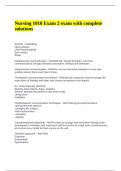
Nursing 1010 Exam 2 exam with complete
solutions
SOLER - ANSSitting
Open posture
Lean toward patient
Eye contact
Relax
Intrapersonal communitcation - ANSSelf talk. People thoughts, and inner
communications strongly influence perception, feelings and behaviors
Interpersonal communication - ANSOne on one interaction between a nurse and
another person that occurs face to face
Therapeutic communication techniques - ANSSpecific responses that encourage the
expression of feelings and ideas and convey acceptance and respect.
Ex: Active listening (SOLER)
Sharing observations, hope, empathy
Silence: prompts the patient to talk when ready
Using touch
Validation
Nontherapeutic communication techniques - ANS-Asking personal questions
-giving personal opinions
-changing the subject
-false reassurance
-sympathy
-arguing
Transformational leadership - ANSFocused on change and innovation through team
development, motivates and empowers staff to function at a high level of performance,
and serves as a model for then nurses on the unit.
TEEAMS approach - ANSTime
Empower
Enthusiastic
Appreciation
, Manages
Support
Magnet recognition - ANSBased on 5 model components:
1) transformational leadership
2) structural empowerment
3) exemplary professional practice
4) new knowledge, innovation and improvements
5) empirical quality tests
Total patient care - ANSNurse is responsible for all aspects of care
Case management - ANSCoordinate and link health care services across all levels of
care, streaming costs and maintains quality.
Decentralized management - ANSDecision making at the level of staff
High priority - ANSImmediate threats to patient survival
Intermediate priority - ANSNon emergency, non life threatening
Low priority - ANSActual or potential problems that are not directly related to a patients
illness or disease
Principles of time management - ANS1) Goal setting
2) Time analysis
3) Priority setting
4) Interruption control
5) Evalutation
The 5 rights of delegation - ANS1) Right task (receptive, require little supervision) Ex:
specimen collection
2) Right circumstances (appropriate patient setting, available resources)
3) Right person (RN --> CNA)
4) Right direction/communication (clear concise description of task, including objectives
and limits)
5) Right supervision/evaluation (provide appropriate monitoring, evelation as needed)
Decision making: Encompasses - ANSResponsibility: duties and activities an individual
performs
Autonomy: independent decisions about patient care
Authority: legitimate power to give commands ands make final decisions
Accountability: answerable for actions
Decsion making: Staff involvement - ANS-Transformational leadership
solutions
SOLER - ANSSitting
Open posture
Lean toward patient
Eye contact
Relax
Intrapersonal communitcation - ANSSelf talk. People thoughts, and inner
communications strongly influence perception, feelings and behaviors
Interpersonal communication - ANSOne on one interaction between a nurse and
another person that occurs face to face
Therapeutic communication techniques - ANSSpecific responses that encourage the
expression of feelings and ideas and convey acceptance and respect.
Ex: Active listening (SOLER)
Sharing observations, hope, empathy
Silence: prompts the patient to talk when ready
Using touch
Validation
Nontherapeutic communication techniques - ANS-Asking personal questions
-giving personal opinions
-changing the subject
-false reassurance
-sympathy
-arguing
Transformational leadership - ANSFocused on change and innovation through team
development, motivates and empowers staff to function at a high level of performance,
and serves as a model for then nurses on the unit.
TEEAMS approach - ANSTime
Empower
Enthusiastic
Appreciation
, Manages
Support
Magnet recognition - ANSBased on 5 model components:
1) transformational leadership
2) structural empowerment
3) exemplary professional practice
4) new knowledge, innovation and improvements
5) empirical quality tests
Total patient care - ANSNurse is responsible for all aspects of care
Case management - ANSCoordinate and link health care services across all levels of
care, streaming costs and maintains quality.
Decentralized management - ANSDecision making at the level of staff
High priority - ANSImmediate threats to patient survival
Intermediate priority - ANSNon emergency, non life threatening
Low priority - ANSActual or potential problems that are not directly related to a patients
illness or disease
Principles of time management - ANS1) Goal setting
2) Time analysis
3) Priority setting
4) Interruption control
5) Evalutation
The 5 rights of delegation - ANS1) Right task (receptive, require little supervision) Ex:
specimen collection
2) Right circumstances (appropriate patient setting, available resources)
3) Right person (RN --> CNA)
4) Right direction/communication (clear concise description of task, including objectives
and limits)
5) Right supervision/evaluation (provide appropriate monitoring, evelation as needed)
Decision making: Encompasses - ANSResponsibility: duties and activities an individual
performs
Autonomy: independent decisions about patient care
Authority: legitimate power to give commands ands make final decisions
Accountability: answerable for actions
Decsion making: Staff involvement - ANS-Transformational leadership


