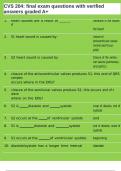
CVS 204: final exam questions with verified
answers graded A+
1. heart sounds are a result of vibrations in the tissues
of
the heart
2. S1 heart sound is caused by: closure of
atrioventricular valves
(mitral and tricus-
pid)
3. S2 heart sound is caused by Closure of the semilu-
nar valves (pulmonary
and aortic)
4. closure of the atrioventricular valves produces S1, this end of QRS
complex
occurs where in the EKG?
5. closure of the semilunar valves produce S2, this occurs end of t
wave
where on the EKG?
6. S2 is diastole and systole onset of diastole, end of
systole
7. S2 occurs at the of ventricular systole end
8. S1 is diastole and systole end of diastole, onset of
systole
9. S1 occurs at the of ventricular systole beginning
10. diastole/systole has a longer time interval diastole
1/
19
,CVS 204: final exam questions with verified
answers graded A+
11. In what case will it be difficult to distinguish rapid heart rate
S1 from S2
12. S3 is known as the (atrial/ventricular) gallop, 1. ventricular
while S4 is known as the (atrial/ventricular) 2. atrial
gallop
2/
19
, CVS 204: final exam questions with verified
answers graded A+
13. If S3 is heard in adults what 2 things can it be 1. diastolic
associ- ated with? overload
2. decreased
ventricular
14. is S3 is heard in elderly it is usually due to compliance
what 2 things:
volume overload, CHF
15. An S4 heart sound is rarely heard, if present what two pressure
overload, hyper-
things can it be due to: tension
16. which one of the atrioventricular valves closes first? mitral
valve
17. heart murmurs are caused by: turbulent blood flow
through abnormal
valves
18. Which semilunar valve closes first? aortic valve
19. mid systolic click is associated with mitral valve prolapse
20. Opening snap is associated with mitral stenosis (or tricus-
pid)
21. - % of cardiac tumors are benign and curable 75-80
22. a sound usually created by turbulent ventricular
blood flow through abnormal vessels is systolic and
called a diastolic
dysfunction
23. Bilateral and biventricular dilatation and of unknown
3/
19
answers graded A+
1. heart sounds are a result of vibrations in the tissues
of
the heart
2. S1 heart sound is caused by: closure of
atrioventricular valves
(mitral and tricus-
pid)
3. S2 heart sound is caused by Closure of the semilu-
nar valves (pulmonary
and aortic)
4. closure of the atrioventricular valves produces S1, this end of QRS
complex
occurs where in the EKG?
5. closure of the semilunar valves produce S2, this occurs end of t
wave
where on the EKG?
6. S2 is diastole and systole onset of diastole, end of
systole
7. S2 occurs at the of ventricular systole end
8. S1 is diastole and systole end of diastole, onset of
systole
9. S1 occurs at the of ventricular systole beginning
10. diastole/systole has a longer time interval diastole
1/
19
,CVS 204: final exam questions with verified
answers graded A+
11. In what case will it be difficult to distinguish rapid heart rate
S1 from S2
12. S3 is known as the (atrial/ventricular) gallop, 1. ventricular
while S4 is known as the (atrial/ventricular) 2. atrial
gallop
2/
19
, CVS 204: final exam questions with verified
answers graded A+
13. If S3 is heard in adults what 2 things can it be 1. diastolic
associ- ated with? overload
2. decreased
ventricular
14. is S3 is heard in elderly it is usually due to compliance
what 2 things:
volume overload, CHF
15. An S4 heart sound is rarely heard, if present what two pressure
overload, hyper-
things can it be due to: tension
16. which one of the atrioventricular valves closes first? mitral
valve
17. heart murmurs are caused by: turbulent blood flow
through abnormal
valves
18. Which semilunar valve closes first? aortic valve
19. mid systolic click is associated with mitral valve prolapse
20. Opening snap is associated with mitral stenosis (or tricus-
pid)
21. - % of cardiac tumors are benign and curable 75-80
22. a sound usually created by turbulent ventricular
blood flow through abnormal vessels is systolic and
called a diastolic
dysfunction
23. Bilateral and biventricular dilatation and of unknown
3/
19