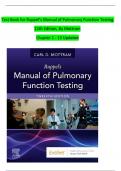
Test Bank for Ruppel’s Manual of Pulmonary Function Testing 12th
* * * * * * * * *
* Edition, By Mottram
* *
Chapter 1 - 13 Updated
* * * * *
,Chapter1:IndicationsforPulmonaryFunctionTestingTest Bank
* * * * * * * *
MULTIPLECHOICE *
1. Whofirstpopularized spirometry forthe evaluation of pulmonary function?
* * * * * * * * *
a. Augustand Marie Krogh * * *
b. AlvanBarach *
c. JohnSeveringhaus *
d. John Hutchinson *
ANS: D *
Hutchinsonpopularizedthe conceptofusingVCtoassesslungfunction, andthenameshe gave to
* * * * * * * * * * * * * * * *
several other lung compartments are still used today.
* * * * * * * *
DIF: 1 REF: p. 2 * OBJ: None MSC: NBRC: None * * *
2. Whichof the following are indications for performing spirometry?
* * * * * * * *
1. Assess the riskof lung resection. * * * * *
2. Determinetheresponsetobronchodilatortherapy. * * * * *
3. Assesstheseverity of restrictivelung disease. * * * * * *
4. Quantify theextent of COPD. * * * *
a. 1 and 4 * *
b. 2 and 3 * *
c. 1 , 2, and 4 * * * *
d. 2 , 3, and 4 * * * *
ANS: C *
Spirometrycannotassessseverityofrestriction; forthat youneedtomeasurelung volumes ( see
* * * * * * * * * * * * * * *
Box 1-2, Chapter 1).
* * * *
DIF: 1 REF: p. 7 * OBJ: EL-2 MSC:NBRC: None * *
,3. The main indication for the measurement of lungvolumes isto do whichof the following?
* * * * * * * * * * * * * * *
a. Diagnoseorassess the severity ofrestriction.
* * * * * *
b. Evaluatetheseverity ofpulmonary hypertension.
* * * * *
c. Determinethelevel ofcardiopulmonary fitness.
* * * * *
d. Assessthe riskof abdominalsurgicalprocedures.
* * * * * *
ANS:A *
Themostcommonreasonfor measuringlungvolumesistoidentify restrictivelung disease. DIF:
* * * * * * * * * * * * * *
1 REF: p. 35 * OBJ: EL-2 MSC: NBRC: None
* *
4. DLCO measurements maybe indicated to evaluate pulmonaryinvolvement in which of the
* * * * * * * * * * * *
following systemic diseases?
* * *
a. Asthma
b. Sarcoidosis
c. Exertional hypoxemia *
, Stuvia.com-TheMarketplacetoBuyandSellyourStudyMaterial
* * * * * * * * * *
d. Guillain-Barrésyndrome *
ANS: B *
Sarcoidosisistheonlysystemicdiseaselistedthataffectsgasexchange. DIF: 1 * * * * * * * * * * * *
* REF: p. 9 | p. 19 | p. 21 | p. 35 OBJ: EL-2 MSC: NBRC: None
* * * * * * * * * * * * * * * *
5. Bloodgasanalysisisusedwith patientswith COPDtodowhich ofthe * * * * * * * * * * * * *
following? *
a. Monitorairwayresponsiveness. * *
b. Determinelevelofcardiopulmonaryfitness. * * * *
c. Detectpulmonaryhypertension. * *
d. Assessneedfor supplementaryO2. * * * *
ANS: D *
Bloodgasanalysisismostcommonly used todetermine theneed forsupplementaloxygen and
* * * * * * * * * * * * * *
to manage patients who require ventilatory support.
* * * * * * *
DIF: 2 REF: p. 15 * OBJ: EL-1
MSC: NBRC: CPFT 2A-2
* * * *
6. Whichof the following cause emphysema? * * * * *
1. 1-Antitrypsindeficiency * *
2. Exposure toenvironmental pollutants * * *
3. Radiation therapy *
4. Cigarettesmoking *
a. 1 and 2 * *
b. 3 and 4 * *
c. 1 , 2, and 4 * * * *
d. 2 , 3, and 4 * * * *
ANS: C *
Emphysemaiscaused primarilybycigarettesmoking.Someemphysemaiscaused bythe absence * * * * * * * * * * * * *
of a protective enzyme. Chronic exposure to environmental pollutants can also contribute to the
* * * * * * * * * * * * * *
development of emphysema.
* * *
DIF: 1 REF: p.11 * OBJ: EL-3|AL-2 * * MSC: NBRC: None * *
7. Anadultpatientcomplainsofchesttightnessandcoughwheneverhejogsincoldweather.
* * * * * * * * * * * * * *
These symptoms are consistent with which of the following?
* * * * * * * * *
a. Cysticfibrosis *
b. Asthma
c. Pulmonaryhypertension *
d. Idiopathicpulmonaryfibrosis * *
|
* * * * * * * * *
* Edition, By Mottram
* *
Chapter 1 - 13 Updated
* * * * *
,Chapter1:IndicationsforPulmonaryFunctionTestingTest Bank
* * * * * * * *
MULTIPLECHOICE *
1. Whofirstpopularized spirometry forthe evaluation of pulmonary function?
* * * * * * * * *
a. Augustand Marie Krogh * * *
b. AlvanBarach *
c. JohnSeveringhaus *
d. John Hutchinson *
ANS: D *
Hutchinsonpopularizedthe conceptofusingVCtoassesslungfunction, andthenameshe gave to
* * * * * * * * * * * * * * * *
several other lung compartments are still used today.
* * * * * * * *
DIF: 1 REF: p. 2 * OBJ: None MSC: NBRC: None * * *
2. Whichof the following are indications for performing spirometry?
* * * * * * * *
1. Assess the riskof lung resection. * * * * *
2. Determinetheresponsetobronchodilatortherapy. * * * * *
3. Assesstheseverity of restrictivelung disease. * * * * * *
4. Quantify theextent of COPD. * * * *
a. 1 and 4 * *
b. 2 and 3 * *
c. 1 , 2, and 4 * * * *
d. 2 , 3, and 4 * * * *
ANS: C *
Spirometrycannotassessseverityofrestriction; forthat youneedtomeasurelung volumes ( see
* * * * * * * * * * * * * * *
Box 1-2, Chapter 1).
* * * *
DIF: 1 REF: p. 7 * OBJ: EL-2 MSC:NBRC: None * *
,3. The main indication for the measurement of lungvolumes isto do whichof the following?
* * * * * * * * * * * * * * *
a. Diagnoseorassess the severity ofrestriction.
* * * * * *
b. Evaluatetheseverity ofpulmonary hypertension.
* * * * *
c. Determinethelevel ofcardiopulmonary fitness.
* * * * *
d. Assessthe riskof abdominalsurgicalprocedures.
* * * * * *
ANS:A *
Themostcommonreasonfor measuringlungvolumesistoidentify restrictivelung disease. DIF:
* * * * * * * * * * * * * *
1 REF: p. 35 * OBJ: EL-2 MSC: NBRC: None
* *
4. DLCO measurements maybe indicated to evaluate pulmonaryinvolvement in which of the
* * * * * * * * * * * *
following systemic diseases?
* * *
a. Asthma
b. Sarcoidosis
c. Exertional hypoxemia *
, Stuvia.com-TheMarketplacetoBuyandSellyourStudyMaterial
* * * * * * * * * *
d. Guillain-Barrésyndrome *
ANS: B *
Sarcoidosisistheonlysystemicdiseaselistedthataffectsgasexchange. DIF: 1 * * * * * * * * * * * *
* REF: p. 9 | p. 19 | p. 21 | p. 35 OBJ: EL-2 MSC: NBRC: None
* * * * * * * * * * * * * * * *
5. Bloodgasanalysisisusedwith patientswith COPDtodowhich ofthe * * * * * * * * * * * * *
following? *
a. Monitorairwayresponsiveness. * *
b. Determinelevelofcardiopulmonaryfitness. * * * *
c. Detectpulmonaryhypertension. * *
d. Assessneedfor supplementaryO2. * * * *
ANS: D *
Bloodgasanalysisismostcommonly used todetermine theneed forsupplementaloxygen and
* * * * * * * * * * * * * *
to manage patients who require ventilatory support.
* * * * * * *
DIF: 2 REF: p. 15 * OBJ: EL-1
MSC: NBRC: CPFT 2A-2
* * * *
6. Whichof the following cause emphysema? * * * * *
1. 1-Antitrypsindeficiency * *
2. Exposure toenvironmental pollutants * * *
3. Radiation therapy *
4. Cigarettesmoking *
a. 1 and 2 * *
b. 3 and 4 * *
c. 1 , 2, and 4 * * * *
d. 2 , 3, and 4 * * * *
ANS: C *
Emphysemaiscaused primarilybycigarettesmoking.Someemphysemaiscaused bythe absence * * * * * * * * * * * * *
of a protective enzyme. Chronic exposure to environmental pollutants can also contribute to the
* * * * * * * * * * * * * *
development of emphysema.
* * *
DIF: 1 REF: p.11 * OBJ: EL-3|AL-2 * * MSC: NBRC: None * *
7. Anadultpatientcomplainsofchesttightnessandcoughwheneverhejogsincoldweather.
* * * * * * * * * * * * * *
These symptoms are consistent with which of the following?
* * * * * * * * *
a. Cysticfibrosis *
b. Asthma
c. Pulmonaryhypertension *
d. Idiopathicpulmonaryfibrosis * *
|