
100% satisfaction guarantee Immediately available after payment Both online and in PDF No strings attached 4.2 TrustPilot
logo-home
Exam (elaborations)

TEST BANK FOR PROBABILITY AND STATISTICS UNIT 1 TEST

Rating
-
Sold
-
Pages
5
Grade
A+
Uploaded on
01-05-2025
Written in
2024/2025

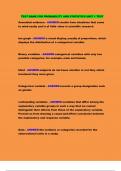
TEST BANK FOR PROBABILITY AND STATISTICS UNIT 1 TEST Anecdotal evidence - ANSWER-results from situations that come to mind easily and is of little value in scientific research bar graph - ANSWER-a visual display, usually of proportions, which displays the distribution of a categorical variable. Binary variables - ANSWER-categorical variables with only two possible categories, for example, male and female. blind - ANSWER-subjects do not know whether or not they which treatment they were given. Categorical variable - ANSWER-records a group designation such as gender. confounding variables - ANSWER-variables that differ among the explanatory variable groups in such a way that we cannot distinguish their effects from those of the explanatory variable. Prevent us from drawing a cause-and-effect conclusion between the explanatory and response variable. Data - ANSWER-the numbers or categories recorded for the observational units in a study. Distribution of a variable - ANSWER-refers to its pattern of variation. dotplot - ANSWER-useful for displaying the distribution of relatively small datasets of a quantitative variable. double-blind - ANSWER-the person evaluating the subjects is also unaware of which subjects receive which treatment. Experiment - ANSWER-a study in which the experimenter actively imposes the treatment on the subjects. Ideally, the groups of subjects are identical in all respects other than the explanatory variable so that the researcher can then see the explanatory variable's direct effects on the response variable. explanatory variable - ANSWER-the variable whose effect you want to study lurking variables - ANSWER-variables that are not considered in the study but that may also be related to the response variable. observational study - ANSWER-researchers passively observe and record information about observational units. Does not control for the possible effects of confounding variables so it cannot establish a cause-and-effect conclusion. Observational unit - ANSWER-The person or thing to which the number or category is assigned parameter - ANSWER-a number that describes population. placebo effect - ANSWER-subjects often respond positively simply to being given a treatment, whether or not the treatment is actually effective. population of a study - ANSWER-the entire group of people or objects of interest. precision - ANSWER-how much the values vary from sample to sample. Related to sample size: sample statistics from larger samples are more precise and closer together than those from the smaller samples. Quantitative variable - ANSWER-measures a numerical characteristic such as height random assignment - ANSWER-preferred method of assigning subjects to treatments (explanatory variable groups) in an experiment: each subject has an equal chance of being assigned to any of the treatment groups. Randomized comparative experiment - ANSWER-Each subject has an equal chance of being assigned to any of the treatment groups. Research question - ANSWER-looks for patterns in a variable or compares a variable across different groups or looks for a relationship between variables. response variable - ANSWER-the variable that you suspect is affected by the other variable. sample - ANSWER-typically small part of the population from whom or which data are gathered to learn about the population as a whole. sample size - ANSWER-number of observational units (people or objects) studied in a sample. sampling bias - ANSWER-if a sampling procedure tends to systematically over-represent certain segments of the population and to under-represent others. sampling variability - ANSWER-the fact that the values of sample statistics vary from sample to sample. simple random sampling - ANSWER-every member of the population has the same and equal chance of being the sample ultimately selected. statistic - ANSWER-number that describes a sample. treatment - ANSWER-explanatory variable group unbiased - ANSWER-if values of the statistic from different random samples are centered at the actual parameter value. Variability - ANSWER-phenomenon of a variable taking on different values or categories from observational unit to observational unit. Variable - ANSWER-any characteristic of a person or thing that can be assigned a number or a category.

Show more Read less
Institution
Course


Whoops! We can’t load your doc right now. Try again or contact support.

Written for

Institution
Study
Course

Document information

Uploaded on
May 1, 2025
Number of pages
5
Written in
2024/2025
Type
Exam (elaborations)
Contains
Questions & answers

Subjects

Content preview

TEST BANK FOR PROBABILITY AND STATISTICS UNIT 1 TEST

Anecdotal evidence - ANSWER-results from situations that come
to mind easily and is of little value in scientific research


bar graph - ANSWER-a visual display, usually of proportions, which
displays the distribution of a categorical variable.


Binary variables - ANSWER-categorical variables with only two
possible categories, for example, male and female.


blind - ANSWER-subjects do not know whether or not they which
treatment they were given.


Categorical variable - ANSWER-records a group designation such
as gender.


confounding variables - ANSWER-variables that differ among the
explanatory variable groups in such a way that we cannot
distinguish their effects from those of the explanatory variable.
Prevent us from drawing a cause-and-effect conclusion between
the explanatory and response variable.


Data - ANSWER-the numbers or categories recorded for the
observational units in a study.

, Distribution of a variable - ANSWER-refers to its pattern of
variation.


dotplot - ANSWER-useful for displaying the distribution of
relatively small datasets of a quantitative variable.


double-blind - ANSWER-the person evaluating the subjects is also
unaware of which subjects receive which treatment.


Experiment - ANSWER-a study in which the experimenter actively
imposes the treatment on the subjects. Ideally, the groups of
subjects are identical in all respects other than the explanatory
variable so that the researcher can then see the explanatory
variable's direct effects on the response variable.


explanatory variable - ANSWER-the variable whose effect you
want to study


lurking variables - ANSWER-variables that are not considered in
the study but that may also be related to the response variable.


observational study - ANSWER-researchers passively observe and
record information about observational units. Does not control for
the possible effects of confounding variables so it cannot
establish a cause-and-effect conclusion.
$7.59
Get access to the full document:

100% satisfaction guarantee
Immediately available after payment
Both online and in PDF
No strings attached

Get to know the seller
Seller avatar
PERFECTSCHOOLERS
1.0
(1)

Get to know the seller

Seller avatar
PERFECTSCHOOLERS Harvard University
Follow You need to be logged in order to follow users or courses
Sold
4
Member since
1 year
Number of followers
0
Documents
156
Last sold
5 months ago
PERFECTSCHOOLERS

"Dedicated to providing high-quality study materials to help students succeed. In order to facilitate and expedite learning, we distribute notes, guides, and resources on a range of topics. Join us for study tips and content designed to boost your grades!"

1.0

1 reviews

5
0
4
0
3
0
2
0
1
1

Why students choose Stuvia

Created by fellow students, verified by reviews

Quality you can trust: written by students who passed their tests and reviewed by others who've used these notes.

Didn't get what you expected? Choose another document

No worries! You can instantly pick a different document that better fits what you're looking for.

Pay as you like, start learning right away

No subscription, no commitments. Pay the way you're used to via credit card and download your PDF document instantly.

Student with book image

“Bought, downloaded, and aced it. It really can be that simple.”

Alisha Student

Frequently asked questions

