PHY 201Test Bank CERTIFICATION GUIDE
FOR 2025/2026 TESTS|MOST COMMON
QUESTIONS WITH CORRECTLY VERIFIED ANSWERS
(LATEST QUIZZES) |ALREADY A+
GRADED|GUARANTEED PASS
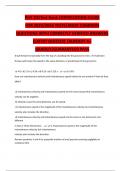
A ball thrown horizontally from the top of a building hits the ground in 0.50 s. If it had been
thrown with twice the speed in the same direction, it would have hit the ground in:
a) 4.0 s b) 1.0 s c) 0.50 s d) 0.25 s e) 0.125 s - c) 0.50 s
How are instantaneous velocity and instantaneous speed related to one another? How do they
differ?
a) Instantaneous velocity and instantaneous speed are the same except that instantaneous
velocity can be negative.
b) Velocity is just the word physicists use for speed.
c) Instantaneous speed is the magnitude of the instantaneous velocity, but instantaneous
velocity also includes the direction.
d) Instantaneous velocity and instantaneous speed are the same in one dimension, but
different
in two or three dimensions. - c) Instantaneous speed is the magnitude of the
instantaneous velocity, but instantaneous
velocity also includes the direction.
Answer questions 3 and 4 for projectile motion on level ground assuming negligible air
resistance (the
, initial angle being neither 0o
nor 90o ).
Is the velocity ever zero?
a) Yes, at the peak of the trajectory.
b) No, never; the magnitude of the velocity vector changes, but it is never zero.
c) No, never; the direction of the velocity changes, but its magnitude remains constant.
d) Yes, when the projectile hits the ground. - b) No, never; the magnitude of the velocity
vector changes, but it is never zero.
Answer questions 3 and 4 for projectile motion on level ground assuming negligible air
resistance (the
initial angle being neither 0o
nor 90o ).
When is the velocity a maximum?
a) At the peak of the trajectory.
b) At the instant after the object is launched, and only then.
c) At the instant before the object lands, and only then.
d) At the instant after the object is launched and again at the instant before it lands.
e) The velocity has a constant magnitude; only the direction changes. - d) At the instant
after the object is launched and again at the instant before it lands.
Tommy throws a red ball straight up into the air at
an initial speed of 15 m/s from an initial height of 1.5 m. At the same time, Michael throws a
blue ball
straight down at an initial speed of 15 m/s from an initial height of 1.5 m. Ignore wind
resistance.
FOR 2025/2026 TESTS|MOST COMMON
QUESTIONS WITH CORRECTLY VERIFIED ANSWERS
(LATEST QUIZZES) |ALREADY A+
GRADED|GUARANTEED PASS
A ball thrown horizontally from the top of a building hits the ground in 0.50 s. If it had been
thrown with twice the speed in the same direction, it would have hit the ground in:
a) 4.0 s b) 1.0 s c) 0.50 s d) 0.25 s e) 0.125 s - c) 0.50 s
How are instantaneous velocity and instantaneous speed related to one another? How do they
differ?
a) Instantaneous velocity and instantaneous speed are the same except that instantaneous
velocity can be negative.
b) Velocity is just the word physicists use for speed.
c) Instantaneous speed is the magnitude of the instantaneous velocity, but instantaneous
velocity also includes the direction.
d) Instantaneous velocity and instantaneous speed are the same in one dimension, but
different
in two or three dimensions. - c) Instantaneous speed is the magnitude of the
instantaneous velocity, but instantaneous
velocity also includes the direction.
Answer questions 3 and 4 for projectile motion on level ground assuming negligible air
resistance (the
, initial angle being neither 0o
nor 90o ).
Is the velocity ever zero?
a) Yes, at the peak of the trajectory.
b) No, never; the magnitude of the velocity vector changes, but it is never zero.
c) No, never; the direction of the velocity changes, but its magnitude remains constant.
d) Yes, when the projectile hits the ground. - b) No, never; the magnitude of the velocity
vector changes, but it is never zero.
Answer questions 3 and 4 for projectile motion on level ground assuming negligible air
resistance (the
initial angle being neither 0o
nor 90o ).
When is the velocity a maximum?
a) At the peak of the trajectory.
b) At the instant after the object is launched, and only then.
c) At the instant before the object lands, and only then.
d) At the instant after the object is launched and again at the instant before it lands.
e) The velocity has a constant magnitude; only the direction changes. - d) At the instant
after the object is launched and again at the instant before it lands.
Tommy throws a red ball straight up into the air at
an initial speed of 15 m/s from an initial height of 1.5 m. At the same time, Michael throws a
blue ball
straight down at an initial speed of 15 m/s from an initial height of 1.5 m. Ignore wind
resistance.