JFIN 2019
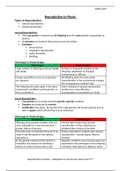
Reproduction in Plants:
Types of Reproduction:
Asexual reproduction.
Sexual reproduction.
Asexual Reproduction:
Only one parent is involved and all offspring have the same genetic composition as
parents.
No gametes are involved, the process occurs by mitosis.
Examples:
Binary fission.
Vegetative reproduction.
Spore formation.
Budding.
Advantages & Disadvantages:
Advantages: Disadvantages:
Large number of offspring produced rapidly As there is no genetic variation in the
and simply. offspring, adaptation to changed
environments is difficult.
Energy expenditure is low as no gametes All offspring share the same weak
are required. characteristics, if the environment changes
the consequences could be fatal.
The offspring will easily adapt in the same Some methods of asexual reproduction
environment conditions as the parents, as produce too many offspring =
they are identical. overpopulation (competition for food).
Sexual Reproduction:
Two parents are involved and their genetic material combines.
Gametes are produced by meiosis.
Fertilization tales place, during which the male gamete and female gamete fuse to
form a zygote, which will develop into an individual.
Advantages & Disadvantages:
Advantages: Disadvantages:
Offspring show greater variation, they are Process takes longer than asexual
more adaptable to a new environment = reproduction + fewer offspring are
greater chance of success. produced (less chance of survival).
Forms the basis of evolution because it can Energy expenditure is higher than asexual
result in the formation of new species. reproduction – special organs, flowers,
(speciation). develop.
As the genetic material of the parents is Negative mutations and recessive genes are
reshuffled, the chances of inheriting a expressed in the phenotype of the offspring
disease or weak characteristics is low. and plants need agents to disperse seeds.
Reproduction in Plants – Adapted from the Answer Series Part II
, JFIN 2019
Flowers as Reproductive Organs:
Angiosperms include all flowering plants.
Flowers are the sexual reproductive organs of Angiosperms.
Flower of a Dicotyledonous Plant:
The perianth in dicotyledonous flowers is
differentiated into two parts: Calyyx and
Corrola.
The flower of the Petunia therefore consists
of four whorls (rings of floral parts):
Calyx.
Corolla.
Androecium.
Gynoecium.
Calyx:
Outermost whorl consisting of five small, green sepals.
The sepals surround the other whorls and protect the flower in bud stage.
Corolla:
Whorl consisting of five striking, brightly-coloured petals that are fused together to
form a trumpet-shaped corolla.
Petals attract insects and birds to flower for pollination.
Androecium (stamens):
This composes the male parts.
The Petunia has five stames that are attached to the inside of the petals.
Each stamen consist of a long filament ending in a lobed anther.
The anther contains pollen sacs in which the pollen is formed.
Gynoecium (pistil):
The innermost whorl is the female part of the flower.
Consists of a single stigma, a thing style and an ovary.
The surface of the stigma is sticky so that pollen can stick to it.
The ovary contains two locules (small cavities) with a large number of ovules.
The ovules are attached to the separating wall between the two lobes.
The ovary is above the place of attachment of the sepals, petals, stamens at the base
of the flower and is known as a superior ovary.
Reproduction in Plants – Adapted from the Answer Series Part II
Reproduction in Plants:
Types of Reproduction:
Asexual reproduction.
Sexual reproduction.
Asexual Reproduction:
Only one parent is involved and all offspring have the same genetic composition as
parents.
No gametes are involved, the process occurs by mitosis.
Examples:
Binary fission.
Vegetative reproduction.
Spore formation.
Budding.
Advantages & Disadvantages:
Advantages: Disadvantages:
Large number of offspring produced rapidly As there is no genetic variation in the
and simply. offspring, adaptation to changed
environments is difficult.
Energy expenditure is low as no gametes All offspring share the same weak
are required. characteristics, if the environment changes
the consequences could be fatal.
The offspring will easily adapt in the same Some methods of asexual reproduction
environment conditions as the parents, as produce too many offspring =
they are identical. overpopulation (competition for food).
Sexual Reproduction:
Two parents are involved and their genetic material combines.
Gametes are produced by meiosis.
Fertilization tales place, during which the male gamete and female gamete fuse to
form a zygote, which will develop into an individual.
Advantages & Disadvantages:
Advantages: Disadvantages:
Offspring show greater variation, they are Process takes longer than asexual
more adaptable to a new environment = reproduction + fewer offspring are
greater chance of success. produced (less chance of survival).
Forms the basis of evolution because it can Energy expenditure is higher than asexual
result in the formation of new species. reproduction – special organs, flowers,
(speciation). develop.
As the genetic material of the parents is Negative mutations and recessive genes are
reshuffled, the chances of inheriting a expressed in the phenotype of the offspring
disease or weak characteristics is low. and plants need agents to disperse seeds.
Reproduction in Plants – Adapted from the Answer Series Part II
, JFIN 2019
Flowers as Reproductive Organs:
Angiosperms include all flowering plants.
Flowers are the sexual reproductive organs of Angiosperms.
Flower of a Dicotyledonous Plant:
The perianth in dicotyledonous flowers is
differentiated into two parts: Calyyx and
Corrola.
The flower of the Petunia therefore consists
of four whorls (rings of floral parts):
Calyx.
Corolla.
Androecium.
Gynoecium.
Calyx:
Outermost whorl consisting of five small, green sepals.
The sepals surround the other whorls and protect the flower in bud stage.
Corolla:
Whorl consisting of five striking, brightly-coloured petals that are fused together to
form a trumpet-shaped corolla.
Petals attract insects and birds to flower for pollination.
Androecium (stamens):
This composes the male parts.
The Petunia has five stames that are attached to the inside of the petals.
Each stamen consist of a long filament ending in a lobed anther.
The anther contains pollen sacs in which the pollen is formed.
Gynoecium (pistil):
The innermost whorl is the female part of the flower.
Consists of a single stigma, a thing style and an ovary.
The surface of the stigma is sticky so that pollen can stick to it.
The ovary contains two locules (small cavities) with a large number of ovules.
The ovules are attached to the separating wall between the two lobes.
The ovary is above the place of attachment of the sepals, petals, stamens at the base
of the flower and is known as a superior ovary.
Reproduction in Plants – Adapted from the Answer Series Part II