Cousins w1
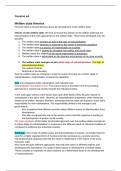
Welfare state theories
This text looks at several theories about the development of the welfare state.
Theses on the welfare state. We look at several key theses on the welfare state that are
representative of the main approaches to the welfare state. These have developed over the
decades:
1. The welfare state emerges as part of the logic of industrialisation.
2. The welfare state develops in response to the needs of advanced capitalism.
3. The welfare state is a product of modernisation of societies.
4. The welfare state is shaped by struggles over politics and social class.
5. Welfare states are shaped by the social organisation of production.
6. The welfare state is determined by the structure and interests of the state or polity.
1. The welfare state emerges as part of the logic of industrialisation. The logic of
industrialisation thesis
- The earliest theories.
- Structural or functionalist
Saw the welfare state as emerging to meet the needs of society at a certain stage of
industrialisation, modernisation or advanced capitalism.
Kerr and colleagues study: Industrialism and industrial man.
Industrialization according to Kerr: The actual course of transition from the preceding
agricultural or commercial society towards the industrial society.
In the early ages workers were thrown back upon their family if they became injured, ill,
unemployed or too old to work. However, as industrialization progresses, wider family ties
tended to be broken. Workers therefore, demanded that the state and business share some
responsibility for their maintenance. The responsibility shifted to the managers and
governments.
- Kerr recognised that different countries adopt different tactics in affecting labor force
development.
- Kerr also recognised the role of the worker protest and elite response in leading to
the development of greater social security.
The main emphasis of this highly functionalist approach was that welfare states emerged at
a certain stage of industrialisation in response to the different needs of industrial societies as
compared to traditional pre-industrial societies.
Rimlinger: Did a study of welfare policy and industrialization in Europe. Concluded that the
need for a highly organized form of income protection increases as a society becomes
industrialized and urbanized and that this need is independent of the nature of the socio-
economic order.
Also found the quite different approaches that had been taken in different regimes and
emphasised the importance of a range of other factors in development of welfare states.
These included an emphasis on class relations as a determinant factor in the development
of social protection.
,Myles and Quadagno: Distinguish a weaker and stronger version of the industrialization
theory. The weak version “that industrialism and its correlates are necessary to account for
the common trend line in welfare state expansion” is rarely questioned. The stronger version
“rests on the assumption that public policy is the product of large, impersonal, economic
forces” is more contentious.
2. The welfare state develops in response to the needs of advanced capitalism.
The functionalist Marxist approach
- Marxist approach
- Highly functionalist
Emphasised that welfare spending was a contradictory process which created tendencies
towards economic, social and political crisis.
O’Connor, Fiscal crisis of the state: The capitalist state has two basic contradictory
functions to fulfil. Accumulation and legitimation.
→ The welfare state in advanced capitalist societies assists both in ensuring the
continuation, stability and efficient working of the economic system; and in ensuring the
integration of social classes and groups and the maintenance of social order.
Nearly all welfare state spending was involved in the accumulation and legitimation functions
and served both purposes. For example: O’conner argued that some education spending
(needed to reproduce and expand workforce) served the accumulation function whereas
other expenditure served the legitimation function.
O’Conner also saw the development of the welfare state as being linked to the current stage
of capitalism. Modern monopoly capitalism differed in two fundamental respects.
1. An economy dominated by large corporations operating in monopolistic industries
generated more inequality.
2. A difference in the manner in which economic and social imbalances were perceived
and acted upon under monopoly capitalism.
- Competitive capitalism: Issues such as unemployment and wage levels appeared to
be the consequence of impersonal forces beyond human control.
- Monopoly capitalism: Inequalities generated by capitalist development begin to
attributed to the conscious policies of large corporations and government agencies
rather than impersonal market forces.
The growth of the state was both the cause and effect of the expansion of monopoly
capitalism. O’Conner also argues that the accumulation of social capital and social expenses
is a contradictory process which creates tendencies towards economic, social and political
crisis.
3. The welfare state is a product of modernisation of societies.
- Nuanced
- Functionalist
- Drawing on the concept of modernisation.
→ Saw the welfare state as a phenomenon of modernization. As a product of the
increasing differentiation and growing societies.
→Saw the welfare state as a product of processes of social and political
mobilisation.
,Flora and Alber : The concept modernisation was vague and ambiguous according to Flora
and Alber, but also useful in the analysis of welfare states because of its emphasis on the
multidimensionality of societal development (The assumption of causal interrelationships
among economic and population growth, social mobilization and political development).
The development of the welfare state could be analyzed according to three different aspects:
1. The process of differentiation of individual and household income, of working and
living space which created specific labor market problems that must be solved by the
state.
2. The evolution of social rights as a consequence of the institutionalisation of political
rights
3. The increasing control, substitution and supplementing of marking by state
bureaucracies.
Flora and Alber used a couple key variables drawing on the modernisation approach.
- Socio-economic development.
- The political mobilization of the working class.
- Constitutional structures.
In their study they found that in contrast to the pioneering countries which first established
social insurance legislation in different areas, the follower countries established their system
usually at a slightly higher level of social economic development and generally at much
higher level of political mobilisation.
They found that countries which introduced social insurance schemes at relatively low levels
of socio-economic development were characterized by relatively high levels of political
mobilisation of the working class and, conversely high levels of political mobilisation were
characterised by relatively high levels of socio-economic development, leading to social
problems which necessitated in introduction of such institutions.
Flora argues that in Western Europe the modern welfare state originated as an answer to
the specific problem of the new industrial working class. The modern welfare state originated
in the late 19th century in Europe and this can be explained by the comparatively high levels
of industrialization and democratization. Flora also recognised the diversity of welfare states.
He argues that at least two basic dimensions of institutional infrastructure were relevant:
1. The degree to which the state had penetrated the welfare institution. The stateness
of the welfare state.
2. The degree to which the welfare institutions reflect social differentiations.
4. The welfare state is shaped by struggles over politics and social class.
- Importance of the mobilisation of workers.
- Importance of social democratic or left-wing parties.
Korpi:
Power resources
Main principles of this approach:
- Control over power resources is a major factor affecting the functioning of the
distributive processes within society, the outcomes and how distribution conflict is
patterned. Thus control over power resources played a major role in determining the
structure of the welfare state.
, - Distribution of power resources in capitalist democracies can vary between nations
and also change over time.
- Major power resources in capitalist democracies are assumed to be related to class
structures. The type of power resources that can be mobilised and used differ in
class-related ways.
- Political democracy plays an important role in the processing of conflicts of interest.
Social democracy
The power resources approach could be used to argue the social democracy but also to
analyse the impact of other key social classes and political actors. Kopri argued against any
interpretation of the power resources approach as a one-factor theory claiming to explain
welfare state development more or less exclusively in terms of working class or left strength.
The power resources approach does not imply that social policy development is based on
the organisational and political power of the working class and left parties alone.
Korpi mainly focuses on the role of social democracy and the mobilisation of wage earners in
the development of welfare states. Korpi supports the social democratic thesis.
The ones that operate within the social democratic approach recognised the limitations:
- Relying exclusively on an emphasis on the role of the working class in the
development of the welfare state.
- Failure to take into account the key role of the middle class and the role of
employers.
These criticisms are not necessarily of the power resources approach but rather of its narrow
application to social democracy and the working class.
The role of the middle class
Baldwin: Emphasised the important role of the middle classes and argued that the social
democratic approach should be seen as ‘but one instance of a broader logic of social
interest behind the welfare state and its development.
Bringing employers back in
Some recent studies have been critical on the democratic approach and emphasised the
role of employers in the development of the welfare states.
Swenson: The power resources approach cannot explain the development of the New Deal
in the US and social democracy can be misleading. It cannot determine whether the strength
of social democracy is correlated. He outlines how employers have frequently favoured the
development of social policy measures. He argues that there is usually a regulatory logic to
the interest of employers who often like government regulation when they see a net benefit
and little risk. Welfare policies can provide much regulation. There are however many
obstacles and handicaps in the way of employers attempting to implement such interests
and in practice reformers with considerable organizational distance from the capitalist world,
were usually responsible for taking the policy initiative.
Mares: Argues that social policies play an important economic role for the labour market
strategies of firms. Suggests that the presence of skilled workers, firm size and the relative
incidence of risk facing a firm can affect employer preferences for social policy
developments. Swank and Martin also provide evidence for this approach.
Welfare state theories
This text looks at several theories about the development of the welfare state.
Theses on the welfare state. We look at several key theses on the welfare state that are
representative of the main approaches to the welfare state. These have developed over the
decades:
1. The welfare state emerges as part of the logic of industrialisation.
2. The welfare state develops in response to the needs of advanced capitalism.
3. The welfare state is a product of modernisation of societies.
4. The welfare state is shaped by struggles over politics and social class.
5. Welfare states are shaped by the social organisation of production.
6. The welfare state is determined by the structure and interests of the state or polity.
1. The welfare state emerges as part of the logic of industrialisation. The logic of
industrialisation thesis
- The earliest theories.
- Structural or functionalist
Saw the welfare state as emerging to meet the needs of society at a certain stage of
industrialisation, modernisation or advanced capitalism.
Kerr and colleagues study: Industrialism and industrial man.
Industrialization according to Kerr: The actual course of transition from the preceding
agricultural or commercial society towards the industrial society.
In the early ages workers were thrown back upon their family if they became injured, ill,
unemployed or too old to work. However, as industrialization progresses, wider family ties
tended to be broken. Workers therefore, demanded that the state and business share some
responsibility for their maintenance. The responsibility shifted to the managers and
governments.
- Kerr recognised that different countries adopt different tactics in affecting labor force
development.
- Kerr also recognised the role of the worker protest and elite response in leading to
the development of greater social security.
The main emphasis of this highly functionalist approach was that welfare states emerged at
a certain stage of industrialisation in response to the different needs of industrial societies as
compared to traditional pre-industrial societies.
Rimlinger: Did a study of welfare policy and industrialization in Europe. Concluded that the
need for a highly organized form of income protection increases as a society becomes
industrialized and urbanized and that this need is independent of the nature of the socio-
economic order.
Also found the quite different approaches that had been taken in different regimes and
emphasised the importance of a range of other factors in development of welfare states.
These included an emphasis on class relations as a determinant factor in the development
of social protection.
,Myles and Quadagno: Distinguish a weaker and stronger version of the industrialization
theory. The weak version “that industrialism and its correlates are necessary to account for
the common trend line in welfare state expansion” is rarely questioned. The stronger version
“rests on the assumption that public policy is the product of large, impersonal, economic
forces” is more contentious.
2. The welfare state develops in response to the needs of advanced capitalism.
The functionalist Marxist approach
- Marxist approach
- Highly functionalist
Emphasised that welfare spending was a contradictory process which created tendencies
towards economic, social and political crisis.
O’Connor, Fiscal crisis of the state: The capitalist state has two basic contradictory
functions to fulfil. Accumulation and legitimation.
→ The welfare state in advanced capitalist societies assists both in ensuring the
continuation, stability and efficient working of the economic system; and in ensuring the
integration of social classes and groups and the maintenance of social order.
Nearly all welfare state spending was involved in the accumulation and legitimation functions
and served both purposes. For example: O’conner argued that some education spending
(needed to reproduce and expand workforce) served the accumulation function whereas
other expenditure served the legitimation function.
O’Conner also saw the development of the welfare state as being linked to the current stage
of capitalism. Modern monopoly capitalism differed in two fundamental respects.
1. An economy dominated by large corporations operating in monopolistic industries
generated more inequality.
2. A difference in the manner in which economic and social imbalances were perceived
and acted upon under monopoly capitalism.
- Competitive capitalism: Issues such as unemployment and wage levels appeared to
be the consequence of impersonal forces beyond human control.
- Monopoly capitalism: Inequalities generated by capitalist development begin to
attributed to the conscious policies of large corporations and government agencies
rather than impersonal market forces.
The growth of the state was both the cause and effect of the expansion of monopoly
capitalism. O’Conner also argues that the accumulation of social capital and social expenses
is a contradictory process which creates tendencies towards economic, social and political
crisis.
3. The welfare state is a product of modernisation of societies.
- Nuanced
- Functionalist
- Drawing on the concept of modernisation.
→ Saw the welfare state as a phenomenon of modernization. As a product of the
increasing differentiation and growing societies.
→Saw the welfare state as a product of processes of social and political
mobilisation.
,Flora and Alber : The concept modernisation was vague and ambiguous according to Flora
and Alber, but also useful in the analysis of welfare states because of its emphasis on the
multidimensionality of societal development (The assumption of causal interrelationships
among economic and population growth, social mobilization and political development).
The development of the welfare state could be analyzed according to three different aspects:
1. The process of differentiation of individual and household income, of working and
living space which created specific labor market problems that must be solved by the
state.
2. The evolution of social rights as a consequence of the institutionalisation of political
rights
3. The increasing control, substitution and supplementing of marking by state
bureaucracies.
Flora and Alber used a couple key variables drawing on the modernisation approach.
- Socio-economic development.
- The political mobilization of the working class.
- Constitutional structures.
In their study they found that in contrast to the pioneering countries which first established
social insurance legislation in different areas, the follower countries established their system
usually at a slightly higher level of social economic development and generally at much
higher level of political mobilisation.
They found that countries which introduced social insurance schemes at relatively low levels
of socio-economic development were characterized by relatively high levels of political
mobilisation of the working class and, conversely high levels of political mobilisation were
characterised by relatively high levels of socio-economic development, leading to social
problems which necessitated in introduction of such institutions.
Flora argues that in Western Europe the modern welfare state originated as an answer to
the specific problem of the new industrial working class. The modern welfare state originated
in the late 19th century in Europe and this can be explained by the comparatively high levels
of industrialization and democratization. Flora also recognised the diversity of welfare states.
He argues that at least two basic dimensions of institutional infrastructure were relevant:
1. The degree to which the state had penetrated the welfare institution. The stateness
of the welfare state.
2. The degree to which the welfare institutions reflect social differentiations.
4. The welfare state is shaped by struggles over politics and social class.
- Importance of the mobilisation of workers.
- Importance of social democratic or left-wing parties.
Korpi:
Power resources
Main principles of this approach:
- Control over power resources is a major factor affecting the functioning of the
distributive processes within society, the outcomes and how distribution conflict is
patterned. Thus control over power resources played a major role in determining the
structure of the welfare state.
, - Distribution of power resources in capitalist democracies can vary between nations
and also change over time.
- Major power resources in capitalist democracies are assumed to be related to class
structures. The type of power resources that can be mobilised and used differ in
class-related ways.
- Political democracy plays an important role in the processing of conflicts of interest.
Social democracy
The power resources approach could be used to argue the social democracy but also to
analyse the impact of other key social classes and political actors. Kopri argued against any
interpretation of the power resources approach as a one-factor theory claiming to explain
welfare state development more or less exclusively in terms of working class or left strength.
The power resources approach does not imply that social policy development is based on
the organisational and political power of the working class and left parties alone.
Korpi mainly focuses on the role of social democracy and the mobilisation of wage earners in
the development of welfare states. Korpi supports the social democratic thesis.
The ones that operate within the social democratic approach recognised the limitations:
- Relying exclusively on an emphasis on the role of the working class in the
development of the welfare state.
- Failure to take into account the key role of the middle class and the role of
employers.
These criticisms are not necessarily of the power resources approach but rather of its narrow
application to social democracy and the working class.
The role of the middle class
Baldwin: Emphasised the important role of the middle classes and argued that the social
democratic approach should be seen as ‘but one instance of a broader logic of social
interest behind the welfare state and its development.
Bringing employers back in
Some recent studies have been critical on the democratic approach and emphasised the
role of employers in the development of the welfare states.
Swenson: The power resources approach cannot explain the development of the New Deal
in the US and social democracy can be misleading. It cannot determine whether the strength
of social democracy is correlated. He outlines how employers have frequently favoured the
development of social policy measures. He argues that there is usually a regulatory logic to
the interest of employers who often like government regulation when they see a net benefit
and little risk. Welfare policies can provide much regulation. There are however many
obstacles and handicaps in the way of employers attempting to implement such interests
and in practice reformers with considerable organizational distance from the capitalist world,
were usually responsible for taking the policy initiative.
Mares: Argues that social policies play an important economic role for the labour market
strategies of firms. Suggests that the presence of skilled workers, firm size and the relative
incidence of risk facing a firm can affect employer preferences for social policy
developments. Swank and Martin also provide evidence for this approach.