Bio Unit 4 Review
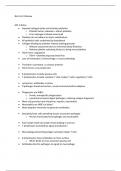
M5-1 Notes
• Exposed collagen binds and activates platelets
o Platelet factors released = attract platelets
o From damage to blood vessel wall
• Platelets do not adhere to intact endothelium
• All epithelial cells underlined by basolateral
• Collagen binding to platelets release clotting granules
o Release vasoconstrictors to minimize blood flow/loss
o Release platelet activating factors to bring more platelets
• Fibrin from coagulation
o Fibrin + platelet plug stop bood loss
• Loss of hemostasis is hemorrhage, or excess bleeding
• Thrombin is protease, so cleaves proteins
• Fibrin forms cross-linked clot
• B lymphocytes include plasma cells
• T lymphocytes include cytotoxic T cells, helper T cells, regulatory T cells
• Lysozymes: antibodies in saliva
• If pathogen breaches barriers, innate immunity before adaptive
• Phagocytes are WBCs
o Innate, nonspecific phagocytosis
o Lysosomal enzymes digest pathogen, reducing antigen fragments
• Mast cell granules have histamine, heparin, interleukins
• Neutrophils are WBCs in blood
• Need adaptive immunity to generate antibodies
• Basophils/mast cells patrolling tissues encounter pathogen
o Recruit monocytes/macrophages and neutrophils
• Each lymph node has lymph vessel leading in and out
• T lymphocyte activated by signal transduction
• Macrophage presenting antigen activates helper T cells
• B lymphocytes have antibodies on their surface
o When binds to virus, becomes plasma cell
• Antibodies bind to pathogen to signal to macrophage
, • Effector B cells make plasma cells to secrete antibodies
o Effector B cells destroyed when pathogen is cleared
• Antibodies by themselves do not destroy pathogens, just bind and signal
• Vaccination is ejection with weakened virus or foreign antigen piece of protein
o Triggers clonal expansion à antibodies à memory B cells
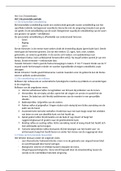
M5-2 Notes
• No muscle surrounding lung tissue
• Esophagus stretches with food, but usually collapsed
• Trachea always open w rigid structure
o Trachea divides into bronchi à lungs
• Bronchi à bronchioles à alveoli
o Gas exchange at alveoli
o No smooth muscle surrounding alveoli, so no support
o Thin basal lamina separates alveoli and blood vessels for efficient gas exchange
§ Connects alveolar cell membrane to endothelial cell membrane
o Little interstitial fluid
• Parasympathetic stimulation constricts bronchioles = decrease ventilation
o Decrease ventilation at rest
• Ciliated epithelial cells line tracheal lumen
• Goblet cells are secretory epithelium
• Without saline layer, mucus cannot be pushed up
• Apical anion channel CFTR pumps Cl- into lumen
o Na+ follows Cl- because of paracellular transport
o H2O follows Na+ and Cl- because of transmembrane regulation
• Drugs can enhance CFTR function to treat cystic fibrosis
• NRDS, newborn respiratory distress syndrome = not enough surfactant, esp in
premature babies so lungs cant inflate easily
• Surfactants disrupt cohesion and surface tension in alveoli (or else alveoli would inflate)
• Alveoli in lower respiratory tract
• Surfactant: protein + phospholipid
• Lungs cannot expand by self bc no muscles
o So change thoracic cavity volume, bc it has muscles
• CA = H2O + CO2
• CO2 + Hb = carbaminohemoglobin
• Transport CO2 either dissolved in plasma, Hb bound, or as bicarbonate
M5-1 Notes
• Exposed collagen binds and activates platelets
o Platelet factors released = attract platelets
o From damage to blood vessel wall
• Platelets do not adhere to intact endothelium
• All epithelial cells underlined by basolateral
• Collagen binding to platelets release clotting granules
o Release vasoconstrictors to minimize blood flow/loss
o Release platelet activating factors to bring more platelets
• Fibrin from coagulation
o Fibrin + platelet plug stop bood loss
• Loss of hemostasis is hemorrhage, or excess bleeding
• Thrombin is protease, so cleaves proteins
• Fibrin forms cross-linked clot
• B lymphocytes include plasma cells
• T lymphocytes include cytotoxic T cells, helper T cells, regulatory T cells
• Lysozymes: antibodies in saliva
• If pathogen breaches barriers, innate immunity before adaptive
• Phagocytes are WBCs
o Innate, nonspecific phagocytosis
o Lysosomal enzymes digest pathogen, reducing antigen fragments
• Mast cell granules have histamine, heparin, interleukins
• Neutrophils are WBCs in blood
• Need adaptive immunity to generate antibodies
• Basophils/mast cells patrolling tissues encounter pathogen
o Recruit monocytes/macrophages and neutrophils
• Each lymph node has lymph vessel leading in and out
• T lymphocyte activated by signal transduction
• Macrophage presenting antigen activates helper T cells
• B lymphocytes have antibodies on their surface
o When binds to virus, becomes plasma cell
• Antibodies bind to pathogen to signal to macrophage
, • Effector B cells make plasma cells to secrete antibodies
o Effector B cells destroyed when pathogen is cleared
• Antibodies by themselves do not destroy pathogens, just bind and signal
• Vaccination is ejection with weakened virus or foreign antigen piece of protein
o Triggers clonal expansion à antibodies à memory B cells
M5-2 Notes
• No muscle surrounding lung tissue
• Esophagus stretches with food, but usually collapsed
• Trachea always open w rigid structure
o Trachea divides into bronchi à lungs
• Bronchi à bronchioles à alveoli
o Gas exchange at alveoli
o No smooth muscle surrounding alveoli, so no support
o Thin basal lamina separates alveoli and blood vessels for efficient gas exchange
§ Connects alveolar cell membrane to endothelial cell membrane
o Little interstitial fluid
• Parasympathetic stimulation constricts bronchioles = decrease ventilation
o Decrease ventilation at rest
• Ciliated epithelial cells line tracheal lumen
• Goblet cells are secretory epithelium
• Without saline layer, mucus cannot be pushed up
• Apical anion channel CFTR pumps Cl- into lumen
o Na+ follows Cl- because of paracellular transport
o H2O follows Na+ and Cl- because of transmembrane regulation
• Drugs can enhance CFTR function to treat cystic fibrosis
• NRDS, newborn respiratory distress syndrome = not enough surfactant, esp in
premature babies so lungs cant inflate easily
• Surfactants disrupt cohesion and surface tension in alveoli (or else alveoli would inflate)
• Alveoli in lower respiratory tract
• Surfactant: protein + phospholipid
• Lungs cannot expand by self bc no muscles
o So change thoracic cavity volume, bc it has muscles
• CA = H2O + CO2
• CO2 + Hb = carbaminohemoglobin
• Transport CO2 either dissolved in plasma, Hb bound, or as bicarbonate