4. Approaches
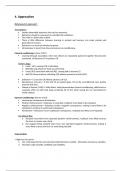
Behaviourist approach:
Assumptions:
Studies observable behaviour that can be measured.
Behaviour should be measured in controlled lab conditions.
The mind is a blank slate at birth.
There is little difference between learning in animals and humans; can study animals and
generalise to humans.
Behaviour is a result of stimulus/response.
All behaviour is learnt from the environment via conditioning.
Classical conditioning: Pavlov (1927)
Learning through association; when two stimuli are repeatedly paired to together they become
associated. NS becomes CS to produce CR.
Pavlov’s dogs:
o Food = UCS, causing UCR of salivating.
o Bell (NS) rang whenever food was presented.
o Food (UCS) associated with bell (NS), causing bell to become CS.
o Bell (CS) alone produces salivating (CR) without presence of food (UCS).
Extinction = CS can lose CR without presence of UCS.
Spontaneous recovery = if UCS and CS are paired again, CR can be reconditioned more quickly
than the first time.
Watson & Rayner (1920)’s ‘Little Albert’ study demonstrates classical conditioning; child learnt to
associate white rat with loud bang, producing CR of fear when seeing the rat. Generalised to
similar objects.
Operant conditioning: Skinner (1953)
Learning by consequence of behaviour.
Positive reinforcement = behaviour is rewarded, making it more likely to be repeated.
Negative reinforcement = behaviour avoids a negative consequence, making it more likely to be
repeated to continue to avoid said consequence.
Punishment = behaviour has an unpleasant consequence, making it less likely to be repeated.
The Skinner Box:
o Rat given food when lever operated (positive reinforcement), making it more likely to press
the lever to receive more food.
o Rat stopped being shocked when lever was operated (negative reinforcement), making it
more likely to press the lever to avoid being shocked.
EVALUATION:
+ High level of control
o Use of lab experiments and only observable behaviour studied – eliminates extraneous variables.
o Therefore, high scientific credibility and reliability.
, HOWEVER: - Oversimplifies behaviour
o Ignores the role of mental processes in human behaviour (cognitive approach
acknowledges these).
o Therefore, reductionist approach – learning is more than merely observable
behaviour.
- Environmental determinism
o No acknowledgement of role of free will in human behaviour (conscious decision-making) – we
are determined by past experiences.
o Therefore, deterministic. Provides a negative outlook, implying we have no ability to change our
fate.
- Cannot extrapolate results
o Research done on animals (Pavlov, Skinner) is blindly generalised to humans – distinction
between the two is ignored (i.e., humans’ active role in decision-making).
o Therefore, limited explanation of human behaviour. Low generalisability.
Social learning theory:
Assumptions:
Behaviour is learnt from experience.
People learn through observation and imitation of others.
Behaviour is learnt through direct and indirect reinforcement.
Stimulus -> Cognitive processes -> Response.
Role model/identification:
Role model = someone who is identified with and models a behaviour which may be imitated.
Identification = more likely to occur if role model possesses similar qualities and/or is of high
status and attractiveness – they do not have to be physically present.
Vicarious reinforcement: indirect learning
Observer sees role model receive reinforcement (positive/negative) for their behaviour.
This will make them more likely to imitate the behaviour in order to achieve the same
consequence as the role model.
Mediational processes: internal mental processes
Between stimulus and response – decide if a new response is required, considering
reinforcement.
1. Attention – notice behaviour of role model.
2. Retention – memorise behaviour observed.
3. Reproduction – imitate behaviour if skills to do so are possessed.
4. Motivation – the will to perform behaviour (from reinforcement).
Process of learning behaviour:
Person pays attention to role model who is modelling a behaviour.
They retain the behaviour and its consequence.
They imitate/reproduce the behaviour if they have the skill, motivated by direct or vicarious
reinforcement.
Behaviourist approach:
Assumptions:
Studies observable behaviour that can be measured.
Behaviour should be measured in controlled lab conditions.
The mind is a blank slate at birth.
There is little difference between learning in animals and humans; can study animals and
generalise to humans.
Behaviour is a result of stimulus/response.
All behaviour is learnt from the environment via conditioning.
Classical conditioning: Pavlov (1927)
Learning through association; when two stimuli are repeatedly paired to together they become
associated. NS becomes CS to produce CR.
Pavlov’s dogs:
o Food = UCS, causing UCR of salivating.
o Bell (NS) rang whenever food was presented.
o Food (UCS) associated with bell (NS), causing bell to become CS.
o Bell (CS) alone produces salivating (CR) without presence of food (UCS).
Extinction = CS can lose CR without presence of UCS.
Spontaneous recovery = if UCS and CS are paired again, CR can be reconditioned more quickly
than the first time.
Watson & Rayner (1920)’s ‘Little Albert’ study demonstrates classical conditioning; child learnt to
associate white rat with loud bang, producing CR of fear when seeing the rat. Generalised to
similar objects.
Operant conditioning: Skinner (1953)
Learning by consequence of behaviour.
Positive reinforcement = behaviour is rewarded, making it more likely to be repeated.
Negative reinforcement = behaviour avoids a negative consequence, making it more likely to be
repeated to continue to avoid said consequence.
Punishment = behaviour has an unpleasant consequence, making it less likely to be repeated.
The Skinner Box:
o Rat given food when lever operated (positive reinforcement), making it more likely to press
the lever to receive more food.
o Rat stopped being shocked when lever was operated (negative reinforcement), making it
more likely to press the lever to avoid being shocked.
EVALUATION:
+ High level of control
o Use of lab experiments and only observable behaviour studied – eliminates extraneous variables.
o Therefore, high scientific credibility and reliability.
, HOWEVER: - Oversimplifies behaviour
o Ignores the role of mental processes in human behaviour (cognitive approach
acknowledges these).
o Therefore, reductionist approach – learning is more than merely observable
behaviour.
- Environmental determinism
o No acknowledgement of role of free will in human behaviour (conscious decision-making) – we
are determined by past experiences.
o Therefore, deterministic. Provides a negative outlook, implying we have no ability to change our
fate.
- Cannot extrapolate results
o Research done on animals (Pavlov, Skinner) is blindly generalised to humans – distinction
between the two is ignored (i.e., humans’ active role in decision-making).
o Therefore, limited explanation of human behaviour. Low generalisability.
Social learning theory:
Assumptions:
Behaviour is learnt from experience.
People learn through observation and imitation of others.
Behaviour is learnt through direct and indirect reinforcement.
Stimulus -> Cognitive processes -> Response.
Role model/identification:
Role model = someone who is identified with and models a behaviour which may be imitated.
Identification = more likely to occur if role model possesses similar qualities and/or is of high
status and attractiveness – they do not have to be physically present.
Vicarious reinforcement: indirect learning
Observer sees role model receive reinforcement (positive/negative) for their behaviour.
This will make them more likely to imitate the behaviour in order to achieve the same
consequence as the role model.
Mediational processes: internal mental processes
Between stimulus and response – decide if a new response is required, considering
reinforcement.
1. Attention – notice behaviour of role model.
2. Retention – memorise behaviour observed.
3. Reproduction – imitate behaviour if skills to do so are possessed.
4. Motivation – the will to perform behaviour (from reinforcement).
Process of learning behaviour:
Person pays attention to role model who is modelling a behaviour.
They retain the behaviour and its consequence.
They imitate/reproduce the behaviour if they have the skill, motivated by direct or vicarious
reinforcement.