ABFM Heart Disease Exam: Questions & Answers: Latest Updated A+ Guide Solution
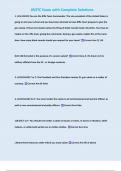
A 78-year-old male with chronic hypertension presents with a sudden onset of severe chest pain radiating to the back, associated with dyspnea and near-syncope. Which one of the following would suggest a diagnosis other than acute myocardial infarction? A 3/6 holosystolic apical murmur and diffuse ST-segment elevation A 2/6 diastolic murmur and weak radial and femoral pulses Diffuse ST-segment elevation of 1-2 mm A pulsus paradoxus of 10 mm Hg Chest and back pain that was mild initially and increased over the next 2 hours (Ans- B The chest pain of aortic dissection is typically described as searing, ripping, or tearing, and frequently radiates to the back or lower extremities. The pain is worst at the time of onset and lasts for hours. Helpful findings on physical examination include asymmetry of pulses or blood pressure, as well as a new murmur of aortic regurgitation (a decrescendo early diastolic murmur heard best in the aortic area, as opposed to holosystolic murmurs). This type of murmur indicates a dissection involving the ascending aorta. The dissection can extend to the pericardial sac and produce a pericardial friction rub on examination, as well as findings of cardiac tamponade. Pulsus paradoxus is a common finding of cardiac tamponade and is defined bya decrease in blood pressure of at least 12 mm Hg with inspiration.Aortic dissection is not usually associated with acute ischemic electrocardiographic changes. Data from the International Registry of Aortic Dissection indicates that ischemic changes were present on an EKG in only 15% of cases. The diagnosis can be established with transesophageal echocardiography, CT, or MRI. The importance of early diagnosis in a patient being evaluated for myocardial infarction is underscored by the fact that aortic dissection is exacerbated by fibrinolytic therapy and anticoagulation. Acute aortic dissection has a lethality rate of 1%-2% per hour after the onset of symptoms in untreated patients. Prompt diagnosis is therefore vital to increase the patient's chances of survival and prevent serious complications. Advanced age, male sex, a long-term history of arterial hypertension, and the presence of an aortic aneurysm confer the greatest population-attributable risk. However, patients with genetic connective tissue disorders such as Marfan, Loeys-Dietz, or EhlersDanlos syndrome, and patients wit A 62-year-old male comes to your office for a routine health maintenance evaluation. He has a history of hypertension, type 2 diabetes, and New York Heart Association class II heart failure. His current medications include metformin (Glucophage), 500 mg twice daily; benazepril (Lotensin), 40 mg daily; chlorthalidone, 12.5 mg daily; atorvastatin (Lipitor), 10 mg daily; and aspirin, 81 mg daily. A physical examination is notable only for a BMI of 29 kg/m2 and a blood pressure of 135/80 mm Hg. His hemoglobin A1c is 6.9%.Which one of the following additional medications would be appropriate to help manage his heart failure?
Written for
- Institution
- ABFM
- Module
- ABFM
Document information
- Uploaded on
- April 17, 2025
- Number of pages
- 70
- Written in
- 2024/2025
- Type
- Exam (elaborations)
- Contains
- Questions & answers
Subjects
-
a 78 year old male with chronic hypertension prese
-
a 62 year old male comes to your office for a rout
-
you see a 63 year old female for follow up 2 month

Also available in package deal