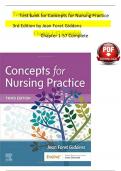
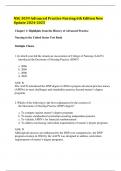
Test bank for Concepts for Nursing Practice
3rd Edition by Jean Foret Giddens
Chapter 1-57 Complete
,Concept 1: Development
Test Bank
MULTIPLE CHOICE
1. The nurse manager of a pediatric clinic could confirm that the new nurse recognized the
purpose of the HEADSS Adolescent Risk Profile when the new nurse responds that it is used
to assess for needs related to
a. anticipatory guidance.
b. low-risk adolescents.
c. physical development.
d. sexual development.
ANS: A
The HEADSS Adolescent Risk Profile is a psychosocial assessment screening tool which
assesses home, education, activities, drugs, sex, and suicide for the purpose of identifying
high-risk adolescents and the need for anticipatory guidance. It is used to identify high-risk,
not low-risk, adolescents. Physical development is assessed with anthropometric data.
Sexual development is assessed using physical examination.
REF: 6 OBJ: NCLEX® Client Needs Category: Health Promotion and Maintenance
2. The nurse preparing a teaching plan for a preschooler knows that, according to Piaget,
the expected stage of development for a preschooler is
a. concrete operational.
b. formal operational.
c. preoperational.
d. sensorimotor.
ANS: C
The expected stage of development for a preschooler (3 to 4 years old) is preoperational.
Concrete operational describes the thinking of a school-age child (7 to 11 years old). Formal
operational describes the thinking of an individual after about 11 years of age. Sensorimotor
describes the earliest pattern of thinking from birth to 2 years old.
REF: 5 OBJ: NCLEX® Client Needs Category: Health Promotion and Maintenance
3. The school nurse talking with a high school class about the difference between growth
and development would best describe growth as
a. processes by which early cells specialize.
b. psychosocial and cognitive changes.
c. qualitative changes associated with aging.
d. quantitative changes in size or weight.
ANS: D
Growth is a quantitative change in which an increase in cell number and size results in an
increase in overall size or weight of the body or any of its parts. The processes by which early
cells specialize are referred to as differentiation. Psychosocial and cognitive changes are
referred to as development. Qualitative changes associated with aging are referred to as
maturation.
, REF: 2 OBJ: NCLEX® Client Needs Category: Health Promotion and Maintenance
4. The most appropriate response of the nurse when a mother asks what the Denver II does
is that it
a. can diagnose developmental disabilities.
b. identifies a need for physical therapy.
c. is a developmental screening tool.
d. provides a framework for health teaching.
ANS: C
The Denver II is the most commonly used measure of developmental status used by health
care professionals; it is a screening tool. Screening tools do not provide a diagnosis. Diagnosis
requires a thorough neurodevelopment history and physical examination. Developmental
delay, which is suggested by screening, is a symptom, not a diagnosis. The need for any
therapy would be identified with a comprehensive evaluation, not a screening tool. Some
providers use the Denver II as a framework for teaching about expected development, but
this is not the primary purpose of the tool.
REF: 4 OBJ: NCLEX® Client Needs Category: Health Promotion and Maintenance
5. To plan early intervention and care for an infant with Down syndrome, the nurse
considers knowledge of other physical development exemplars such as
a. cerebral palsy.
b. failure to thrive.
c. fetal alcohol syndrome.
d. hydrocephaly.
ANS: D
Hydrocephaly is also a physical development exemplar. Cerebral palsy is an exemplar of
adaptive developmental delay. Failure to thrive is an exemplar of social/emotional
developmental delay. Fetal alcohol syndrome is an exemplar of cognitive developmental
delay.
REF: 9 OBJ: NCLEX® Client Needs Category: Health Promotion and Maintenance
6. To plan early intervention and care for a child with a developmental delay, the nurse
would consider knowledge of the concepts most significantly impacted by development,
including
a. culture.
b. environment.
c. functional status.
d. nutrition.
ANS: C
, Function is one of the concepts most significantly impacted by development. Others include
sensory-perceptual, cognition, mobility, reproduction, and sexuality. Knowledge of these
concepts can help the nurse anticipate areas that need to be addressed. Culture is a
concept that is considered to significantly affect development; the difference is the concepts
that affect development are those that represent major influencing factors (causes), hence
determination of development and would be the focus of preventive interventions.
Environment is considered to significantly affect development. Nutrition is considered to
significantly affect development.
REF: 1 OBJ: NCLEX® Client Needs Category: Health Promotion and Maintenance
7. A mother icomplains ito ithe inurse iat ithe ipediatric iclinic ithat iher i4-year-old ichild ialways
italks ito iher itoys iand imakes iup istories. iThe imother iwants iher ichild ito ihave ia ipsychologic
ievaluation.
The inurse’s ibest iinitial iresponse iis ito
a. refer ithe ichild ito ia ipsychologist.
b. explain ithat iplaying imake ibelieve iwith idolls iand ipeople iis inormal iat ithis iage.
c. complete ia idevelopmental iscreening.
d. separate ithe ichild ifrom ithe imother ito iget imore iinformation.
ANS: i B
By ithe iend iof ithe ifourth iyear, iit iis iexpected ithat ia ichild iwill iengage iin ifantasy, iso ithis iis
inormal iat ithis iage. iA ireferral ito ia ipsychologist iwould ibe ipremature ibased ionly ion ithe
icomplaint iof ithe imother. iCompleting ia idevelopmental iscreening iwould ibe ivery
iappropriate ibut inot ithe iinitial iresponse. iThe inurse iwould icertainly iwant ito iget imore
iinformation, ibut iseparating ithe ichild ifrom ithe imother iis inot inecessary iat ithis itime.
REF: i i5 OBJ: i NCLEX® iClient iNeeds iCategory: iHealth iPromotion iand iMaintenance
8. A i17-year-old igirl iis ihospitalized ifor iappendicitis, iand iher imother iasks ithe inurse iwhy ishe iis
iso ineedy iand iacting ilike ia ichild. iThe ibest iresponse iof ithe inurse iis ithat iin ithe ihospital,
iadolescents
a. have iseparation ianxiety.
b. rebel iagainst irules.
c. regress ibecause iof istress.
d. want ito iknow ieverything.
ANS: i C
Regression ito ian iearlier istage iof idevelopment iis ia icommon iresponse ito istress. iSeparation
ianxiety iis imost icommon iin iinfants iand itoddlers. iRebellion iagainst ihospital irules iis iusually
inot ian iissue iif ithe iadolescent iunderstands ithe irules iand iwould inot icreate ichildlike
ibehaviors. iAn iadolescent imay iwant ito i“know ieverything” iwith itheir ilogical ithinking iand
ideductive ireasoning, ibut ithat iwould inot iexplain iwhy ithey iwould iact ilike ia ichild.
REF: i i4 OBJ: i NCLEX® iClient iNeeds iCategory: iHealth iPromotion iand iMaintenance
3rd Edition by Jean Foret Giddens
Chapter 1-57 Complete
,Concept 1: Development
Test Bank
MULTIPLE CHOICE
1. The nurse manager of a pediatric clinic could confirm that the new nurse recognized the
purpose of the HEADSS Adolescent Risk Profile when the new nurse responds that it is used
to assess for needs related to
a. anticipatory guidance.
b. low-risk adolescents.
c. physical development.
d. sexual development.
ANS: A
The HEADSS Adolescent Risk Profile is a psychosocial assessment screening tool which
assesses home, education, activities, drugs, sex, and suicide for the purpose of identifying
high-risk adolescents and the need for anticipatory guidance. It is used to identify high-risk,
not low-risk, adolescents. Physical development is assessed with anthropometric data.
Sexual development is assessed using physical examination.
REF: 6 OBJ: NCLEX® Client Needs Category: Health Promotion and Maintenance
2. The nurse preparing a teaching plan for a preschooler knows that, according to Piaget,
the expected stage of development for a preschooler is
a. concrete operational.
b. formal operational.
c. preoperational.
d. sensorimotor.
ANS: C
The expected stage of development for a preschooler (3 to 4 years old) is preoperational.
Concrete operational describes the thinking of a school-age child (7 to 11 years old). Formal
operational describes the thinking of an individual after about 11 years of age. Sensorimotor
describes the earliest pattern of thinking from birth to 2 years old.
REF: 5 OBJ: NCLEX® Client Needs Category: Health Promotion and Maintenance
3. The school nurse talking with a high school class about the difference between growth
and development would best describe growth as
a. processes by which early cells specialize.
b. psychosocial and cognitive changes.
c. qualitative changes associated with aging.
d. quantitative changes in size or weight.
ANS: D
Growth is a quantitative change in which an increase in cell number and size results in an
increase in overall size or weight of the body or any of its parts. The processes by which early
cells specialize are referred to as differentiation. Psychosocial and cognitive changes are
referred to as development. Qualitative changes associated with aging are referred to as
maturation.
, REF: 2 OBJ: NCLEX® Client Needs Category: Health Promotion and Maintenance
4. The most appropriate response of the nurse when a mother asks what the Denver II does
is that it
a. can diagnose developmental disabilities.
b. identifies a need for physical therapy.
c. is a developmental screening tool.
d. provides a framework for health teaching.
ANS: C
The Denver II is the most commonly used measure of developmental status used by health
care professionals; it is a screening tool. Screening tools do not provide a diagnosis. Diagnosis
requires a thorough neurodevelopment history and physical examination. Developmental
delay, which is suggested by screening, is a symptom, not a diagnosis. The need for any
therapy would be identified with a comprehensive evaluation, not a screening tool. Some
providers use the Denver II as a framework for teaching about expected development, but
this is not the primary purpose of the tool.
REF: 4 OBJ: NCLEX® Client Needs Category: Health Promotion and Maintenance
5. To plan early intervention and care for an infant with Down syndrome, the nurse
considers knowledge of other physical development exemplars such as
a. cerebral palsy.
b. failure to thrive.
c. fetal alcohol syndrome.
d. hydrocephaly.
ANS: D
Hydrocephaly is also a physical development exemplar. Cerebral palsy is an exemplar of
adaptive developmental delay. Failure to thrive is an exemplar of social/emotional
developmental delay. Fetal alcohol syndrome is an exemplar of cognitive developmental
delay.
REF: 9 OBJ: NCLEX® Client Needs Category: Health Promotion and Maintenance
6. To plan early intervention and care for a child with a developmental delay, the nurse
would consider knowledge of the concepts most significantly impacted by development,
including
a. culture.
b. environment.
c. functional status.
d. nutrition.
ANS: C
, Function is one of the concepts most significantly impacted by development. Others include
sensory-perceptual, cognition, mobility, reproduction, and sexuality. Knowledge of these
concepts can help the nurse anticipate areas that need to be addressed. Culture is a
concept that is considered to significantly affect development; the difference is the concepts
that affect development are those that represent major influencing factors (causes), hence
determination of development and would be the focus of preventive interventions.
Environment is considered to significantly affect development. Nutrition is considered to
significantly affect development.
REF: 1 OBJ: NCLEX® Client Needs Category: Health Promotion and Maintenance
7. A mother icomplains ito ithe inurse iat ithe ipediatric iclinic ithat iher i4-year-old ichild ialways
italks ito iher itoys iand imakes iup istories. iThe imother iwants iher ichild ito ihave ia ipsychologic
ievaluation.
The inurse’s ibest iinitial iresponse iis ito
a. refer ithe ichild ito ia ipsychologist.
b. explain ithat iplaying imake ibelieve iwith idolls iand ipeople iis inormal iat ithis iage.
c. complete ia idevelopmental iscreening.
d. separate ithe ichild ifrom ithe imother ito iget imore iinformation.
ANS: i B
By ithe iend iof ithe ifourth iyear, iit iis iexpected ithat ia ichild iwill iengage iin ifantasy, iso ithis iis
inormal iat ithis iage. iA ireferral ito ia ipsychologist iwould ibe ipremature ibased ionly ion ithe
icomplaint iof ithe imother. iCompleting ia idevelopmental iscreening iwould ibe ivery
iappropriate ibut inot ithe iinitial iresponse. iThe inurse iwould icertainly iwant ito iget imore
iinformation, ibut iseparating ithe ichild ifrom ithe imother iis inot inecessary iat ithis itime.
REF: i i5 OBJ: i NCLEX® iClient iNeeds iCategory: iHealth iPromotion iand iMaintenance
8. A i17-year-old igirl iis ihospitalized ifor iappendicitis, iand iher imother iasks ithe inurse iwhy ishe iis
iso ineedy iand iacting ilike ia ichild. iThe ibest iresponse iof ithe inurse iis ithat iin ithe ihospital,
iadolescents
a. have iseparation ianxiety.
b. rebel iagainst irules.
c. regress ibecause iof istress.
d. want ito iknow ieverything.
ANS: i C
Regression ito ian iearlier istage iof idevelopment iis ia icommon iresponse ito istress. iSeparation
ianxiety iis imost icommon iin iinfants iand itoddlers. iRebellion iagainst ihospital irules iis iusually
inot ian iissue iif ithe iadolescent iunderstands ithe irules iand iwould inot icreate ichildlike
ibehaviors. iAn iadolescent imay iwant ito i“know ieverything” iwith itheir ilogical ithinking iand
ideductive ireasoning, ibut ithat iwould inot iexplain iwhy ithey iwould iact ilike ia ichild.
REF: i i4 OBJ: i NCLEX® iClient iNeeds iCategory: iHealth iPromotion iand iMaintenance