Introduction
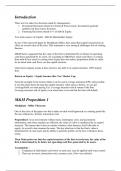
There are two sides two decisions made by management -
1. Investment Decisions related to Current & Fixed Assets. Investments generate
cashflows & they lead to Investors.
2. Financing Decisions related to % of debt & Equity.
Two main sources of Capital - Debt & Shareholders Equity.
In one of the renowned paper by Modigliani-Miller, they stated that capital structure has no
effect on overall value of the firm. This statement is very strong & challenges lots of existing
theories.
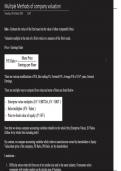
M&M theory suggested that the value of the firm is determined by its future net operating
cash flows generated by its assets. So according to M&M how much cash flows is coming
from debt & how much is coming from Equity does not matter /proportions holds no value.
So its about total cash flows, not the capital structure.
Unlevered company means it does not have any debt in its capital structure. 100% Equity
firm.
Return on Equity = Equity Income after Tax/ Market Cap.
From the example in the lecture slides it can be seen Leverage maximize EPS, only possible
if you buy back shares & keep the capital structure value same as before. As you get
Leverage/Debt you start paying Tax. Leverage increases risk & return of the firm.
Leverage increases risk of equity even when there is no risk that the firm will default.
M&M Proposition 1
Modigliani - Miller Theorems
One of the critic of the paper was that it takes an ideal world approach as a starting point like
the one without tax, friction, transaction costs
Proposition I: In an environment without taxes, bankruptcy costs, and asymmetric
information, and where markets are efficient, the value of a firm is unaffected by its capital
structure. This means that it does not matter whether a firm finances itself with debt or
equity; its overall value remains the same. The key idea here is that the firm's value is
determined by its real assets and its ability to generate profits, not by how it finances those
assets.
Their Main point was that the capital structure of the firm is irrelevant, the value of the
firm is determined by its future net operating cash flow generated by its assets.
Assumptions -
1. Companies & Individuals can borrow at same rate. (can be applied until some extent)
2. There are no taxes, transaction costs, issuance costs. (Not very realistic)
There are two sides two decisions made by management -
1. Investment Decisions related to Current & Fixed Assets. Investments generate
cashflows & they lead to Investors.
2. Financing Decisions related to % of debt & Equity.
Two main sources of Capital - Debt & Shareholders Equity.
In one of the renowned paper by Modigliani-Miller, they stated that capital structure has no
effect on overall value of the firm. This statement is very strong & challenges lots of existing
theories.
M&M theory suggested that the value of the firm is determined by its future net operating
cash flows generated by its assets. So according to M&M how much cash flows is coming
from debt & how much is coming from Equity does not matter /proportions holds no value.
So its about total cash flows, not the capital structure.
Unlevered company means it does not have any debt in its capital structure. 100% Equity
firm.
Return on Equity = Equity Income after Tax/ Market Cap.
From the example in the lecture slides it can be seen Leverage maximize EPS, only possible
if you buy back shares & keep the capital structure value same as before. As you get
Leverage/Debt you start paying Tax. Leverage increases risk & return of the firm.
Leverage increases risk of equity even when there is no risk that the firm will default.
M&M Proposition 1
Modigliani - Miller Theorems
One of the critic of the paper was that it takes an ideal world approach as a starting point like
the one without tax, friction, transaction costs
Proposition I: In an environment without taxes, bankruptcy costs, and asymmetric
information, and where markets are efficient, the value of a firm is unaffected by its capital
structure. This means that it does not matter whether a firm finances itself with debt or
equity; its overall value remains the same. The key idea here is that the firm's value is
determined by its real assets and its ability to generate profits, not by how it finances those
assets.
Their Main point was that the capital structure of the firm is irrelevant, the value of the
firm is determined by its future net operating cash flow generated by its assets.
Assumptions -
1. Companies & Individuals can borrow at same rate. (can be applied until some extent)
2. There are no taxes, transaction costs, issuance costs. (Not very realistic)