2025
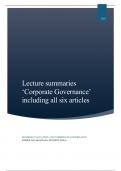
Lecture summaries
‘Corporate Governance’
including all six articles
BUSINESS VALUATION AND CORPORATE GOVERNANCE
FIDDER, B.R. (BASTIAAN, STUDENT M-BA)
, 1
Contents
Lecture 5: Introduction to Corporate Governance .............................................................................. 2
Lecture 6: Ownership structure + article 1 ......................................................................................... 4
Article 1: Blockholder dispersion ................................................................................................... 4
Lecture 7: Institutional investors + article 2........................................................................................ 6
Article 2: international influence of institutional investors .............................................................. 6
Lecture 8: Board structure + article 3 ................................................................................................ 8
Article 3: sudden deaths of independent directors ......................................................................... 9
Lecture 9: Board diversity + article 4................................................................................................ 10
Article 4: diversity of boards ........................................................................................................ 10
Lecture 10: Compensation + Article 5 ............................................................................................. 12
Article 5: pay-performance sensitivity CEO’s ............................................................................... 12
Lecture 11: Compensation + Article 6 ............................................................................................. 14
Article 6: corporate jets as perks ................................................................................................. 14
Lecture 12: International Corporate Governance ............................................................................. 16
, 2
Lecture 5: Introduction to Corporate Governance
Main difference between a corporation and any other business (e.g. partnership or solo
entrepreneurship), is the distinct separation from ownership and control (i.e. shareholders,
boards and management as a way to separate). Ownership and control are separated by daily
management (managers etc.) and ownership (shareholders). The board is elected by
shareholders, they also hire and fire the daily management and monitor/supervise managers.
Agents are hired to perform a job for a compensation (insiders or outsiders) by the principal
of the organisation (e.g. CEO…). They may have different interests, which has the potential
risk of the agent acting in his own interest (so called agency problems!)
Information asymmetry theory is a theory that describes the problems that can arise
between an agent and a principal when they both have different self-interests (conflict of
interest arise). There are two main types of information problems in information asymmetry
theory.
• Adverse selection: when buyers have more/different information than sellers or visa
versa (e.g. insider trading). Before the contract
• Moral hazard: incentive to increase exposure to risk because it doesn’t bear the full
cost of that risk. After the contract
It is important to be able to make a clear distinction between the two (one is before contract;
other one is after). In the corporate setting this is also possible (shareholders employ
managers).
Lecture summaries
‘Corporate Governance’
including all six articles
BUSINESS VALUATION AND CORPORATE GOVERNANCE
FIDDER, B.R. (BASTIAAN, STUDENT M-BA)
, 1
Contents
Lecture 5: Introduction to Corporate Governance .............................................................................. 2
Lecture 6: Ownership structure + article 1 ......................................................................................... 4
Article 1: Blockholder dispersion ................................................................................................... 4
Lecture 7: Institutional investors + article 2........................................................................................ 6
Article 2: international influence of institutional investors .............................................................. 6
Lecture 8: Board structure + article 3 ................................................................................................ 8
Article 3: sudden deaths of independent directors ......................................................................... 9
Lecture 9: Board diversity + article 4................................................................................................ 10
Article 4: diversity of boards ........................................................................................................ 10
Lecture 10: Compensation + Article 5 ............................................................................................. 12
Article 5: pay-performance sensitivity CEO’s ............................................................................... 12
Lecture 11: Compensation + Article 6 ............................................................................................. 14
Article 6: corporate jets as perks ................................................................................................. 14
Lecture 12: International Corporate Governance ............................................................................. 16
, 2
Lecture 5: Introduction to Corporate Governance
Main difference between a corporation and any other business (e.g. partnership or solo
entrepreneurship), is the distinct separation from ownership and control (i.e. shareholders,
boards and management as a way to separate). Ownership and control are separated by daily
management (managers etc.) and ownership (shareholders). The board is elected by
shareholders, they also hire and fire the daily management and monitor/supervise managers.
Agents are hired to perform a job for a compensation (insiders or outsiders) by the principal
of the organisation (e.g. CEO…). They may have different interests, which has the potential
risk of the agent acting in his own interest (so called agency problems!)
Information asymmetry theory is a theory that describes the problems that can arise
between an agent and a principal when they both have different self-interests (conflict of
interest arise). There are two main types of information problems in information asymmetry
theory.
• Adverse selection: when buyers have more/different information than sellers or visa
versa (e.g. insider trading). Before the contract
• Moral hazard: incentive to increase exposure to risk because it doesn’t bear the full
cost of that risk. After the contract
It is important to be able to make a clear distinction between the two (one is before contract;
other one is after). In the corporate setting this is also possible (shareholders employ
managers).