1
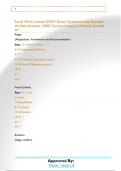
Social Work License (MSW Exam) Questions with Detailed
Verified Answers (100% Correct Answers) /Already Graded
A+
Piaget
(Adaptations, Assimilation and Accommodation)
Ans: 0-1 Sensory-Motor
2-4 Preoperational Period
5-7 "
8-12 Concrete Operations period
13-18 formal Operations period
19-21
21 +
50 +
Freud (Libido)
Ans: 0-1 Oral
2-4 Anal
Oedipal/Phallic
8-12 Latency
13-18 Genital
19-21 "
21+ "
50 + "
Erickson
(Stage conflict)
Approved By:
vPretest - Stuvia US
,2
Ans: 0-1 Trust vs. Mistrust (stage #1)
2-4 Autonomy vs. Shame & Doubt (stage #2)
5-7 Initiative vs. Guilt (stage #3)
8-12 Industry vs. Inferiority (stage #4)
13-18 Identity vs. Role Diffusion, confusion (stage #5)
19-21 Intimacy Vs. Isolation (stage #6)
21 + Generativity vs. Stagnation (stage #7)
50 + Integrity vs. Despair (stage #8)
Trust vs. Mistrust (stage 1) 0-1
Ans: During infancy (0-1) the child is dependent on mother for food and care.
As the child incorporates or takes in through sucking and swallowing; there is a
receptivity to what is being offered. The mother is responsible for coordinating
the child's experience of getting and hers of giving. At the latter part of this
stage the child's eyes begin to focus and incorporation becomes more active as
the child bites to "hold onto" things. If the mother provides a predictable
environment in which the child's needs are met, a sense of basic trust will
develop. This sense of trust implies not only sameness and continuity from the
caretaker, but also self-trust in one's capacity to cope with urges. According to
Erickson, it is the quality rather than the quantity of maternal care that is
critical at this stage. Successful resolution will lead to a lasting ego quality of
hope, an enduring belief that wishes can be fulfilled. Unsuccessful resolution
will lead to a sense of mistrust in other people and the environment.
Autonomy vs. Shame and Doubt (stage 2) 2-3
Ans: During early childhood (2-3) the child learns a sense of autonomy
through retention and elimination of urine and feces. As the child's muscles
mature to the point that bodily wastes can be retained or expelled at will, the
child experiments with two simultaneous social modalities "holding on" and
"letting go." Parents must be firm and tolerant so that the child can gradually
learn bowel and bladder control and a "sense of self-control without loss of
self esteem." From this emerges a sense of autonomy and pride, and the lasting
ego quality of WILL POWER, the determination to use free choice and self-
restraint. Unsuccessful resolution of this stage will lead to lifelong feelings of
shame and doubt.
Approved By:
vPretest - Stuvia US
,3
Initiative vs. Guilt (stage 3) 3-5
Ans: During the play age (3-5), increased locomotor mastery (walking and
running) gives the child a wider radius of goals. In addition, language skills add
to the ability to imagine "so many things he cannot avoid frightening himself
with what he himself has created and thought up." The Oedipal wishes and the
ambivalent feelings that accompany them must be repressed in order to
temporarily mask the initiative toward the opposite sex parent. While this
initiative is a prerequisite for masculine and feminine behaviors later in life, it is
now repressed of necessity-in order to avoid the guilt that would accompany
knowledge of incestuous thoughts. Parents assist the child in learning
appropriate roles, including gender roles, as the child diverts the sexual drive
into acceptable activities. At this point conscience, or superego, becomes
established to govern the initiative. Proper resolution of this stage leads to a
lasting ego quality of purpose, the courage to pursue goals. Unsuccessful
resolution leads to feeling of shame.
Industry vs. Inferiority (stage 4) 6-12
Ans: The child now enters the school age (6-12) and is enmeshed in the
"world" of school and opportunities for new types of mastery. As children
develop their abilities in new skills and tasks, they desire recognition gained
from producing things. Through this, they develop a sense of industry and a
lasting ego quality of competence. Unsuccessful resolution of this stage leads to
life long feelings of inferiority and inadequacy.
Identity vs. Role Confusion (stage 5) 12-18
Approved By:
vPretest - Stuvia US
, 4
Ans: As the child approaches adolescence (12-18 or so), physical and
hormonal changes mark the beginning of puberty. Rapid growth and physical
genital maturity disrupt the earlier continuity of childhood. This stage is
perhaps the most important for Erikson, as the adolescent must now forge a
lasting ego identity through aligning his or her basic dries, endowments, and
opportunities. A sense of ego identity is "the accrued confidence that ones
ability to maintain inner sameness and continuity...is matched by the sameness
and continuity of ones meaning for others. Thus, self-esteem grows to be a
conviction that one is learning effective steps toward a tangible future, that one
is developing a defined personality within a social reality which one
understands. As the adolescent struggles to integrate past and future views of
self and begins to define new appropriate sex roles, an identity crisis may
emerge from this confusion. New expectations from parents may add to this
stress. Tolerance, understanding, and guidance in the home can assist the
adolescent in achieving an integrated identity. Unsuccessful resolution can
result in either role confusion or identity diffusion, a state in which the
individual is left with strong doubts about who he or she "is." This may lead to
delinquency, psychotic incidents, or over-identification with others. Youths
who emerge with a strong sense of identity and individuality gain a lasting ego
quality of fidelity or freely pledges loyalties.
Intimacy vs. Isolation (stage 6) (early to late 20s)
Ans: Young adulthood (early to late 20s) brings an end to the years of
childhood and youth. It is now time for choosing a career, socializing with the
opposite sex, and eventually marriage and raising a family. Interpersonal
intimacy is the task of this stage, encompassing both psychological and sexual
intimacy. Failure to achieve intimacy leads to isolation, an inability to develop
intimate and meaningful relationship. The person who cannot be intimate will
likely be self-absorbed. Proper resolution of this stage leads to a lasting ego
quality of love, or mutuality of devotion.
Generativity vs. Stagnation (stage 7) (late 20s-50s)
Approved By:
vPretest - Stuvia US
Social Work License (MSW Exam) Questions with Detailed
Verified Answers (100% Correct Answers) /Already Graded
A+
Piaget
(Adaptations, Assimilation and Accommodation)
Ans: 0-1 Sensory-Motor
2-4 Preoperational Period
5-7 "
8-12 Concrete Operations period
13-18 formal Operations period
19-21
21 +
50 +
Freud (Libido)
Ans: 0-1 Oral
2-4 Anal
Oedipal/Phallic
8-12 Latency
13-18 Genital
19-21 "
21+ "
50 + "
Erickson
(Stage conflict)
Approved By:
vPretest - Stuvia US
,2
Ans: 0-1 Trust vs. Mistrust (stage #1)
2-4 Autonomy vs. Shame & Doubt (stage #2)
5-7 Initiative vs. Guilt (stage #3)
8-12 Industry vs. Inferiority (stage #4)
13-18 Identity vs. Role Diffusion, confusion (stage #5)
19-21 Intimacy Vs. Isolation (stage #6)
21 + Generativity vs. Stagnation (stage #7)
50 + Integrity vs. Despair (stage #8)
Trust vs. Mistrust (stage 1) 0-1
Ans: During infancy (0-1) the child is dependent on mother for food and care.
As the child incorporates or takes in through sucking and swallowing; there is a
receptivity to what is being offered. The mother is responsible for coordinating
the child's experience of getting and hers of giving. At the latter part of this
stage the child's eyes begin to focus and incorporation becomes more active as
the child bites to "hold onto" things. If the mother provides a predictable
environment in which the child's needs are met, a sense of basic trust will
develop. This sense of trust implies not only sameness and continuity from the
caretaker, but also self-trust in one's capacity to cope with urges. According to
Erickson, it is the quality rather than the quantity of maternal care that is
critical at this stage. Successful resolution will lead to a lasting ego quality of
hope, an enduring belief that wishes can be fulfilled. Unsuccessful resolution
will lead to a sense of mistrust in other people and the environment.
Autonomy vs. Shame and Doubt (stage 2) 2-3
Ans: During early childhood (2-3) the child learns a sense of autonomy
through retention and elimination of urine and feces. As the child's muscles
mature to the point that bodily wastes can be retained or expelled at will, the
child experiments with two simultaneous social modalities "holding on" and
"letting go." Parents must be firm and tolerant so that the child can gradually
learn bowel and bladder control and a "sense of self-control without loss of
self esteem." From this emerges a sense of autonomy and pride, and the lasting
ego quality of WILL POWER, the determination to use free choice and self-
restraint. Unsuccessful resolution of this stage will lead to lifelong feelings of
shame and doubt.
Approved By:
vPretest - Stuvia US
,3
Initiative vs. Guilt (stage 3) 3-5
Ans: During the play age (3-5), increased locomotor mastery (walking and
running) gives the child a wider radius of goals. In addition, language skills add
to the ability to imagine "so many things he cannot avoid frightening himself
with what he himself has created and thought up." The Oedipal wishes and the
ambivalent feelings that accompany them must be repressed in order to
temporarily mask the initiative toward the opposite sex parent. While this
initiative is a prerequisite for masculine and feminine behaviors later in life, it is
now repressed of necessity-in order to avoid the guilt that would accompany
knowledge of incestuous thoughts. Parents assist the child in learning
appropriate roles, including gender roles, as the child diverts the sexual drive
into acceptable activities. At this point conscience, or superego, becomes
established to govern the initiative. Proper resolution of this stage leads to a
lasting ego quality of purpose, the courage to pursue goals. Unsuccessful
resolution leads to feeling of shame.
Industry vs. Inferiority (stage 4) 6-12
Ans: The child now enters the school age (6-12) and is enmeshed in the
"world" of school and opportunities for new types of mastery. As children
develop their abilities in new skills and tasks, they desire recognition gained
from producing things. Through this, they develop a sense of industry and a
lasting ego quality of competence. Unsuccessful resolution of this stage leads to
life long feelings of inferiority and inadequacy.
Identity vs. Role Confusion (stage 5) 12-18
Approved By:
vPretest - Stuvia US
, 4
Ans: As the child approaches adolescence (12-18 or so), physical and
hormonal changes mark the beginning of puberty. Rapid growth and physical
genital maturity disrupt the earlier continuity of childhood. This stage is
perhaps the most important for Erikson, as the adolescent must now forge a
lasting ego identity through aligning his or her basic dries, endowments, and
opportunities. A sense of ego identity is "the accrued confidence that ones
ability to maintain inner sameness and continuity...is matched by the sameness
and continuity of ones meaning for others. Thus, self-esteem grows to be a
conviction that one is learning effective steps toward a tangible future, that one
is developing a defined personality within a social reality which one
understands. As the adolescent struggles to integrate past and future views of
self and begins to define new appropriate sex roles, an identity crisis may
emerge from this confusion. New expectations from parents may add to this
stress. Tolerance, understanding, and guidance in the home can assist the
adolescent in achieving an integrated identity. Unsuccessful resolution can
result in either role confusion or identity diffusion, a state in which the
individual is left with strong doubts about who he or she "is." This may lead to
delinquency, psychotic incidents, or over-identification with others. Youths
who emerge with a strong sense of identity and individuality gain a lasting ego
quality of fidelity or freely pledges loyalties.
Intimacy vs. Isolation (stage 6) (early to late 20s)
Ans: Young adulthood (early to late 20s) brings an end to the years of
childhood and youth. It is now time for choosing a career, socializing with the
opposite sex, and eventually marriage and raising a family. Interpersonal
intimacy is the task of this stage, encompassing both psychological and sexual
intimacy. Failure to achieve intimacy leads to isolation, an inability to develop
intimate and meaningful relationship. The person who cannot be intimate will
likely be self-absorbed. Proper resolution of this stage leads to a lasting ego
quality of love, or mutuality of devotion.
Generativity vs. Stagnation (stage 7) (late 20s-50s)
Approved By:
vPretest - Stuvia US