
Theme 1: brain basics
Type Notes
Due @March 24, 2025
Status Done
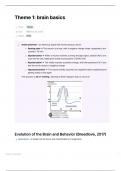
💡 Action potential = an electrical signal that travels along a neuron
Resting state ⇒ The neuron is at rest, with a negative charge inside compared to the
outside (-70 mV)
Depolarization ⇒ When a neuron receives a strong enough signal, sodium (Na⁺) ions
rush into the cell, making the inside more positive (+30/40 mV)
Repolarization ⇒ The inside reaches a positive charge, and then potassium (K⁺) ions
exit the cell to restore a negative charge
Hyperpolarization ⇒ The neuron briefly becomes too negative before stabilizing and
getting ready to fire again
This process is all-or-nothing, meaning it either happens fully or not al all
Evolution of the Brain and Behavior (Breedlove, 2017)
Naturalists = a student of the forms and classifications of organisms
Theme 1: brain basics 1
, Evolution = the process by which a population of interbreeding individuals changes over long
periods of time
Evolution by natural selection = the Darwinian theory that evolution proceeds by differential
success in reproduction
Four main observations (Darwin):
1. Reproduction will tend to increase a population rapidly unless factors limit it
2. Individuals of a given species are not identical
3. Some of the variation among individuals is inherited
4. Not all of the offspring of a given generation survive to reproduce
Interference ⇒ the variations among individuals affect the probability of their surviving long
enough to reproduce, thereby passing on their individual characteristics to their offspring
Natural Selection
Adaptations = a trait that increases the probability that an individual will leave offspring in
subsequent generations
Sexual selection (Darwin) = a form of evolution through natural selection in which members of one
sex favor specific heritable traits in the other sex when choosing a reproductive partner
Convergent evolution = the evolutionary process by which responses to similar ecological features
bring about similarities in behavior or structure among animals that are only distantly related
Homoplasy = a physical resemblance between physical or behavioral characteristics due to
convergent evolution (e.g. the similar body forms of tuna and dolphins)
Homology = a physical resemblance that is based on common ancestry
Analogy = a similarity of function, although the structures of interest may look different (e.g. the
human hand and an elephant’s trunk)
Darwin’s theory had uncertainty about two important processes:
1. The mechanism by which an individual inherits its characteristics form its parents
2. The source of individual variation upon which natural selection acts
Genetics = the study of inheritance, including the genes encoded in DNA
Mutations = a change in the nucleotide sequence of a gene as a result of unfaithful replication
they are heritable
Theme 1: brain basics 2
, may be harmful, neutral, or beneficial
a slight reproductive advantage (conspecifics) will make the mutation more and more
widespread
Evolution has no goal or endpoint, it is a continual remolding of organisms in response to their
environment, driven by reproductive success
Chromosome = a complex of condensed strands of DNA and associated protein molecules, found
in the nucleus of the cell
Gene = a length of DNA that encodes the information for constructing a particular protein
Epigenetics = the study of factors (experiences and the environment) that affect gene expression,
without changing the structure of the genes itself
In Linnaeus’s system, each species is assigned two names:
1. Genus = a group of species that resemble each other because of shared inheritance
2. Species = a group of individuals that can readily interbreed to produce fertile offspring
Linnaean classification: example dog
1. Kingdom ⇒ all living beings (including fungi, and bacteria)
2. Phylum ⇒ Vertebrates
3. Class ⇒ mammals
4. Order ⇒ carnivores
5. Family ⇒ Canids
6. Genus ⇒ dogs, wolves, coyotes, jackals
7. Species ⇒ domestic dog
Remember: Kindly Put Clothes On, For Goodness Sake
Phylogeny = the evolutionary history of a particular group of organisms
the similarities between some species of organisms reflect phylogeny
The phylogenetic approach looks at patterns among related species, which allows scientists to
make interferences about the evolution of behaviors
DNA appears to change at a steady average in all lineages
so DNA samples from two species can be used to estimate how long ago they diverged from a
common ancestor
Studying Other Species
Theme 1: brain basics 3
, Different kinds of animas have evolved specific behaviors and neural mechanisms that allow them
to exploit specific sets of environmental opportunities, or ecological niches
Ecological niche = the unique assortment of environmental opportunities and challenges to which
each organism is adapted
Species who different solutions to the challenges of survival, which has led to changes in brain
structure
The capability to store information must have arisen early in evolution
because even simple animals show lasting changes in behavior following important
experiences
The strategies that different species use to obtain food are correlated with brain size and structure
example: mammals that eat food that are difficult to find tend to have larger brains
example: finding novel ways of getting food is related to the size of the forebrain in different
birds
Conclusion: selection pressures favored increased size of the forebrain, allowing these species to
cope with environmental challenges and opportunities in new flexible ways
Behavioral adaptations have been related to differences in relative sizes of certain brain structures
example: the auditory center (inferior colliculus) is much larger in bats that depend on hearing,
while the bats that depend on sight have a larger visual center (superior colliculus)
Vertebrate Brains’s Basic Structure
Mammals all share the same basic set of brain regions for visual, auditory, and somatosensory
processing (arranged in the same basic pattern)
The relative size, proportions, and anatomical locations are different due to evolutionary
modification and ecological niches
the differences between the brains of humans and other mammals are mainly quantitative
Rat brain differences:
The cerebral hemispheres occupy a much greater proportion of the brain in humans
The human cerebral cortex is highly convoluted (i.e. covered in gyri and sulci)
The olfactory bulb is relatively larger in rates
probably related to the rat’s much greater use of the sense of smell
Theme 1: brain basics 4
Type Notes
Due @March 24, 2025
Status Done
💡 Action potential = an electrical signal that travels along a neuron
Resting state ⇒ The neuron is at rest, with a negative charge inside compared to the
outside (-70 mV)
Depolarization ⇒ When a neuron receives a strong enough signal, sodium (Na⁺) ions
rush into the cell, making the inside more positive (+30/40 mV)
Repolarization ⇒ The inside reaches a positive charge, and then potassium (K⁺) ions
exit the cell to restore a negative charge
Hyperpolarization ⇒ The neuron briefly becomes too negative before stabilizing and
getting ready to fire again
This process is all-or-nothing, meaning it either happens fully or not al all
Evolution of the Brain and Behavior (Breedlove, 2017)
Naturalists = a student of the forms and classifications of organisms
Theme 1: brain basics 1
, Evolution = the process by which a population of interbreeding individuals changes over long
periods of time
Evolution by natural selection = the Darwinian theory that evolution proceeds by differential
success in reproduction
Four main observations (Darwin):
1. Reproduction will tend to increase a population rapidly unless factors limit it
2. Individuals of a given species are not identical
3. Some of the variation among individuals is inherited
4. Not all of the offspring of a given generation survive to reproduce
Interference ⇒ the variations among individuals affect the probability of their surviving long
enough to reproduce, thereby passing on their individual characteristics to their offspring
Natural Selection
Adaptations = a trait that increases the probability that an individual will leave offspring in
subsequent generations
Sexual selection (Darwin) = a form of evolution through natural selection in which members of one
sex favor specific heritable traits in the other sex when choosing a reproductive partner
Convergent evolution = the evolutionary process by which responses to similar ecological features
bring about similarities in behavior or structure among animals that are only distantly related
Homoplasy = a physical resemblance between physical or behavioral characteristics due to
convergent evolution (e.g. the similar body forms of tuna and dolphins)
Homology = a physical resemblance that is based on common ancestry
Analogy = a similarity of function, although the structures of interest may look different (e.g. the
human hand and an elephant’s trunk)
Darwin’s theory had uncertainty about two important processes:
1. The mechanism by which an individual inherits its characteristics form its parents
2. The source of individual variation upon which natural selection acts
Genetics = the study of inheritance, including the genes encoded in DNA
Mutations = a change in the nucleotide sequence of a gene as a result of unfaithful replication
they are heritable
Theme 1: brain basics 2
, may be harmful, neutral, or beneficial
a slight reproductive advantage (conspecifics) will make the mutation more and more
widespread
Evolution has no goal or endpoint, it is a continual remolding of organisms in response to their
environment, driven by reproductive success
Chromosome = a complex of condensed strands of DNA and associated protein molecules, found
in the nucleus of the cell
Gene = a length of DNA that encodes the information for constructing a particular protein
Epigenetics = the study of factors (experiences and the environment) that affect gene expression,
without changing the structure of the genes itself
In Linnaeus’s system, each species is assigned two names:
1. Genus = a group of species that resemble each other because of shared inheritance
2. Species = a group of individuals that can readily interbreed to produce fertile offspring
Linnaean classification: example dog
1. Kingdom ⇒ all living beings (including fungi, and bacteria)
2. Phylum ⇒ Vertebrates
3. Class ⇒ mammals
4. Order ⇒ carnivores
5. Family ⇒ Canids
6. Genus ⇒ dogs, wolves, coyotes, jackals
7. Species ⇒ domestic dog
Remember: Kindly Put Clothes On, For Goodness Sake
Phylogeny = the evolutionary history of a particular group of organisms
the similarities between some species of organisms reflect phylogeny
The phylogenetic approach looks at patterns among related species, which allows scientists to
make interferences about the evolution of behaviors
DNA appears to change at a steady average in all lineages
so DNA samples from two species can be used to estimate how long ago they diverged from a
common ancestor
Studying Other Species
Theme 1: brain basics 3
, Different kinds of animas have evolved specific behaviors and neural mechanisms that allow them
to exploit specific sets of environmental opportunities, or ecological niches
Ecological niche = the unique assortment of environmental opportunities and challenges to which
each organism is adapted
Species who different solutions to the challenges of survival, which has led to changes in brain
structure
The capability to store information must have arisen early in evolution
because even simple animals show lasting changes in behavior following important
experiences
The strategies that different species use to obtain food are correlated with brain size and structure
example: mammals that eat food that are difficult to find tend to have larger brains
example: finding novel ways of getting food is related to the size of the forebrain in different
birds
Conclusion: selection pressures favored increased size of the forebrain, allowing these species to
cope with environmental challenges and opportunities in new flexible ways
Behavioral adaptations have been related to differences in relative sizes of certain brain structures
example: the auditory center (inferior colliculus) is much larger in bats that depend on hearing,
while the bats that depend on sight have a larger visual center (superior colliculus)
Vertebrate Brains’s Basic Structure
Mammals all share the same basic set of brain regions for visual, auditory, and somatosensory
processing (arranged in the same basic pattern)
The relative size, proportions, and anatomical locations are different due to evolutionary
modification and ecological niches
the differences between the brains of humans and other mammals are mainly quantitative
Rat brain differences:
The cerebral hemispheres occupy a much greater proportion of the brain in humans
The human cerebral cortex is highly convoluted (i.e. covered in gyri and sulci)
The olfactory bulb is relatively larger in rates
probably related to the rat’s much greater use of the sense of smell
Theme 1: brain basics 4


