4/12/25, 7:21 NUR2459 Module 8 Flashcards |
PM
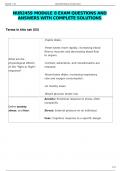
NUR2459 MODULE 8 EXAM QUESTIONS AND
ANSWERS WITH COMPLETE SOLUTIONS
Terms in this set (53)
-Pupils dilate.
-Heart beats more rapidly, increasing blood
flow to muscles and decreasing blood flow
to organs.
What are the
physiological effects -Cortisol, adrenaline, and noradrenaline are
of the "fight or flight" released.
response?
-Bronchioles dilate, increasing respiratory
rate and oxygen consumption.
-GI motility slows.
-Blood glucose levels rise
Anxiety: Emotional response to stress, often
nonspecific.
Define anxiety,
stress, and fear. Stress: External pressure on an individual.
Fear: Cognitive response to a specific danger
1/11
, 4/12/25, 7:21 NUR2459 Module 8 Flashcards |
PM
Mild: Heightened perception, peak functioning.
Moderate: Reduced perceptual field,
restlessness, gastric discomfort.
What are the levels of
anxiety, and their
Severe: Difficulty concentrating, tachycardia,
characteristics?
hyperventilation.
Panic: Loss of reality, hallucinations,
purposeless hyperactivity
-Female gender (higher prevalence).
What are the risk -Acute medical conditions (e.g., hyperthyroidism).
factors for anxiety
and obsessive- -Substance-induced anxiety (current use or
compulsive withdrawal).
disorders?
-Medications mimicking anxiety symptoms
-Sudden onset of extreme fear with
feelings of impending doom.
Define panic disorder -Requires 4+ symptoms: palpitations,
and its criteria. shortness of breath, nausea, paresthesia,
derealization, fear of dying, etc.
-Episodes last 15-30 minutes
-Stay with the patient; ensure safety.
-Maintain a calm, matter-of-fact approach.
What are the nursing
interventions for panic-
-Use short, simple statements.
level anxiety?
-Reduce environmental stimuli.
-Teach relaxation techniques post-crisis
-Persistent and excessive anxiety/worry for
What is generalized
2/11
PM
NUR2459 MODULE 8 EXAM QUESTIONS AND
ANSWERS WITH COMPLETE SOLUTIONS
Terms in this set (53)
-Pupils dilate.
-Heart beats more rapidly, increasing blood
flow to muscles and decreasing blood flow
to organs.
What are the
physiological effects -Cortisol, adrenaline, and noradrenaline are
of the "fight or flight" released.
response?
-Bronchioles dilate, increasing respiratory
rate and oxygen consumption.
-GI motility slows.
-Blood glucose levels rise
Anxiety: Emotional response to stress, often
nonspecific.
Define anxiety,
stress, and fear. Stress: External pressure on an individual.
Fear: Cognitive response to a specific danger
1/11
, 4/12/25, 7:21 NUR2459 Module 8 Flashcards |
PM
Mild: Heightened perception, peak functioning.
Moderate: Reduced perceptual field,
restlessness, gastric discomfort.
What are the levels of
anxiety, and their
Severe: Difficulty concentrating, tachycardia,
characteristics?
hyperventilation.
Panic: Loss of reality, hallucinations,
purposeless hyperactivity
-Female gender (higher prevalence).
What are the risk -Acute medical conditions (e.g., hyperthyroidism).
factors for anxiety
and obsessive- -Substance-induced anxiety (current use or
compulsive withdrawal).
disorders?
-Medications mimicking anxiety symptoms
-Sudden onset of extreme fear with
feelings of impending doom.
Define panic disorder -Requires 4+ symptoms: palpitations,
and its criteria. shortness of breath, nausea, paresthesia,
derealization, fear of dying, etc.
-Episodes last 15-30 minutes
-Stay with the patient; ensure safety.
-Maintain a calm, matter-of-fact approach.
What are the nursing
interventions for panic-
-Use short, simple statements.
level anxiety?
-Reduce environmental stimuli.
-Teach relaxation techniques post-crisis
-Persistent and excessive anxiety/worry for
What is generalized
2/11