

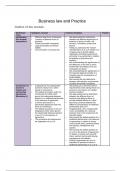
Business law and Practice
Outline of the module
Workshop/ Subtopics covered Common mistakes Tracker
Topic
Introduction • Different legal forms of business • Not appreciating the distinctions
(Pre-module • Taxation of different forms of between the different legal forms of
preparation) business business in terms of costs, risk,
• Private and public companies structure, formalities, privacy and
• Legal personality and limited finance
liability • Failing to understand the “hybrid”
• Core principles of contract law characteristics of an LLP (similar to a
company due to limited liability,
registration and filing requirements
yet similar to a partnership in relation
to flexibility of procedure and
taxation)
• Not understanding the significance of
the difference in the way in which
partnerships (including LLPs) and
companies are taxed
• Not understanding the significance of
the separate legal personality of a
company and the consequence of
limited liability
• Not knowing the key distinctions
between and statutory requirements
of public and private companies
Introduction to • Analysing the most appropriate • Not picking up on all of the client’s
business business medium for a client requirements and/or taking these into
models and based on instructions account in your advice on suitable
partnership • The default provisions under the business medium
agreements Partnership Act 1890 which • Not appreciating all the distinctions
(Workshop 1) govern the relationship between between the different forms of
partners in a traditional partnership business and applying these to
in the absence of agreement provide detailed advice to a client
• Common provisions in a • Becoming confused between the
partnership agreement and why different characteristics of traditional
these are necessary partnerships and LLPs
• The default provisions in the LLP • Forgetting that a PLC will generally
Regulations 2001 which govern not be a possibility for a start-up
the relationship between partners business due to the requirement for
in an LLP in the absence of £50,000 capital
agreement • Not knowing the default position for a
• The procedure and requirement traditional partnership in the absence
for registration of an LLP of agreement in relation to issues
such as profit share, partners joining
and leaving, management and
salaries
• Not knowing the default position for
an LLP in the absence of agreement
in relation to issues such as profit
share, partners joining and leaving,
management and salaries
• Failing to appreciate why it is so
important for partners in either a
traditional partnership or an LLP to
, enter into a detailed partnership
agreement which defines the
relationship between the partners
• Not understanding the range of
issues which must be covered in a
partnership agreement (for a
partnership or LLP)
• Not knowing the procedure and
requirements for registration of an
LLP
Formation of a • A comparison of the different • Not knowing the documentation
company procedures available for formation required for formation of a company
(Workshop 2) of a company (formation from and the significance of the articles of
scratch or conversion of a shelf association
company) • Confusing the quorum and notice
• The documentation required for requirements for board and general
formation of a company: the meetings
memorandum, articles of • Confusing the voting requirements
association and Companies House for board resolutions and resolutions
filing requirements (Form IN01, of the shareholders (ordinary and
other filings if necessary) special resolutions)
• The information and personnel • Not understanding the difference
required to form a company: between ordinary and special
directors, shareholders, company resolutions of shareholders
secretary (if required) • Not appreciating the requirement for
• Company decision making and a board meeting to take place prior to
meetings: board meetings and a general meeting (since the
general meetings directors need to pass a board
• The requirements of notice and resolution to call the general
quorum for a board meeting and a meeting) and also after the general
general meeting meeting (for the directors to put into
• The procedure involved in effect the resolutions passed by the
formation of a company using the shareholders and to direct the
shelf company conversion method company secretary to deal with the
• The order of meetings post meeting matters)
• Board minutes and general • Not knowing the post meeting filing
meeting minutes requirements required once a shelf
• Post meeting filings required when company conversion has taken place
a shelf company conversion takes
place
Directors’ • The general duties of directors • Failing to correctly identify the
duties and under s 171 – 177 Companies Act relevant duties of directors which
responsibilities 2006 apply in a given scenario
– disclosure, • The duty of directors to declare • Not identifying the requirement for
duties and their interests in transactions with directors to declare their interests or
specific the company the point in time at which this must
transactions • The effect of Model Article 14 be done
(Workshop 3) which applies where a director is • Failure to identify scenarios in which
interested in a transaction with the specific restrictions apply to a
company to prohibit that director transaction
from counting in the quorum or • Misapplying the statutory provisions
voting at the board meeting to setting out the meaning of a long
approve the transaction term service contract or a substantial
• Specific duties of directors in property transaction
relation to transactions: substantial • Confusing loans, quasi loans and
property transactions, long term credit transactions
service contracts and loans and • Forgetting to consider the
associated transactions with requirement for a holding company to
directors obtain shareholder approval in
• The requirement of shareholder appropriate cases
approval by ordinary resolution for • Failing to apply the wholly owned
a service contract with a subsidiary exception to approval
, guaranteed term exceeding 2 requirements for substantial property
years transactions, long term service
• The requirement of shareholder contracts and loans and associated
approval by ordinary resolution transactions
where a transfer of a substantial • Forgetting the requirement for a
non-cash asset takes place memorandum and the 15 day
between a company and a director requirement in relation to long term
(or director of the holding company service contracts and loans and
or a connected person) associated transactions
• The distinction between loans,
quasi loans and credit transactions
• The concept of companies
associated with a plc in relation to
restrictions on loans and
associated transactions
• The wholly owned subsidiary
exception for shareholder approval
• The requirement for a
memorandum and the 15 day
requirement in relation to long
term service contracts and loans
and associated transactions
Shareholders’ • The procedure for removal of a • Forgetting to apply the 28 clear day
rights and director under the Companies Act “special notice” requirement for a
remedies 2006, including notice and voting resolution to remove a director
(Workshop 4) requirements • Failing to understand the process by
• The ability of shareholders holding which shareholders may call a
over 5% of the shares to require general meeting and the timing
the directors to call a general requirements of the procedure
meeting and ultimately to call the • Failing to appreciate the threshold
general meeting themselves if the shareholding requirements for
board do not do so within the shareholders to serve notice on the
relevant time board to call a general meeting and
• The rights of a director subject to a then to call the meeting themselves if
removal resolution directors do not do so
• Shareholders' agreements – how • Not appreciating that a director who
and when they are used is also a shareholder is not subject to
• Bushell v Faith clauses in the any statutory restriction in voting at
articles and the effect of these on the general meeting on the resolution
a resolution for the removal of a for their removal
director • Not understanding the effect of a
• The effect of a provision in the provision in a shareholders
shareholders agreement agreement or a Bushell v Faith
preventing the removal of a clause in the articles on a removal
director unless all shareholders resolution
unanimously agree • Failing to understand that a
• Minority shareholder actions: derivative claim is a claim brought by
derivative claims, unfair prejudice a shareholder on behalf of the
• The meaning of a derivative claim company and the ramifications of this
and the two stage hearing process (ie that any remedy is for the
• The grounds and remedies company itself and not the
available for a claim for unfair shareholder)
prejudice • Not understanding the 2 stage
• Just and equitable winding up process for court approval for a
derivative claim
• Confusing derivative claims with a
claim for unfair prejudice; failing to
appreciate which remedy would be
appropriate in different scenarios
• Failing to understand who may bring
a claim for unfair prejudice and on
what grounds
, • Not understanding the nature of a
claim for just and equitable winding
up of a company and why this is an
unlikely remedy for the court to order
in most circumstances where a
minority shareholder brings a
petition.
Corporate • The procedure for issuing shares • Failing to consider whether the
finance: Equity • When directors will need to be shareholders will need to pass an
(Workshop 5) granted authority to allot shares by ordinary resolution to grant the
the shareholders directors authority to issue the new
• Automatic authority to allot shares shares
under s 550 • Not correctly applying the definition
• The meaning of “equity securities” of “equity securities” in order to
and pre-emption rights determine whether the new shares
• The procedure for disapplying pre- will carry pre-emption rights
emption rights • Failing to consider whether the
• When the articles of association articles of association will need to be
will need to be amended and the amended
procedure for effecting this • Confusing the shareholder
• The procedural formalities resolutions required at each stage of
required following a new issue of the procedure for issuing shares
shares • Forgetting to advise in relation to the
• The general prohibition on filing requirements and other
providing financial advice under s formalities required following a new
19 FSMA 2000 share issue
• Prohibited financial assistance • Failing to correctly apply the statutory
under s 678 and 679 Companies prohibitions on financial assistance to
Act 2006 determine whether a company may
give assistance to a purchaser of its
shares
• Failing to identify where a scenario
involves potentially prohibited
financial advice
Taxation of • The distinction between income • Confusing the terms total income, net
individuals: IT, and capital income and taxable income
CGT and IHT • The method for calculating an • Failing to deduct the appropriate tax
(Workshop 6) individual’s liability to income tax reliefs to give the net income
• Understanding the terms total • Failing to taper the personal
income, net income, taxable allowance where this is required
income • Forgetting to apply the personal
• The tax reliefs that can be savings allowance
deducted from total income to give • Forgetting that different rates apply to
net income (eg pension the calculation of income tax payable
contributions, interest on qualifying on dividend income
loans) • Confusing income and capital income
• Deducting the personal allowance and expenditure for the purposes of
from net income to give taxable taxation
income • Deducting the incorrect types of
• How to calculate the available expenditure in calculating the CGT
personal allowance payable on a chargeable gain
• Personal savings allowances • Failing to identify when business
• Splitting the taxable income into asset disposal relief may be available
non-savings, savings and dividend in the calculation of IHT
income and applying the relevant
rates to determine the tax payable
• The method for calculating an
individual’s liability to capital gains
tax (CGT)
• When CGT is payable
• How to calculate the chargeable
gain and the types of expenditure
Outline of the module
Workshop/ Subtopics covered Common mistakes Tracker
Topic
Introduction • Different legal forms of business • Not appreciating the distinctions
(Pre-module • Taxation of different forms of between the different legal forms of
preparation) business business in terms of costs, risk,
• Private and public companies structure, formalities, privacy and
• Legal personality and limited finance
liability • Failing to understand the “hybrid”
• Core principles of contract law characteristics of an LLP (similar to a
company due to limited liability,
registration and filing requirements
yet similar to a partnership in relation
to flexibility of procedure and
taxation)
• Not understanding the significance of
the difference in the way in which
partnerships (including LLPs) and
companies are taxed
• Not understanding the significance of
the separate legal personality of a
company and the consequence of
limited liability
• Not knowing the key distinctions
between and statutory requirements
of public and private companies
Introduction to • Analysing the most appropriate • Not picking up on all of the client’s
business business medium for a client requirements and/or taking these into
models and based on instructions account in your advice on suitable
partnership • The default provisions under the business medium
agreements Partnership Act 1890 which • Not appreciating all the distinctions
(Workshop 1) govern the relationship between between the different forms of
partners in a traditional partnership business and applying these to
in the absence of agreement provide detailed advice to a client
• Common provisions in a • Becoming confused between the
partnership agreement and why different characteristics of traditional
these are necessary partnerships and LLPs
• The default provisions in the LLP • Forgetting that a PLC will generally
Regulations 2001 which govern not be a possibility for a start-up
the relationship between partners business due to the requirement for
in an LLP in the absence of £50,000 capital
agreement • Not knowing the default position for a
• The procedure and requirement traditional partnership in the absence
for registration of an LLP of agreement in relation to issues
such as profit share, partners joining
and leaving, management and
salaries
• Not knowing the default position for
an LLP in the absence of agreement
in relation to issues such as profit
share, partners joining and leaving,
management and salaries
• Failing to appreciate why it is so
important for partners in either a
traditional partnership or an LLP to
, enter into a detailed partnership
agreement which defines the
relationship between the partners
• Not understanding the range of
issues which must be covered in a
partnership agreement (for a
partnership or LLP)
• Not knowing the procedure and
requirements for registration of an
LLP
Formation of a • A comparison of the different • Not knowing the documentation
company procedures available for formation required for formation of a company
(Workshop 2) of a company (formation from and the significance of the articles of
scratch or conversion of a shelf association
company) • Confusing the quorum and notice
• The documentation required for requirements for board and general
formation of a company: the meetings
memorandum, articles of • Confusing the voting requirements
association and Companies House for board resolutions and resolutions
filing requirements (Form IN01, of the shareholders (ordinary and
other filings if necessary) special resolutions)
• The information and personnel • Not understanding the difference
required to form a company: between ordinary and special
directors, shareholders, company resolutions of shareholders
secretary (if required) • Not appreciating the requirement for
• Company decision making and a board meeting to take place prior to
meetings: board meetings and a general meeting (since the
general meetings directors need to pass a board
• The requirements of notice and resolution to call the general
quorum for a board meeting and a meeting) and also after the general
general meeting meeting (for the directors to put into
• The procedure involved in effect the resolutions passed by the
formation of a company using the shareholders and to direct the
shelf company conversion method company secretary to deal with the
• The order of meetings post meeting matters)
• Board minutes and general • Not knowing the post meeting filing
meeting minutes requirements required once a shelf
• Post meeting filings required when company conversion has taken place
a shelf company conversion takes
place
Directors’ • The general duties of directors • Failing to correctly identify the
duties and under s 171 – 177 Companies Act relevant duties of directors which
responsibilities 2006 apply in a given scenario
– disclosure, • The duty of directors to declare • Not identifying the requirement for
duties and their interests in transactions with directors to declare their interests or
specific the company the point in time at which this must
transactions • The effect of Model Article 14 be done
(Workshop 3) which applies where a director is • Failure to identify scenarios in which
interested in a transaction with the specific restrictions apply to a
company to prohibit that director transaction
from counting in the quorum or • Misapplying the statutory provisions
voting at the board meeting to setting out the meaning of a long
approve the transaction term service contract or a substantial
• Specific duties of directors in property transaction
relation to transactions: substantial • Confusing loans, quasi loans and
property transactions, long term credit transactions
service contracts and loans and • Forgetting to consider the
associated transactions with requirement for a holding company to
directors obtain shareholder approval in
• The requirement of shareholder appropriate cases
approval by ordinary resolution for • Failing to apply the wholly owned
a service contract with a subsidiary exception to approval
, guaranteed term exceeding 2 requirements for substantial property
years transactions, long term service
• The requirement of shareholder contracts and loans and associated
approval by ordinary resolution transactions
where a transfer of a substantial • Forgetting the requirement for a
non-cash asset takes place memorandum and the 15 day
between a company and a director requirement in relation to long term
(or director of the holding company service contracts and loans and
or a connected person) associated transactions
• The distinction between loans,
quasi loans and credit transactions
• The concept of companies
associated with a plc in relation to
restrictions on loans and
associated transactions
• The wholly owned subsidiary
exception for shareholder approval
• The requirement for a
memorandum and the 15 day
requirement in relation to long
term service contracts and loans
and associated transactions
Shareholders’ • The procedure for removal of a • Forgetting to apply the 28 clear day
rights and director under the Companies Act “special notice” requirement for a
remedies 2006, including notice and voting resolution to remove a director
(Workshop 4) requirements • Failing to understand the process by
• The ability of shareholders holding which shareholders may call a
over 5% of the shares to require general meeting and the timing
the directors to call a general requirements of the procedure
meeting and ultimately to call the • Failing to appreciate the threshold
general meeting themselves if the shareholding requirements for
board do not do so within the shareholders to serve notice on the
relevant time board to call a general meeting and
• The rights of a director subject to a then to call the meeting themselves if
removal resolution directors do not do so
• Shareholders' agreements – how • Not appreciating that a director who
and when they are used is also a shareholder is not subject to
• Bushell v Faith clauses in the any statutory restriction in voting at
articles and the effect of these on the general meeting on the resolution
a resolution for the removal of a for their removal
director • Not understanding the effect of a
• The effect of a provision in the provision in a shareholders
shareholders agreement agreement or a Bushell v Faith
preventing the removal of a clause in the articles on a removal
director unless all shareholders resolution
unanimously agree • Failing to understand that a
• Minority shareholder actions: derivative claim is a claim brought by
derivative claims, unfair prejudice a shareholder on behalf of the
• The meaning of a derivative claim company and the ramifications of this
and the two stage hearing process (ie that any remedy is for the
• The grounds and remedies company itself and not the
available for a claim for unfair shareholder)
prejudice • Not understanding the 2 stage
• Just and equitable winding up process for court approval for a
derivative claim
• Confusing derivative claims with a
claim for unfair prejudice; failing to
appreciate which remedy would be
appropriate in different scenarios
• Failing to understand who may bring
a claim for unfair prejudice and on
what grounds
, • Not understanding the nature of a
claim for just and equitable winding
up of a company and why this is an
unlikely remedy for the court to order
in most circumstances where a
minority shareholder brings a
petition.
Corporate • The procedure for issuing shares • Failing to consider whether the
finance: Equity • When directors will need to be shareholders will need to pass an
(Workshop 5) granted authority to allot shares by ordinary resolution to grant the
the shareholders directors authority to issue the new
• Automatic authority to allot shares shares
under s 550 • Not correctly applying the definition
• The meaning of “equity securities” of “equity securities” in order to
and pre-emption rights determine whether the new shares
• The procedure for disapplying pre- will carry pre-emption rights
emption rights • Failing to consider whether the
• When the articles of association articles of association will need to be
will need to be amended and the amended
procedure for effecting this • Confusing the shareholder
• The procedural formalities resolutions required at each stage of
required following a new issue of the procedure for issuing shares
shares • Forgetting to advise in relation to the
• The general prohibition on filing requirements and other
providing financial advice under s formalities required following a new
19 FSMA 2000 share issue
• Prohibited financial assistance • Failing to correctly apply the statutory
under s 678 and 679 Companies prohibitions on financial assistance to
Act 2006 determine whether a company may
give assistance to a purchaser of its
shares
• Failing to identify where a scenario
involves potentially prohibited
financial advice
Taxation of • The distinction between income • Confusing the terms total income, net
individuals: IT, and capital income and taxable income
CGT and IHT • The method for calculating an • Failing to deduct the appropriate tax
(Workshop 6) individual’s liability to income tax reliefs to give the net income
• Understanding the terms total • Failing to taper the personal
income, net income, taxable allowance where this is required
income • Forgetting to apply the personal
• The tax reliefs that can be savings allowance
deducted from total income to give • Forgetting that different rates apply to
net income (eg pension the calculation of income tax payable
contributions, interest on qualifying on dividend income
loans) • Confusing income and capital income
• Deducting the personal allowance and expenditure for the purposes of
from net income to give taxable taxation
income • Deducting the incorrect types of
• How to calculate the available expenditure in calculating the CGT
personal allowance payable on a chargeable gain
• Personal savings allowances • Failing to identify when business
• Splitting the taxable income into asset disposal relief may be available
non-savings, savings and dividend in the calculation of IHT
income and applying the relevant
rates to determine the tax payable
• The method for calculating an
individual’s liability to capital gains
tax (CGT)
• When CGT is payable
• How to calculate the chargeable
gain and the types of expenditure


