

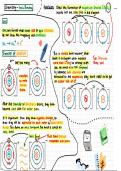
Chemistry-Ionic Bonding question: Draw the formation of magnesium Chlorite CMC)
Include just the Outer Shell in the
diagram
:
3
Ions X · X · X
We
ons are formed when atoms lose
show this
or
gain electrons .
Mg & Cl e & Cl e
can
happening with equations .
· ·
No Nat + e- X · ·
,
!
Transfer of electrons This is almost bone however, when
there is a
diagram which includes Two Chlorines
-
One too many more than 2 ions we
, arrange them Three ions .
X X
-
like we would in a real
compound
t
.
XX ⑧
, because both chlorines
So are
X transfers O
attracted to would need be put
magnesium they
the to
,
X No X to make CI
· either side of it
X X n on
X Chlorine & 2+
· X X · X
XX Stable
. ⑳
&
& Cl e Mg & Cl e
· ·
After the transfer of electrons occurs both
, they
·
become ions with full outer shells .
X & &
that
It is important
they will be
that they
attracted
have
to
opposite
each other
charges ,
so
by electrostatic
-
. This forms
forces an ionic compound
. The force is called an
ionic bond
&
-
X
Ionic Bond
X
-
Must show
movement
electron
with arrow .
..
E
Inten
·
t
XX
X -
⑧
O & -
X No X
X - n CI
·
E
X
X
↑
&
XX - ⑳ -
-
Include just the Outer Shell in the
diagram
:
3
Ions X · X · X
We
ons are formed when atoms lose
show this
or
gain electrons .
Mg & Cl e & Cl e
can
happening with equations .
· ·
No Nat + e- X · ·
,
!
Transfer of electrons This is almost bone however, when
there is a
diagram which includes Two Chlorines
-
One too many more than 2 ions we
, arrange them Three ions .
X X
-
like we would in a real
compound
t
.
XX ⑧
, because both chlorines
So are
X transfers O
attracted to would need be put
magnesium they
the to
,
X No X to make CI
· either side of it
X X n on
X Chlorine & 2+
· X X · X
XX Stable
. ⑳
&
& Cl e Mg & Cl e
· ·
After the transfer of electrons occurs both
, they
·
become ions with full outer shells .
X & &
that
It is important
they will be
that they
attracted
have
to
opposite
each other
charges ,
so
by electrostatic
-
. This forms
forces an ionic compound
. The force is called an
ionic bond
&
-
X
Ionic Bond
X
-
Must show
movement
electron
with arrow .
..
E
Inten
·
t
XX
X -
⑧
O & -
X No X
X - n CI
·
E
X
X
↑
&
XX - ⑳ -
-


