Wednesday March 5, 2025
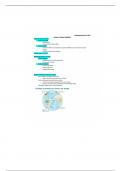
Lecture 7- Ocean circulation
Types of Ocean Currents
- Surface currents
o Wind driven
o Primarily horizontal motion
- Deep currents
o Driven by differences in density caused by differences in temperature and
salinity
o Vertical and horizonal motions
Surface ocean currents
Measuring surface currents
Direct methods
o Floating device track through time
o Fixed current meter
- Indirect methods
o Pressure gradients
o Radar altimeters
o Doppler flow meter
Surface currents are driven by winds
- Occur within and above pycnocline
o Affect only 10% of ocean water on Earth
- Friction between wind and ocean surface
o 2% of wind energy transferred to ocean surface
o Surface currents slower speed than corresponding winds
- Generally, follow earth’s win belt pattern
,Surface currents are affected by other factors
- Distribution of continents
o Influences flow in each ocean basin
- Other current influences
- Gravity
- Friction
- Coriolis effect
Largest surface current features: Subtropical Gyres
- Gyres: large, circular loops of moving water
- Subtropical gyres centered around 30 degrees latitude
Bounded by
- Equatorial current
- Western boundary currents
- Northern or southern boundary currents
- Eastern boundary currents
Four subtropical gyre currents
- Equatorial currents
o North or so8th of equator
o Travel westward
- Western boundary currents
o Warm water moving from equatorial regions
o Western edge of ocean basins
- Northern or southern boundary currents
o Easterly water flow across ocean basin
o Northern boundary currents in Northern Hemisphere
o Southern boundary currents in Southern Hemisphere
- Eastern Boundary Currents
o Cool waters
o Eastern edge of ocean basins
, Other surface currents
-
o Eastward flow between North and South Equatorial currents
o Due to minimal Coriolis effect at equator
-
o Rotate opposite subtropical gyres due to polar easterlies
o Smaller and fewer than subtropical gyres
The winds drive Ekman spirals and Ekman transport
- Observation that Arctic Ocean ice moved at a 20-to 40-degree angle to the right of the
wind
- Southern Hemisphere movement to the left of the wind
What is an Ekman spiral?
- Surface currents are deflected 45° from wind
- Each successive layer with depth is slower driven by
friction with layer above, and further deflected by
Coriolis
- Spirals to right in N.H., left in S.H
Lecture 7- Ocean circulation
Types of Ocean Currents
- Surface currents
o Wind driven
o Primarily horizontal motion
- Deep currents
o Driven by differences in density caused by differences in temperature and
salinity
o Vertical and horizonal motions
Surface ocean currents
Measuring surface currents
Direct methods
o Floating device track through time
o Fixed current meter
- Indirect methods
o Pressure gradients
o Radar altimeters
o Doppler flow meter
Surface currents are driven by winds
- Occur within and above pycnocline
o Affect only 10% of ocean water on Earth
- Friction between wind and ocean surface
o 2% of wind energy transferred to ocean surface
o Surface currents slower speed than corresponding winds
- Generally, follow earth’s win belt pattern
,Surface currents are affected by other factors
- Distribution of continents
o Influences flow in each ocean basin
- Other current influences
- Gravity
- Friction
- Coriolis effect
Largest surface current features: Subtropical Gyres
- Gyres: large, circular loops of moving water
- Subtropical gyres centered around 30 degrees latitude
Bounded by
- Equatorial current
- Western boundary currents
- Northern or southern boundary currents
- Eastern boundary currents
Four subtropical gyre currents
- Equatorial currents
o North or so8th of equator
o Travel westward
- Western boundary currents
o Warm water moving from equatorial regions
o Western edge of ocean basins
- Northern or southern boundary currents
o Easterly water flow across ocean basin
o Northern boundary currents in Northern Hemisphere
o Southern boundary currents in Southern Hemisphere
- Eastern Boundary Currents
o Cool waters
o Eastern edge of ocean basins
, Other surface currents
-
o Eastward flow between North and South Equatorial currents
o Due to minimal Coriolis effect at equator
-
o Rotate opposite subtropical gyres due to polar easterlies
o Smaller and fewer than subtropical gyres
The winds drive Ekman spirals and Ekman transport
- Observation that Arctic Ocean ice moved at a 20-to 40-degree angle to the right of the
wind
- Southern Hemisphere movement to the left of the wind
What is an Ekman spiral?
- Surface currents are deflected 45° from wind
- Each successive layer with depth is slower driven by
friction with layer above, and further deflected by
Coriolis
- Spirals to right in N.H., left in S.H