Chemie-Lernzettel
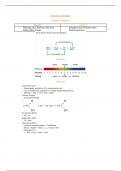
Donator-Akzeptor
Donator Akzeptor
▪ Ablösung eines Teilchens oder einer ▪ Aufnahme eines Teilchens eines
funktionellen Gruppe Reaktionspartners
pH-Werte
Nachweise
▪ Carbonation CO2 2-
-> Säurezugabe, wodurch in CO2 umgewandelt wird
-> CO2 ins Kalkwasser eingeleitet => weißer Niederschlag fällt aus
-> NaHCO3 + HCl -> CO2 + H2O + NaCl
▪ Carboxy-Gruppe
-> mit unedlem Metall
->
O O
2 R-C + Zu -> H2 + Zu 2+ + 2 R-C
O-H O-H
▪ Oxoniumion (H3O+)
-> UI = rot
▪ Hydroxidion (OH-)
-> UI = blau
▪ Ammonium (NH4+)
-> versetzen mit Natronlauge -> Gasbildung
-> NH4Cl + NaOH -> NH3 (UI = blau) + NaCl + H2O
-> im feuchten UI
=> NH 3 + H2O -> NH4+ + OH-
, Reaktionen von Säuren mit unedlen Metallen & Carbonaten
Neutralisationsreaktion
▪ bei Reaktion von saurer & alkalischer Lösung entsteht immer Salz & Wasser
▪ Übertragung von Protonen & Reaktion ist exotherm
▪ Reaktionsgleichung
OH- + H3O ⇌ 2 H2O
▪ Strukturformel
H-O + H-O-H ⇌ H-O-H + H-O-H
H
Protonenübergang
Definition Säuren & Basen nach Brönsted
Säuren Basen
▪ Protonendonoren ▪ Protonenakzeptoren
▪ Voraussetzung für Säuremoleküle: ▪ Voraussetzung für Basenmoleküle:
-> acide gebundene Protonen vorhanden -> freies Elektronenpaar vorhanden!
(H & gebundenes Atom; hohe 𝛥𝐸𝑁)
Starke & schwache Säuren & Basen
▪ Beispiel: Lösung mit Stearinsäure, Wasser und UI sowie Lösung mit Essigsäure, Wasser und UI
-> Lösung mit Stearinsäure => grün (nichts entsteht); Lösung mit Essigsäure => orange (saure Lösung mit
Oxoniumionen)
-> Warum?
=> Stearinsäure = Carbonsäure mit 18 C-Atomen
=> löst sich nicht im Wasser & reagiert damit nicht
=> kein H3O+ kann entstehen
=> deswegen UI grün
-> Ameisensäure am stärksten, da das H-Proton sehr acid ist
Ampholyte
▪ Teilchen, die als Säure und Base reagieren können
▪ Beispiel: H2O
-> beide Voraussetzungen sind erfüllt
=> acides Proton & freie e- Paare vorhanden
Donator-Akzeptor
Donator Akzeptor
▪ Ablösung eines Teilchens oder einer ▪ Aufnahme eines Teilchens eines
funktionellen Gruppe Reaktionspartners
pH-Werte
Nachweise
▪ Carbonation CO2 2-
-> Säurezugabe, wodurch in CO2 umgewandelt wird
-> CO2 ins Kalkwasser eingeleitet => weißer Niederschlag fällt aus
-> NaHCO3 + HCl -> CO2 + H2O + NaCl
▪ Carboxy-Gruppe
-> mit unedlem Metall
->
O O
2 R-C + Zu -> H2 + Zu 2+ + 2 R-C
O-H O-H
▪ Oxoniumion (H3O+)
-> UI = rot
▪ Hydroxidion (OH-)
-> UI = blau
▪ Ammonium (NH4+)
-> versetzen mit Natronlauge -> Gasbildung
-> NH4Cl + NaOH -> NH3 (UI = blau) + NaCl + H2O
-> im feuchten UI
=> NH 3 + H2O -> NH4+ + OH-
, Reaktionen von Säuren mit unedlen Metallen & Carbonaten
Neutralisationsreaktion
▪ bei Reaktion von saurer & alkalischer Lösung entsteht immer Salz & Wasser
▪ Übertragung von Protonen & Reaktion ist exotherm
▪ Reaktionsgleichung
OH- + H3O ⇌ 2 H2O
▪ Strukturformel
H-O + H-O-H ⇌ H-O-H + H-O-H
H
Protonenübergang
Definition Säuren & Basen nach Brönsted
Säuren Basen
▪ Protonendonoren ▪ Protonenakzeptoren
▪ Voraussetzung für Säuremoleküle: ▪ Voraussetzung für Basenmoleküle:
-> acide gebundene Protonen vorhanden -> freies Elektronenpaar vorhanden!
(H & gebundenes Atom; hohe 𝛥𝐸𝑁)
Starke & schwache Säuren & Basen
▪ Beispiel: Lösung mit Stearinsäure, Wasser und UI sowie Lösung mit Essigsäure, Wasser und UI
-> Lösung mit Stearinsäure => grün (nichts entsteht); Lösung mit Essigsäure => orange (saure Lösung mit
Oxoniumionen)
-> Warum?
=> Stearinsäure = Carbonsäure mit 18 C-Atomen
=> löst sich nicht im Wasser & reagiert damit nicht
=> kein H3O+ kann entstehen
=> deswegen UI grün
-> Ameisensäure am stärksten, da das H-Proton sehr acid ist
Ampholyte
▪ Teilchen, die als Säure und Base reagieren können
▪ Beispiel: H2O
-> beide Voraussetzungen sind erfüllt
=> acides Proton & freie e- Paare vorhanden