
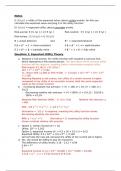
Notes
U [ E (y) ] = utility of the expected value; about certain events, for this you
calculate the expected value and plug it in the utility function
E [ U (y) ] = expected utility; about uncertain events
Risk-averse: E [ U (y) ] < U [ E (y) ] Risk-neutral: : E [ U (y) ] = U [ E (y) ]
Risk-loving: : E [ U (y) ] < U [ E (y) ]
Β = actual behavior and Β^ = expected behavior
If β = β^ = 1 -> time-consistent If β = β^ < 1 => sophisticated
If 1 > β^ > β -> partially naïve if β^ = 1 > β -> fully naïve
Question 1: Expected Utility Theory
a. Natasha is risk-averse, her utility function will visualize a concave line,
which represents a risk-averse person. The derivative of the concave utility
function will be negative, meaning there is decreasing marginal utility.
Risk-averse: E [ U(y) ] < U [ E(y) ]
U(I) = I0.5 = 100.5 = 3.162
vs. choice 50% 11.000 or 50% 9.000 -> E [U(y)] = 0.5 * 9 0.5 + 0.5 * 110.5
= 3.158
Meaning Natasha is risk-averse, her utility of a certain income is higher
compared to her utility of an uncertain income (with the same expected
value as the certain income).
b. – increasing absolute risk aversion -> if I = 100, U = 10, if I = 200, U =
14,12
- Decreasing relative risk aversion -> if I +100%, U + (14,12 – 10)/10 x
100% = 41,2%
Absolute Risk Aversion (ARA): - U “(y) / U’(y) Relative risk aversion: y
* ARA
ARA: -1/4 y-3/2 / ½ y-1/2 = - [ -1/2 y-1] = ½ y-1
Derivative = -1/2 y-2 is negative, meaning the utility function shows
decreasing absolute risk aversion.
RRA: y * ½ y-1 = ½ Derivative = 0, meaning the utility function
shows constant relative risk aversion.
c. Option 1; certain income of I = 10
Utility: 100.5 = 3.162
Option 2; expected income of I = 0.5 x 16 + 0.5 x 5 = 10.5
Expected Utility: 0.5 x 160.5 + 0.5 x 50.5 = 3.118
will not take the new job, because the utility of her current job is higher.
d. Yes, she would be willing to pay for insurance.
The difference of utility levels; 3.16 – 3.12 = 0.04
0.04 = I0.5
?
Expected income, E (y) = 0.5 * 16,000 + 0.5 * 5,000 = 10,500
3.118 = y1/2 -> y = 9.722 (income of 9,722)
, Risk premium = Expected income – certainty equivalent = 10,500 – 9,722
= 778 euros
Natasha would be willing to pay (maximum) 778 euros to insure her
income.
Question 2: Measuring Risk Preferences
a. Because only after the fourth time choosing, option A's expected return is
lower than option B's when you are risk neutral.
b. When the income of a person increases, they will want to hold more money
in risky assets percentage-wise when they are increasing relative risk
aversion.
c. Yes, they find evidence for increasing relative risk aversion, because as the
time of decision-making increases, the probability of A, the ‘safe’ option,
decreases; people tend to become more risk-seeking.
Question 4: Inconsistent Time Preferences
a. K = X1 + X2 + X3 is the constraint
u (x) = ln (x)
Max Ut = U0 + βδU1 + βδ2U2 = ln (x) + βδ * ln (x) + βδ2 * ln (x)
u(x) + ½ * 1 * u(x) + ½ * 12 * u(x) = ½ ln (x) + ½ ln (x) = ln (x)
Langrain = ln (x) + ½ ln (x2) + ½ ln (x3) – λ ( X1 + X2 + X3 – K)
Derivative L w.r.t. X1 = 1/X1 – λ -> λ = 1/X1
Derivative L w.r.t. X2 = 1/2X2 – λ = 0 -> λ = 1/2X2
Derivative L w.r.t X3 = 1/2X3 – λ = 0 -> λ = 1/2X3
Derivative L w.r.t. λ = X1 + X2 + X3 – K = 0
1/x1 = 1/2X2 -> X1 = 2 * X2 = 2 * X3 X1 + X1/2 + X1/2 – K = 0
2 * X1 = K -> X1 = ½ K -> X2 = ¼ K & X3 = ¼ K = planned
consumption
b. Ln (x), left for period 3 is ½ ln (x) with a budget of 1/3 K
Max Ut = u (x) + βδU1 = ln (x2) + ½ ln (x3) with constraint X2 + X3 = ½ K
L = ln (x2) + ½ ln (x3) – λ (X2 + X3 – ½ K)
Derivative w.r.t. X2 = 1/X2 – λ λ = 1/X2
Derivative w.r.t. X3 = ½* X3 – λ λ = ½* X3
Derivative w.r.t. λ = X2 + X3 – ½ K
1/X2 = ½*X3 -> X2 = 2* X3 2 * X3 + X3 = ½ K -> 3
* X3 = ½ K
X3 = 1/6 K and X2 = 1/3 K= planned consumption
c. Yes player will stick to his plan after consuming x 1, because β of ½ is
correctly estimated as a factor of time-inconsistency, in question a and b,
the player chooses to do the same action.
No, the player is inconsistent, because in period 2, he does not stick to the
plan made in period 1.
Question 5: Time Preferences and Self-Control
a. U0 = u0 + βδu1 + βδ2u2 with u0 = 0, u1 = 0 or -4, u2 = 0 or 6 (-6?)
, b. time-consistent preferences; Eric will take the course
-4 + 1 * 0.9 * 6 = 1.4
Sophisticated decision-maker; Eric will take the course, because he realizes
that in the end, the pay-off is bigger if he decides to take the course
-4 + 0.7 * 0.9 * 6 = -0.22
Partially naïve decision-maker; Eric will probably not take the course,
because his utility level with β(head) will be 0 + 0.8 * 0.9 * -4 + 0.8 * 0.92 * 6
= 1.008 vs 0 (?)
calculation
Fully naïve decision-maker; Eric will not take the course, because he will
choose for the highest utility in period 1; 0 (instead of -4), leading to no
further pay-off in period 2
calculation
c. – time-consistent preferences; Eric will take the course
- Sophisticated decision-maker; Eric will take the course, because he
realizes that in the end, the pay-off is bigger if he decides to take the
course
- Partially naïve decision-maker; 0.7 * 0.9 * -4 + 0.7 * 0.9 2 * 6 = 0.882,
Eric will probably not take the course (?)
- Fully naïve decision-maker; Eric will not take the course, because he will
choose for the highest utility in period 1; 0 (instead of -4), leading to no
further pay-off in period 2
d. Eric will only be subject to the self-control problem when he is a partially
naïve decision (and fully naïve) maker, because in that case he wrongly
estimates his ability of time-consistency choice-making, when he is a
sophisticated decision-maker he knows his self-control factor truly.
Question 1: Nash equilibrium
a.
A B
A 1, -1 -1, 1
B -1, 1 1, -1
b.
A B
A 2, 2 1, 1
B 1, 1 3, 3
c.
A B
A 2, 1 0, 0
B 0, 0 1, 2
?
Question 2: Mixed and Pure Nash equilibria
- Nash equilibria in pure strategies:
If player 2 chooses C, player 1 will choose C.
If player 2 chooses D, player 1 will choose D.
If player 1 chooses C, player 2 will choose C.
If player 1 chooses D, player 2 will choose D.
U [ E (y) ] = utility of the expected value; about certain events, for this you
calculate the expected value and plug it in the utility function
E [ U (y) ] = expected utility; about uncertain events
Risk-averse: E [ U (y) ] < U [ E (y) ] Risk-neutral: : E [ U (y) ] = U [ E (y) ]
Risk-loving: : E [ U (y) ] < U [ E (y) ]
Β = actual behavior and Β^ = expected behavior
If β = β^ = 1 -> time-consistent If β = β^ < 1 => sophisticated
If 1 > β^ > β -> partially naïve if β^ = 1 > β -> fully naïve
Question 1: Expected Utility Theory
a. Natasha is risk-averse, her utility function will visualize a concave line,
which represents a risk-averse person. The derivative of the concave utility
function will be negative, meaning there is decreasing marginal utility.
Risk-averse: E [ U(y) ] < U [ E(y) ]
U(I) = I0.5 = 100.5 = 3.162
vs. choice 50% 11.000 or 50% 9.000 -> E [U(y)] = 0.5 * 9 0.5 + 0.5 * 110.5
= 3.158
Meaning Natasha is risk-averse, her utility of a certain income is higher
compared to her utility of an uncertain income (with the same expected
value as the certain income).
b. – increasing absolute risk aversion -> if I = 100, U = 10, if I = 200, U =
14,12
- Decreasing relative risk aversion -> if I +100%, U + (14,12 – 10)/10 x
100% = 41,2%
Absolute Risk Aversion (ARA): - U “(y) / U’(y) Relative risk aversion: y
* ARA
ARA: -1/4 y-3/2 / ½ y-1/2 = - [ -1/2 y-1] = ½ y-1
Derivative = -1/2 y-2 is negative, meaning the utility function shows
decreasing absolute risk aversion.
RRA: y * ½ y-1 = ½ Derivative = 0, meaning the utility function
shows constant relative risk aversion.
c. Option 1; certain income of I = 10
Utility: 100.5 = 3.162
Option 2; expected income of I = 0.5 x 16 + 0.5 x 5 = 10.5
Expected Utility: 0.5 x 160.5 + 0.5 x 50.5 = 3.118
will not take the new job, because the utility of her current job is higher.
d. Yes, she would be willing to pay for insurance.
The difference of utility levels; 3.16 – 3.12 = 0.04
0.04 = I0.5
?
Expected income, E (y) = 0.5 * 16,000 + 0.5 * 5,000 = 10,500
3.118 = y1/2 -> y = 9.722 (income of 9,722)
, Risk premium = Expected income – certainty equivalent = 10,500 – 9,722
= 778 euros
Natasha would be willing to pay (maximum) 778 euros to insure her
income.
Question 2: Measuring Risk Preferences
a. Because only after the fourth time choosing, option A's expected return is
lower than option B's when you are risk neutral.
b. When the income of a person increases, they will want to hold more money
in risky assets percentage-wise when they are increasing relative risk
aversion.
c. Yes, they find evidence for increasing relative risk aversion, because as the
time of decision-making increases, the probability of A, the ‘safe’ option,
decreases; people tend to become more risk-seeking.
Question 4: Inconsistent Time Preferences
a. K = X1 + X2 + X3 is the constraint
u (x) = ln (x)
Max Ut = U0 + βδU1 + βδ2U2 = ln (x) + βδ * ln (x) + βδ2 * ln (x)
u(x) + ½ * 1 * u(x) + ½ * 12 * u(x) = ½ ln (x) + ½ ln (x) = ln (x)
Langrain = ln (x) + ½ ln (x2) + ½ ln (x3) – λ ( X1 + X2 + X3 – K)
Derivative L w.r.t. X1 = 1/X1 – λ -> λ = 1/X1
Derivative L w.r.t. X2 = 1/2X2 – λ = 0 -> λ = 1/2X2
Derivative L w.r.t X3 = 1/2X3 – λ = 0 -> λ = 1/2X3
Derivative L w.r.t. λ = X1 + X2 + X3 – K = 0
1/x1 = 1/2X2 -> X1 = 2 * X2 = 2 * X3 X1 + X1/2 + X1/2 – K = 0
2 * X1 = K -> X1 = ½ K -> X2 = ¼ K & X3 = ¼ K = planned
consumption
b. Ln (x), left for period 3 is ½ ln (x) with a budget of 1/3 K
Max Ut = u (x) + βδU1 = ln (x2) + ½ ln (x3) with constraint X2 + X3 = ½ K
L = ln (x2) + ½ ln (x3) – λ (X2 + X3 – ½ K)
Derivative w.r.t. X2 = 1/X2 – λ λ = 1/X2
Derivative w.r.t. X3 = ½* X3 – λ λ = ½* X3
Derivative w.r.t. λ = X2 + X3 – ½ K
1/X2 = ½*X3 -> X2 = 2* X3 2 * X3 + X3 = ½ K -> 3
* X3 = ½ K
X3 = 1/6 K and X2 = 1/3 K= planned consumption
c. Yes player will stick to his plan after consuming x 1, because β of ½ is
correctly estimated as a factor of time-inconsistency, in question a and b,
the player chooses to do the same action.
No, the player is inconsistent, because in period 2, he does not stick to the
plan made in period 1.
Question 5: Time Preferences and Self-Control
a. U0 = u0 + βδu1 + βδ2u2 with u0 = 0, u1 = 0 or -4, u2 = 0 or 6 (-6?)
, b. time-consistent preferences; Eric will take the course
-4 + 1 * 0.9 * 6 = 1.4
Sophisticated decision-maker; Eric will take the course, because he realizes
that in the end, the pay-off is bigger if he decides to take the course
-4 + 0.7 * 0.9 * 6 = -0.22
Partially naïve decision-maker; Eric will probably not take the course,
because his utility level with β(head) will be 0 + 0.8 * 0.9 * -4 + 0.8 * 0.92 * 6
= 1.008 vs 0 (?)
calculation
Fully naïve decision-maker; Eric will not take the course, because he will
choose for the highest utility in period 1; 0 (instead of -4), leading to no
further pay-off in period 2
calculation
c. – time-consistent preferences; Eric will take the course
- Sophisticated decision-maker; Eric will take the course, because he
realizes that in the end, the pay-off is bigger if he decides to take the
course
- Partially naïve decision-maker; 0.7 * 0.9 * -4 + 0.7 * 0.9 2 * 6 = 0.882,
Eric will probably not take the course (?)
- Fully naïve decision-maker; Eric will not take the course, because he will
choose for the highest utility in period 1; 0 (instead of -4), leading to no
further pay-off in period 2
d. Eric will only be subject to the self-control problem when he is a partially
naïve decision (and fully naïve) maker, because in that case he wrongly
estimates his ability of time-consistency choice-making, when he is a
sophisticated decision-maker he knows his self-control factor truly.
Question 1: Nash equilibrium
a.
A B
A 1, -1 -1, 1
B -1, 1 1, -1
b.
A B
A 2, 2 1, 1
B 1, 1 3, 3
c.
A B
A 2, 1 0, 0
B 0, 0 1, 2
?
Question 2: Mixed and Pure Nash equilibria
- Nash equilibria in pure strategies:
If player 2 chooses C, player 1 will choose C.
If player 2 chooses D, player 1 will choose D.
If player 1 chooses C, player 2 will choose C.
If player 1 chooses D, player 2 will choose D.


