
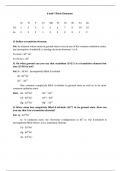
d and f Block Elements
Sc Ti V Cr Mn Fe Co Ni Cu Zn
3d 1 2 3 5 5 6 7 8 10 10
4s 2 2 2 1 2 2 2 2 1 2
Q. Define a transition element.
Sol. An element whose atom in ground state or ion in one of the common oxidation states,
has incomplete d-subshell i.e; having electrons between 1 to 9.
Cu atom : 3d10 4s1
Cu (II) ion : 3d9
Q. On what ground can you say that scandium (Z=21) is a transition element but
zinc (Z=30) is not?
Sol. Sc : 3d14s2 : Incompletely filled 3d orbital
Zn :3d104s2
Zn2+ : 3d10
Zinc contains completely filled d-orbitals in ground state as well as in its most
common oxidation state.
Note Zn : 3d104s2 Zn2+ : 3d10
Cd : 4d105s2 Cd2+ : 4d10
Hg : 5d106s2 Hg2+ : 5d10
Q. Silver atom has completely filled d-orbitals (4d 10) in its ground state. How can
you say that it is a transition element?
Sol. Ag : 4d105s1
In +2 oxidation state, the electronic configuration is 4d 9 i.e. the d-subshell is
incompletely filled. Hence, it is a transition element.
Cu : 3d104s1
Ag : 4d105s1
Au : 5d106s1
, d and f Block Elemnets
General electronic configuration
(n-1) d1-10 ns0-2
Sc Ti V Cr Mn Fe Co Ni Cu Zn
3d 1 2 3 5 5 6 7 8 10 10
4s 2 2 2 1 2 2 2 2 1 2
Ni : 3d8 4s2 Ni(28)
Pd : 4d10 5s0 Pd(46)
Pt : 5d9 6s1 Pt(78)
Atomic Radii
Sc Ti V Cr Mn Fe Co Ni Cu Zn
3d 1 2 3 5 5 6 7 8 10 10
4s 2 2 2 1 2 2 2 2 1 2
Size 162 147 134 127 126 126 125 124 124 138
(pm)
Size
Size Constaant Size
(i) In the beginning, the atomic radius decreases with the increase in atomic
number as the nuclear charge increases whereas the shielding/screening effect
of unpaired d electrons is very small.
(ii) After first five elements, no. of paired electrons increases and screening effect
increases.
This counterbalances the increased nuclear charge due to increase in atomic
number. As a result, the atomic radii remain practically same. (There is no
change in the size from Fe to Cu).
(iii) At the end of the period, there is a slight increase in the atomic radii (Zn : 138
pm)
The electron-electron repulsions between added electrons in the same orbital
are greater than the attractive forces due to increased nuclear charge.
This results in the expansion of the electron cloud and thus the atomic radius
increases.
Electron-electron Nucleus-electron
repulsive interactions attractive interactions
(iv) Size of 4d elements > Size of 3d elements
(Y_____ Cd) (SC______ Zn)
, (v) Size of 5d elements = Size of 4d elements
(La______ Hg) (Y______ Cd)
Lanthanide contraction
Ionic radii
Fe Fe2+ Fe3+
26p+ 26p+ 26p+
26e- 2e- 23e-
126pm 76 64
The ionic radii decrease with increase in oxidation state.
Element: Sc Ti V Cr Mn Fe Co Ni Cu Zn
M2+(pm): 81 91 84 88 80 76 74 72 72 74
Ionic Radii Decreases
Metallic Character
Sc Ti V Cr Mn Fe Co Ni Cu Zn
3d 1 2 3 5 5 6 7 8 10 10
4S 2 2 2 1 2 2 2 2 1 2
In the formation of metallic bonds, both ns and (n-1) d-electrons participate.
Greater the number of unpaired d-electrons, stronger is the bonding due to the
overlapping of unpaired electrons between different metal atoms.
Cr : 3d5 4s1 Maximum number of
Mo : 4d5 5s1 unpaired d-electrons.
W: 5d4 6s2 ∴ Hard metals.
Zn : 3d10 4s2 Absence of unpaired electrons.
Cd : 4d10 5s2 ∴ Not very hard metals.
Hg : 5d10 6s2
Enthalpy of atomization ( Ha):
It is the heat required to break the metal lattice to get free atoms.
M(s) M(g)
Sc Ti V Cr Mn Fe Co Ni Cu Zn
3d 1 2 3 5 5 6 7 8 10 10
4s 2 2 2 1 2 2 2 2 1 2
Q. Define a transition element.
Sol. An element whose atom in ground state or ion in one of the common oxidation states,
has incomplete d-subshell i.e; having electrons between 1 to 9.
Cu atom : 3d10 4s1
Cu (II) ion : 3d9
Q. On what ground can you say that scandium (Z=21) is a transition element but
zinc (Z=30) is not?
Sol. Sc : 3d14s2 : Incompletely filled 3d orbital
Zn :3d104s2
Zn2+ : 3d10
Zinc contains completely filled d-orbitals in ground state as well as in its most
common oxidation state.
Note Zn : 3d104s2 Zn2+ : 3d10
Cd : 4d105s2 Cd2+ : 4d10
Hg : 5d106s2 Hg2+ : 5d10
Q. Silver atom has completely filled d-orbitals (4d 10) in its ground state. How can
you say that it is a transition element?
Sol. Ag : 4d105s1
In +2 oxidation state, the electronic configuration is 4d 9 i.e. the d-subshell is
incompletely filled. Hence, it is a transition element.
Cu : 3d104s1
Ag : 4d105s1
Au : 5d106s1
, d and f Block Elemnets
General electronic configuration
(n-1) d1-10 ns0-2
Sc Ti V Cr Mn Fe Co Ni Cu Zn
3d 1 2 3 5 5 6 7 8 10 10
4s 2 2 2 1 2 2 2 2 1 2
Ni : 3d8 4s2 Ni(28)
Pd : 4d10 5s0 Pd(46)
Pt : 5d9 6s1 Pt(78)
Atomic Radii
Sc Ti V Cr Mn Fe Co Ni Cu Zn
3d 1 2 3 5 5 6 7 8 10 10
4s 2 2 2 1 2 2 2 2 1 2
Size 162 147 134 127 126 126 125 124 124 138
(pm)
Size
Size Constaant Size
(i) In the beginning, the atomic radius decreases with the increase in atomic
number as the nuclear charge increases whereas the shielding/screening effect
of unpaired d electrons is very small.
(ii) After first five elements, no. of paired electrons increases and screening effect
increases.
This counterbalances the increased nuclear charge due to increase in atomic
number. As a result, the atomic radii remain practically same. (There is no
change in the size from Fe to Cu).
(iii) At the end of the period, there is a slight increase in the atomic radii (Zn : 138
pm)
The electron-electron repulsions between added electrons in the same orbital
are greater than the attractive forces due to increased nuclear charge.
This results in the expansion of the electron cloud and thus the atomic radius
increases.
Electron-electron Nucleus-electron
repulsive interactions attractive interactions
(iv) Size of 4d elements > Size of 3d elements
(Y_____ Cd) (SC______ Zn)
, (v) Size of 5d elements = Size of 4d elements
(La______ Hg) (Y______ Cd)
Lanthanide contraction
Ionic radii
Fe Fe2+ Fe3+
26p+ 26p+ 26p+
26e- 2e- 23e-
126pm 76 64
The ionic radii decrease with increase in oxidation state.
Element: Sc Ti V Cr Mn Fe Co Ni Cu Zn
M2+(pm): 81 91 84 88 80 76 74 72 72 74
Ionic Radii Decreases
Metallic Character
Sc Ti V Cr Mn Fe Co Ni Cu Zn
3d 1 2 3 5 5 6 7 8 10 10
4S 2 2 2 1 2 2 2 2 1 2
In the formation of metallic bonds, both ns and (n-1) d-electrons participate.
Greater the number of unpaired d-electrons, stronger is the bonding due to the
overlapping of unpaired electrons between different metal atoms.
Cr : 3d5 4s1 Maximum number of
Mo : 4d5 5s1 unpaired d-electrons.
W: 5d4 6s2 ∴ Hard metals.
Zn : 3d10 4s2 Absence of unpaired electrons.
Cd : 4d10 5s2 ∴ Not very hard metals.
Hg : 5d10 6s2
Enthalpy of atomization ( Ha):
It is the heat required to break the metal lattice to get free atoms.
M(s) M(g)


