Core Study APFCE
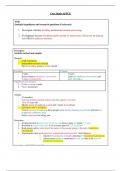
Aims
(include hypotheses and research questions if relevant)
1. Investigate whether doodling assisted information processing
2. If it happens because doodling enables people to attend more effectively to primary
task OR if it enhances memory
Procedure
(include method and sample)
Method:
- LAB experiment
- Independent measures design
- Ppts in doodling group or control group
Doodling Control
- 20 ppts - 20 ppts
- Had to listen to telephone conversation - Listen to telephone conversation and
WHILE DOODLING NOT DOODLE
Telephone conversation:
1. People coming to party
2. Places mentioned
Sample:
- 40 members
- Panel at medical research council unit for cognitive research
- 18 to 55 years old
- Mostly female [2 males in control and 3 males in doodling]
- OPPORTUNITY SAMPLE
- Used to increase boredom as these people were already planning to go home and had just
completed a different study
- Paid a small sum for taking part
Procedure:
1. All ppts listened to dull mock telephone call about a party => lasted 2.5 mins
2. Recorded in monotonous tone at an average speed of 227 words/min
3. Both groups told to write down the names of the people going to the party [monitored
information]
4. Experimenter then apologised for ‘unexpected recall activities’ that followed
o Asked to recall names of people attending => monitored information
o Asked names of places mentioned => not told this at the start =>
incidental information
Order if 2 tests COUNTERBALANCED
Aims
(include hypotheses and research questions if relevant)
1. Investigate whether doodling assisted information processing
2. If it happens because doodling enables people to attend more effectively to primary
task OR if it enhances memory
Procedure
(include method and sample)
Method:
- LAB experiment
- Independent measures design
- Ppts in doodling group or control group
Doodling Control
- 20 ppts - 20 ppts
- Had to listen to telephone conversation - Listen to telephone conversation and
WHILE DOODLING NOT DOODLE
Telephone conversation:
1. People coming to party
2. Places mentioned
Sample:
- 40 members
- Panel at medical research council unit for cognitive research
- 18 to 55 years old
- Mostly female [2 males in control and 3 males in doodling]
- OPPORTUNITY SAMPLE
- Used to increase boredom as these people were already planning to go home and had just
completed a different study
- Paid a small sum for taking part
Procedure:
1. All ppts listened to dull mock telephone call about a party => lasted 2.5 mins
2. Recorded in monotonous tone at an average speed of 227 words/min
3. Both groups told to write down the names of the people going to the party [monitored
information]
4. Experimenter then apologised for ‘unexpected recall activities’ that followed
o Asked to recall names of people attending => monitored information
o Asked names of places mentioned => not told this at the start =>
incidental information
Order if 2 tests COUNTERBALANCED