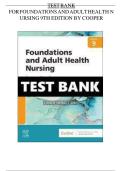
Test Bank for Foundations and Adult Health Nursing 9th Edition Cooper Chapter 1 - 58 Updated
Test Bank for Foundations and Adult
Health Nursing 9th Edition Cooper
Chapter 1 - 58 Updated
Chapter 01: The Evolution of Nursing
Cooper: Foundations and Adult Health Nursing, 9th Edition
MULTIPLE
CHOICES
1. What is a nursing program considered when certified by a state agency?
a. Accredited
b. Approved
c. Provisional
d. Exemplified
ANS: B
Approved means certified by a state agency for having met minimum standards;
accredited means certified by the NLN for havingmet more complex standards.
Provisional and exemplified are not terms used in regard to nursing program
certification.
DIF: Cognitive Level: Knowledge REF:
p. 10 OBJ: 5 TOP:
Nursing programs KEY: Nursing
Process Step: N/AMSC: NCLEX: N/A
2. Which of the following must the nurse recognize regarding the health care delivery
system?
a. It includes all states.
b. It affects the illness of patients.
c. Insurance companies are not involved.
Test Bank Page 1
, Test Bank for Foundations and Adult Health Nursing 9th Edition Cooper Chapter 1 - 58 Updated
d. The major goal is to achieve optimal levels of health care.
ANS: D
The nurse must recognize that in the health care delivery system, the major goal is to
achieve optimal levels of health care. Thehealth care system consists of a network of
agencies, facilities, and providers involved with health care in a specified geographic
area. Insurance companies do have involvement in the health care system. The illness
of patients is not necessarily affected by thehealth care system.
DIF: Cognitive Level: Comprehension REF:
p. 12 OBJ: 7 TOP: Health
care systems KEY: Nursing
Process Step: N/AMSC: NCLEX: N/A
3. What is required by the health care team to identify the needs of a patient and to design
care to meet those needs?
a. The Kardex
b. The health care provider‘s order sheet
c. An individualized care plan
d. The nurse‘s notes
ANS: C
An individualized care plan involves all health care workers and outlines care to meet
the needs of the individual patient. The Kardex, health care provider‘s order sheet, and
nurse‘s notes do not identify the needs of the patient nor are they designed to assist all
members of the health care team to meet those needs.
DIF: Cognitive Level: Comprehension REF: p. 13 OBJ: 8 | 9
TOP: Care plan KEY: Nursing Process Step: Planning MSC:
NCLEX: N/A
4. Patient care emphasis on wellness, rather than illness, begins as a result of:
a. increased education concerning causes of illness.
b. improved insurance payments.
c. decentralized care centers.
d. increased number of health care givers.
ANS: A
Test Bank Page 2
, Test Bank for Foundations and Adult Health Nursing 9th Edition Cooper Chapter 1 - 58 Updated
The acute awareness of preventive medicine has resulted in today‘s emphasis on
education about issues such as smoking, heart disease, drug and alcohol abuse, weight
control, and mental health and wellness promotion activities. This preventive
education hasresulted in an emphasis on wellness, rather than illness. Improved
insurance payments, decentralized care centers, and increased numbers of health care
givers did not influence an emphasis on wellness.
DIF: Cognitive Level: Comprehension REF: p. 12 OBJ: 4 | 8
TOP: Wellness KEY: Nursing Process Step: N/A MSC:
NCLEX: N/A
5. What is the most effective process to ensure that the care plan is meeting the needs of the
patient?
a. Documentation
b. Communication
c. Evaluation
d. Planning
ANS: B
Communication is the primary essential component among the health care team to
evaluate and modify the care plan. Documentation, evaluation, and planning are not
primary essential components to ensure the care plan is meeting the needs of the
patient.
DIF: Cognitive Level: Comprehension REF:
p. 17 OBJ: 8 TOP:
Communication KEY: Nursing
Process Step: N/AMSC: NCLEX: N/A
6. How does an interdisciplinary approach to patient treatment enhance care?
a. By improving efficiency of care
b. By reducing the number of caregivers
c. By preventing the fragmentation of patient care
d. By shortening hospital stay
ANS: C
An interdisciplinary approach prevents fragmentation of care. An interdisciplinary
approach does not improve the efficiency ofcare, reduce the number of caregivers,
Test Bank Page 3
, Test Bank for Foundations and Adult Health Nursing 9th Edition Cooper Chapter 1 - 58 Updated
or shorten hospital stay.
DIF: Cognitive Level: Comprehension
REF: p. 16 OBJ: 8 | 9 TOP:
Interdisciplinary approach KEY: Nursing
Process Step: N/AMSC: NCLEX: N/A
7. How may a newly licensed LPN/LVN practice?
a. Independently in a hospital setting
b. With an experienced LPN/LVN
c. Under the supervision of a health care provider or RN
d. As a sole health care provider in a clinic setting
ANS: C
An LPN/LVN practices under the supervision of a health care provider, dentist, OD, or
RN.
DIF: Cognitive Level: Knowledge REF:
p. 11 OBJ: 11 TOP:
Vocational nursing KEY: Nursing
Process Step: N/AMSC: NCLEX: N/A
8. Whose influence on nursing practice in the 19th century was related to improvement
of patient environment as a method of healthpromotion?
a. Clara Barton
b. Linda Richards
c. Dorothea Dix
d. Florence Nightingale
ANS: D
The influence of Florence Nightingale was highly significant in the 19th century as she
fought for sanitary conditions, fresh air, andgeneral improvement in the patient
environment. Clara Barton developed the American Red Cross in 1881. Linda
Richards is known as the first trained nurse in America, was responsible for the
development of the first nursing and hospital records, and is credited with the
development of our present-day documentation system. Dorothea Dix was the pioneer
crusader for elevation of standards of care for the mentally ill and superintendent of
female nurses of the Union Army.
Test Bank Page 4
Test Bank for Foundations and Adult
Health Nursing 9th Edition Cooper
Chapter 1 - 58 Updated
Chapter 01: The Evolution of Nursing
Cooper: Foundations and Adult Health Nursing, 9th Edition
MULTIPLE
CHOICES
1. What is a nursing program considered when certified by a state agency?
a. Accredited
b. Approved
c. Provisional
d. Exemplified
ANS: B
Approved means certified by a state agency for having met minimum standards;
accredited means certified by the NLN for havingmet more complex standards.
Provisional and exemplified are not terms used in regard to nursing program
certification.
DIF: Cognitive Level: Knowledge REF:
p. 10 OBJ: 5 TOP:
Nursing programs KEY: Nursing
Process Step: N/AMSC: NCLEX: N/A
2. Which of the following must the nurse recognize regarding the health care delivery
system?
a. It includes all states.
b. It affects the illness of patients.
c. Insurance companies are not involved.
Test Bank Page 1
, Test Bank for Foundations and Adult Health Nursing 9th Edition Cooper Chapter 1 - 58 Updated
d. The major goal is to achieve optimal levels of health care.
ANS: D
The nurse must recognize that in the health care delivery system, the major goal is to
achieve optimal levels of health care. Thehealth care system consists of a network of
agencies, facilities, and providers involved with health care in a specified geographic
area. Insurance companies do have involvement in the health care system. The illness
of patients is not necessarily affected by thehealth care system.
DIF: Cognitive Level: Comprehension REF:
p. 12 OBJ: 7 TOP: Health
care systems KEY: Nursing
Process Step: N/AMSC: NCLEX: N/A
3. What is required by the health care team to identify the needs of a patient and to design
care to meet those needs?
a. The Kardex
b. The health care provider‘s order sheet
c. An individualized care plan
d. The nurse‘s notes
ANS: C
An individualized care plan involves all health care workers and outlines care to meet
the needs of the individual patient. The Kardex, health care provider‘s order sheet, and
nurse‘s notes do not identify the needs of the patient nor are they designed to assist all
members of the health care team to meet those needs.
DIF: Cognitive Level: Comprehension REF: p. 13 OBJ: 8 | 9
TOP: Care plan KEY: Nursing Process Step: Planning MSC:
NCLEX: N/A
4. Patient care emphasis on wellness, rather than illness, begins as a result of:
a. increased education concerning causes of illness.
b. improved insurance payments.
c. decentralized care centers.
d. increased number of health care givers.
ANS: A
Test Bank Page 2
, Test Bank for Foundations and Adult Health Nursing 9th Edition Cooper Chapter 1 - 58 Updated
The acute awareness of preventive medicine has resulted in today‘s emphasis on
education about issues such as smoking, heart disease, drug and alcohol abuse, weight
control, and mental health and wellness promotion activities. This preventive
education hasresulted in an emphasis on wellness, rather than illness. Improved
insurance payments, decentralized care centers, and increased numbers of health care
givers did not influence an emphasis on wellness.
DIF: Cognitive Level: Comprehension REF: p. 12 OBJ: 4 | 8
TOP: Wellness KEY: Nursing Process Step: N/A MSC:
NCLEX: N/A
5. What is the most effective process to ensure that the care plan is meeting the needs of the
patient?
a. Documentation
b. Communication
c. Evaluation
d. Planning
ANS: B
Communication is the primary essential component among the health care team to
evaluate and modify the care plan. Documentation, evaluation, and planning are not
primary essential components to ensure the care plan is meeting the needs of the
patient.
DIF: Cognitive Level: Comprehension REF:
p. 17 OBJ: 8 TOP:
Communication KEY: Nursing
Process Step: N/AMSC: NCLEX: N/A
6. How does an interdisciplinary approach to patient treatment enhance care?
a. By improving efficiency of care
b. By reducing the number of caregivers
c. By preventing the fragmentation of patient care
d. By shortening hospital stay
ANS: C
An interdisciplinary approach prevents fragmentation of care. An interdisciplinary
approach does not improve the efficiency ofcare, reduce the number of caregivers,
Test Bank Page 3
, Test Bank for Foundations and Adult Health Nursing 9th Edition Cooper Chapter 1 - 58 Updated
or shorten hospital stay.
DIF: Cognitive Level: Comprehension
REF: p. 16 OBJ: 8 | 9 TOP:
Interdisciplinary approach KEY: Nursing
Process Step: N/AMSC: NCLEX: N/A
7. How may a newly licensed LPN/LVN practice?
a. Independently in a hospital setting
b. With an experienced LPN/LVN
c. Under the supervision of a health care provider or RN
d. As a sole health care provider in a clinic setting
ANS: C
An LPN/LVN practices under the supervision of a health care provider, dentist, OD, or
RN.
DIF: Cognitive Level: Knowledge REF:
p. 11 OBJ: 11 TOP:
Vocational nursing KEY: Nursing
Process Step: N/AMSC: NCLEX: N/A
8. Whose influence on nursing practice in the 19th century was related to improvement
of patient environment as a method of healthpromotion?
a. Clara Barton
b. Linda Richards
c. Dorothea Dix
d. Florence Nightingale
ANS: D
The influence of Florence Nightingale was highly significant in the 19th century as she
fought for sanitary conditions, fresh air, andgeneral improvement in the patient
environment. Clara Barton developed the American Red Cross in 1881. Linda
Richards is known as the first trained nurse in America, was responsible for the
development of the first nursing and hospital records, and is credited with the
development of our present-day documentation system. Dorothea Dix was the pioneer
crusader for elevation of standards of care for the mentally ill and superintendent of
female nurses of the Union Army.
Test Bank Page 4