Human Anatomy & Physiology, 8e (Marieb/Hoehn)
Chapter 11 Fundamentals of the Nervous System and Nervous Tissue
Matching Questions
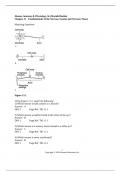
Figure 11.1
Using Figure 11.1, match the following:
1) Which neuron would connect to a muscle?
Answer: A
Diff: 1 Page Ref: Tbl. 11.1
2) Which neuron would be found in the retina of the eye?
Answer: B
Diff: 1 Page Ref: Tbl. 11.1
3) Which neuron is a sensory neuron found in a reflex arc?
Answer: C
Diff: 1 Page Ref: Tbl. 11.1
4) Which neuron is never myelinated?
Answer: B
Diff: 1 Page Ref: Tbl. 11.1
1
Copyright © 2010 Pearson Education, Inc.
,5) Which neuron is rare?
Answer: B
Diff: 1 Page Ref: 393; Tbl. 11.1
6) In a reflex arc, which neuron has its cell body inside the spinal cord?
Answer: A
Diff: 1 Page Ref: 394; Tbl. 11.1
7) Which neuron is common only in dorsal root ganglia of the spinal cord and sensory ganglia of
cranial nerves?
Answer: C
Diff: 1 Page Ref: 394; Tbl. 11.1
8) Which is by far the most common neuron type?
Answer: A
Diff: 1 Page Ref: 394; Tbl. 11.1
Figure 11.2
Using Figure 11.2, match the following:
9) Ion channel.
Answer: E
Diff: 1 Page Ref: 409; Fig. 11.17
2
Copyright © 2010 Pearson Education, Inc.
, 10) Synaptic vesicles.
Answer: C
Diff: 1 Page Ref: 409; Fig. 11.17
11) Calcium ions.
Answer: A
Diff: 3 Page Ref: 409; Fig. 11.17
12) Postsynaptic membrane.
Answer: B
Diff: 1 Page Ref: 409; Fig. 11.17
13) Synaptic cleft.
Answer: D
Diff: 1 Page Ref: 409; Fig. 11.17
Match the following:
A) Action potential
B) Depolarization
C) Absolute refractory period
D) Relative refractory period
E) Repolarization
14) The neuron cannot respond to a second stimulus, no matter how strong.
Diff: 1 Page Ref: 404
15) The interior of the cell becomes less negative due to an influx of sodium ions.
Diff: 1 Page Ref: 398
16) The specific period during which potassium ions diffuse out of the neuron due to a change in
membrane permeability.
Diff: 1 Page Ref: 402
17) Also called a nerve impulse transmitted by axons.
Diff: 1 Page Ref: 399
18) An exceptionally strong stimulus can trigger a response.
Diff: 1 Page Ref: 404
Answers: 14) C 15) B 16) E 17) A 18) D
3
Copyright © 2010 Pearson Education, Inc.
Chapter 11 Fundamentals of the Nervous System and Nervous Tissue
Matching Questions
Figure 11.1
Using Figure 11.1, match the following:
1) Which neuron would connect to a muscle?
Answer: A
Diff: 1 Page Ref: Tbl. 11.1
2) Which neuron would be found in the retina of the eye?
Answer: B
Diff: 1 Page Ref: Tbl. 11.1
3) Which neuron is a sensory neuron found in a reflex arc?
Answer: C
Diff: 1 Page Ref: Tbl. 11.1
4) Which neuron is never myelinated?
Answer: B
Diff: 1 Page Ref: Tbl. 11.1
1
Copyright © 2010 Pearson Education, Inc.
,5) Which neuron is rare?
Answer: B
Diff: 1 Page Ref: 393; Tbl. 11.1
6) In a reflex arc, which neuron has its cell body inside the spinal cord?
Answer: A
Diff: 1 Page Ref: 394; Tbl. 11.1
7) Which neuron is common only in dorsal root ganglia of the spinal cord and sensory ganglia of
cranial nerves?
Answer: C
Diff: 1 Page Ref: 394; Tbl. 11.1
8) Which is by far the most common neuron type?
Answer: A
Diff: 1 Page Ref: 394; Tbl. 11.1
Figure 11.2
Using Figure 11.2, match the following:
9) Ion channel.
Answer: E
Diff: 1 Page Ref: 409; Fig. 11.17
2
Copyright © 2010 Pearson Education, Inc.
, 10) Synaptic vesicles.
Answer: C
Diff: 1 Page Ref: 409; Fig. 11.17
11) Calcium ions.
Answer: A
Diff: 3 Page Ref: 409; Fig. 11.17
12) Postsynaptic membrane.
Answer: B
Diff: 1 Page Ref: 409; Fig. 11.17
13) Synaptic cleft.
Answer: D
Diff: 1 Page Ref: 409; Fig. 11.17
Match the following:
A) Action potential
B) Depolarization
C) Absolute refractory period
D) Relative refractory period
E) Repolarization
14) The neuron cannot respond to a second stimulus, no matter how strong.
Diff: 1 Page Ref: 404
15) The interior of the cell becomes less negative due to an influx of sodium ions.
Diff: 1 Page Ref: 398
16) The specific period during which potassium ions diffuse out of the neuron due to a change in
membrane permeability.
Diff: 1 Page Ref: 402
17) Also called a nerve impulse transmitted by axons.
Diff: 1 Page Ref: 399
18) An exceptionally strong stimulus can trigger a response.
Diff: 1 Page Ref: 404
Answers: 14) C 15) B 16) E 17) A 18) D
3
Copyright © 2010 Pearson Education, Inc.