Human Anatomy & Physiology, 8e (Marieb/Hoehn)
Chapter 5 The Integumentary System
Matching Questions
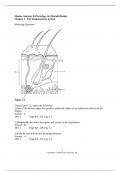
Figure 5.1
Using Figure 5.1, match the following:
1) Site of the dermal ridges that produce epidermal ridges on the epidermal surfaces of the
fingers.
Answer: E
Diff: 1 Page Ref: 152; Fig. 5.1
2) Responsible for shock absorption and located in the hypodermis.
Answer: B
Diff: 1 Page Ref: 149; Fig. 5.1
3) Pulls the hair follicle into an upright position.
Answer: A
Diff: 1 Page Ref: 157; Fig. 5.1
1
Copyright © 2010 Pearson Education, Inc.
,4) Sudoriferous gland.
Answer: C
Diff: 1 Page Ref: 155; Fig. 5.1
5) Dense irregular connective tissue.
Answer: D
Diff: 1 Page Ref: 152; Fig. 5.1
6) Region that thickens markedly when one gains weight.
Answer: B
Diff: 1 Page Ref: 149: Fig. 5.1
7) Pain receptors are found here.
Answer: E
Diff: 1 Page Ref: 152; Fig. 5.1
Match the following:
A) Keratin
B) Merkel disc
C) Cornified keratinocytes
D) Keratinocytes
E) Epidermal dendritic cells
8) The most abundant cells of the epidermis.
Diff: 1 Page Ref: 150
9) The protein found in the epidermis that is responsible for toughening the skin.
Diff: 1 Page Ref: 150, 152
10) Cells plus a disc-like sensory nerve ending that functions as a sensory receptor for touch.
Diff: 1 Page Ref: 150
11) Skin macrophages that help activate the immune system.
Diff: 1 Page Ref: 150
12) Cell remnants of the stratum corneum.
Diff: 1 Page Ref: 150, 152
Answers: 8) D 9) A 10) B 11) E 12) C
Match the following:
A) Stratum basale
B) Sudoriferous glands
C) Stratum corneum
D) Vellus
2
Copyright © 2010 Pearson Education, Inc.
, 13) The layer of the epidermis where the cells are considered protective but nonviable.
Diff: 1 Page Ref: 152
14) The glands that serve an important function in thermoregulation.
Diff: 1 Page Ref: 155
15) The layer that contains the mitotic viable cells of the epidermis.
Diff: 2 Page Ref: 150
16) Hair that lacks pigment and is often called "immature hair."
Diff: 1 Page Ref: 159
Answers: 13) C 14) B 15) A 16) D
Match the following:
A) Erythemia
B) Jaundice
C) Addison’s disease
D) Pallor
E) Cyanosis
17) May indicate embarrassment, fever, hypertension, inflammation, or allergy.
Diff: 2 Page Ref: 155
18) May indicate fear, anger, anemia, or low blood pressure.
Diff: 2 Page Ref: 155
19) Usually indicates a liver disorder.
Diff: 2 Page Ref: 155
20) Appearance of a permanent tan; bronzing.
Diff: 2 Page Ref: 155
21) A bluish color in light-skinned individuals.
Diff: 2 Page Ref: 155
Answers: 17) A 18) D 19) B 20) C 21) E
True/False Questions
1) The apocrine sweat glands are fairly unimportant in thermoregulation.
Answer: TRUE
Diff: 3 Page Ref: 156
3
Copyright © 2010 Pearson Education, Inc.
Chapter 5 The Integumentary System
Matching Questions
Figure 5.1
Using Figure 5.1, match the following:
1) Site of the dermal ridges that produce epidermal ridges on the epidermal surfaces of the
fingers.
Answer: E
Diff: 1 Page Ref: 152; Fig. 5.1
2) Responsible for shock absorption and located in the hypodermis.
Answer: B
Diff: 1 Page Ref: 149; Fig. 5.1
3) Pulls the hair follicle into an upright position.
Answer: A
Diff: 1 Page Ref: 157; Fig. 5.1
1
Copyright © 2010 Pearson Education, Inc.
,4) Sudoriferous gland.
Answer: C
Diff: 1 Page Ref: 155; Fig. 5.1
5) Dense irregular connective tissue.
Answer: D
Diff: 1 Page Ref: 152; Fig. 5.1
6) Region that thickens markedly when one gains weight.
Answer: B
Diff: 1 Page Ref: 149: Fig. 5.1
7) Pain receptors are found here.
Answer: E
Diff: 1 Page Ref: 152; Fig. 5.1
Match the following:
A) Keratin
B) Merkel disc
C) Cornified keratinocytes
D) Keratinocytes
E) Epidermal dendritic cells
8) The most abundant cells of the epidermis.
Diff: 1 Page Ref: 150
9) The protein found in the epidermis that is responsible for toughening the skin.
Diff: 1 Page Ref: 150, 152
10) Cells plus a disc-like sensory nerve ending that functions as a sensory receptor for touch.
Diff: 1 Page Ref: 150
11) Skin macrophages that help activate the immune system.
Diff: 1 Page Ref: 150
12) Cell remnants of the stratum corneum.
Diff: 1 Page Ref: 150, 152
Answers: 8) D 9) A 10) B 11) E 12) C
Match the following:
A) Stratum basale
B) Sudoriferous glands
C) Stratum corneum
D) Vellus
2
Copyright © 2010 Pearson Education, Inc.
, 13) The layer of the epidermis where the cells are considered protective but nonviable.
Diff: 1 Page Ref: 152
14) The glands that serve an important function in thermoregulation.
Diff: 1 Page Ref: 155
15) The layer that contains the mitotic viable cells of the epidermis.
Diff: 2 Page Ref: 150
16) Hair that lacks pigment and is often called "immature hair."
Diff: 1 Page Ref: 159
Answers: 13) C 14) B 15) A 16) D
Match the following:
A) Erythemia
B) Jaundice
C) Addison’s disease
D) Pallor
E) Cyanosis
17) May indicate embarrassment, fever, hypertension, inflammation, or allergy.
Diff: 2 Page Ref: 155
18) May indicate fear, anger, anemia, or low blood pressure.
Diff: 2 Page Ref: 155
19) Usually indicates a liver disorder.
Diff: 2 Page Ref: 155
20) Appearance of a permanent tan; bronzing.
Diff: 2 Page Ref: 155
21) A bluish color in light-skinned individuals.
Diff: 2 Page Ref: 155
Answers: 17) A 18) D 19) B 20) C 21) E
True/False Questions
1) The apocrine sweat glands are fairly unimportant in thermoregulation.
Answer: TRUE
Diff: 3 Page Ref: 156
3
Copyright © 2010 Pearson Education, Inc.