CHAPTER 18 - Endocrine System
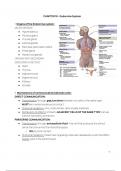
1. Organs of the Endocrine system:
MAJOR ORGANS
● Hypothalamus
● Pituitary gland
● Thyroid gland
● Adrenal glands
● Pancreas (pancreatic Islets)
● Pineal gland
● Parathyroid glands
ORGANS WITH SECONDARY
ENDOCRINE FUNCTION
● Heart
● Thymus
● Adipose tissue
● Digestive tract
● Kidneys
● Gonads
2. Mechanisms of communication between cells:
DIRECT COMMUNICATION
● Transmission: through gap junctions between two cells of the same type -
MUST be in extensive physical contact
● Chemical mediators: ions, small solutes, lipid-soluble materials
● Distribution of eects: limited to ADJACENT CELLS OF THE SAME TYPE that are
interconnected by connexons
PARACRINE COMMUNICATION
● Transmission: through extracellular fluid - the cell that produces the stimuli
sends the stimuli into the interstitial space
○ NO physical contact
● Chemical mediators: Paracrines (signaling molecules released by a cell that aect
nearby cells in the same tissue)
1
, ● Distribution of eects: limited to a LOCAL AREA - target cells MUST have
appropriate receptors
AUTOCRINE COMMUNICATION
● Transmission: Through extracellular fluid - the stimulating cell releases the stimuli
into interstitial space, and the SAME CELL RESPONDS to the stimulus
● Chemical mediators: Autocrines (signaling molecules released by a cell that act
on the same cell that produced them [auto- : self, same] )
● Distribution of eects: Limited to the cell that SECRETES THE HORMONE
○ EX Prostaglandins secreted by smooth muscle cells in the same cells to
contract
ENDOCRINE
COMMUNICATION
● Transmission: Through
the bloodstream
(Endocrine glands
release hormones into
the bloodstream - the
hormones travel through
the blood to reach
DISTANT target
cells/organs/tissues)
● Chemical mediators:
Hormones - Chemical messengers that regulate various physiological processes
in the body
● Distribution of eects: Target cells are primarily in other tissues and organs and
must have APPROPRIATE RECEPTORS
○ Alters the metabolic activities of many organs
SYNAPTIC COMMUNICATION
● Transmission: Across synapses (a junction between two nerve cells)
● Chemical mediators: Neurotransmiers - Chemical messengers that transmit
signals across a synapse from one neuron to another neuron, muscle cell, or
gland cell.
○ EX of Neurotransmiers: Serotonin, Dopamine, Acetylcholine ACh)
2
, ● Distribution of eects: Limited to very SPECIFIC AREA; target cells MUST have
APPROPRIATE RECEPTORS
○ Synaptic communication leads to Action Potentials (propagated along
axons) and allows for high-speed “messages” (neurotransmiers) to
reach specific destinations.
○ Ideal for crisis management
3. Setup of endocrine communication:
● SIGNALING CELLS the signalling cells are the Endocrine Glands
○ Pituitary Gland, Hypothalamus, Thyroid Gland, Adrenal Glands (Medulla &
Cortex), Pancreas (Pancreatic Islets), Pineal Gland, and the Parathyroid
Gland
● HORMONES Stimulate the synthesis of enzymes or structural proteins by
activating appropriate genes in the nucleus
○ Can INCREASE or DECREASE the rate of synthesis by changing the rate
of transcription or translation
○ Turn existing enzyme or membrane channels “on” or “o” by changing
the shape or structure
● TARGET CELLS Cells that have specific receptors for particular hormones.
○ Have RECEPTORS needed to bind (detect) and “read” hormonal
messages
■ Receptors are the MOST IMPORTANT - can have two dierent
eects from the same stimulus because the target cells and
receptors are dierent.
4. Types of hormones:
● Amino acid derivatives
● Peptide hormones
● Lipid derivatives
AMINO ACID DERIVATIVES
● Small molecules that are structurally related to amino acids
○ DERIVATIVES OF TYROSINE
■ Thyroid hormones - Thyroxine (T4 , Triiodothyronine (T3
3
1. Organs of the Endocrine system:
MAJOR ORGANS
● Hypothalamus
● Pituitary gland
● Thyroid gland
● Adrenal glands
● Pancreas (pancreatic Islets)
● Pineal gland
● Parathyroid glands
ORGANS WITH SECONDARY
ENDOCRINE FUNCTION
● Heart
● Thymus
● Adipose tissue
● Digestive tract
● Kidneys
● Gonads
2. Mechanisms of communication between cells:
DIRECT COMMUNICATION
● Transmission: through gap junctions between two cells of the same type -
MUST be in extensive physical contact
● Chemical mediators: ions, small solutes, lipid-soluble materials
● Distribution of eects: limited to ADJACENT CELLS OF THE SAME TYPE that are
interconnected by connexons
PARACRINE COMMUNICATION
● Transmission: through extracellular fluid - the cell that produces the stimuli
sends the stimuli into the interstitial space
○ NO physical contact
● Chemical mediators: Paracrines (signaling molecules released by a cell that aect
nearby cells in the same tissue)
1
, ● Distribution of eects: limited to a LOCAL AREA - target cells MUST have
appropriate receptors
AUTOCRINE COMMUNICATION
● Transmission: Through extracellular fluid - the stimulating cell releases the stimuli
into interstitial space, and the SAME CELL RESPONDS to the stimulus
● Chemical mediators: Autocrines (signaling molecules released by a cell that act
on the same cell that produced them [auto- : self, same] )
● Distribution of eects: Limited to the cell that SECRETES THE HORMONE
○ EX Prostaglandins secreted by smooth muscle cells in the same cells to
contract
ENDOCRINE
COMMUNICATION
● Transmission: Through
the bloodstream
(Endocrine glands
release hormones into
the bloodstream - the
hormones travel through
the blood to reach
DISTANT target
cells/organs/tissues)
● Chemical mediators:
Hormones - Chemical messengers that regulate various physiological processes
in the body
● Distribution of eects: Target cells are primarily in other tissues and organs and
must have APPROPRIATE RECEPTORS
○ Alters the metabolic activities of many organs
SYNAPTIC COMMUNICATION
● Transmission: Across synapses (a junction between two nerve cells)
● Chemical mediators: Neurotransmiers - Chemical messengers that transmit
signals across a synapse from one neuron to another neuron, muscle cell, or
gland cell.
○ EX of Neurotransmiers: Serotonin, Dopamine, Acetylcholine ACh)
2
, ● Distribution of eects: Limited to very SPECIFIC AREA; target cells MUST have
APPROPRIATE RECEPTORS
○ Synaptic communication leads to Action Potentials (propagated along
axons) and allows for high-speed “messages” (neurotransmiers) to
reach specific destinations.
○ Ideal for crisis management
3. Setup of endocrine communication:
● SIGNALING CELLS the signalling cells are the Endocrine Glands
○ Pituitary Gland, Hypothalamus, Thyroid Gland, Adrenal Glands (Medulla &
Cortex), Pancreas (Pancreatic Islets), Pineal Gland, and the Parathyroid
Gland
● HORMONES Stimulate the synthesis of enzymes or structural proteins by
activating appropriate genes in the nucleus
○ Can INCREASE or DECREASE the rate of synthesis by changing the rate
of transcription or translation
○ Turn existing enzyme or membrane channels “on” or “o” by changing
the shape or structure
● TARGET CELLS Cells that have specific receptors for particular hormones.
○ Have RECEPTORS needed to bind (detect) and “read” hormonal
messages
■ Receptors are the MOST IMPORTANT - can have two dierent
eects from the same stimulus because the target cells and
receptors are dierent.
4. Types of hormones:
● Amino acid derivatives
● Peptide hormones
● Lipid derivatives
AMINO ACID DERIVATIVES
● Small molecules that are structurally related to amino acids
○ DERIVATIVES OF TYROSINE
■ Thyroid hormones - Thyroxine (T4 , Triiodothyronine (T3
3