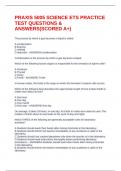
PRAXIS 5005 SCIENCE ETS PRACTICE
TEST QUESTIONS &
ANSWERS(SCORED A+)
The process by which a gas becomes a liquid is called
A.condensation
B.freezing
C.melting
D.reduction - ANSWERA.condensation
Condensation is the process by which a gas becomes a liquid.
Which of the following human organs is responsible for the formation of sperm cells?
A.Pancreas
B.Thyroid
C.Ovary
D.Testis - ANSWERD.Testis
In human males, the testis is the organ in which the formation of sperm cells occurs.
Which of the following best describes the approximate length of time it takes Earth to
rotate once about its axis?
A.One hour
B.One day
C.One month
D.One year - ANSWERB.One day
On average, it takes 24 hours, or one day, for Earth to rotate once about its axis. The
rotation of Earth about its axis leads to the cycle of day and night.
Which THREE of the following are generally acceptable rules for laboratory
activities?
A.Students should wash their hands after mixing chemicals in the laboratory.
B.Students should inform the teacher immediately of any accidents or spills in the
laboratory.
C.Students should use cracked glassware only when the teacher is in the laboratory.
D.Students should read instructions thoroughly before performing laboratory
procedures. - ANSWERA.Students should wash their hands after mixing chemicals
in the laboratory.
B.Students should inform the teacher immediately of any accidents or spills in the
laboratory.
,D.Students should read instructions thoroughly before performing laboratory
procedures
To prevent accidental ingestion or absorption of potentially harmful substances,
students should wash their hands after working with chemicals. To help maintain a
safe environment, accidents and spills in the laboratory should be reported to the
teacher immediately so that a correct response can be implemented. To safely and
effectively complete laboratory procedures, students should read instructions
thoroughly before starting the procedures. Cracked glassware is a safety hazard and
should never be used.
Which of the following processes most directly involves the movement of water from
the atmosphere to Earth's surface?
A.Infiltration
B.Precipitation
C.Transpiration
D.Sublimation - ANSWERB.Precipitation
Precipitation is the process by which atmospheric water falls to Earth's surface in the
form of rain, hail, sleet, or snow. Because atmospheric water returns to Earth's
surface primarily through the process of precipitation, it is an important part of the
water cycle. Infiltration is the process by which water on Earth's surface enters the
subsurface soil and rock. Transpiration is the process by which water evaporates
from plant leaves and enters the atmosphere. Sublimation is the process by which a
substance transitions directly from the solid phase to the gas phase without going
through the liquid phase.
Which of the following is an important function of the digestive system?
A.Absorbing nutrients into the body
B.Transporting signals to and from different parts of the body
C.Providing structural support for the body
D.Protecting the body from ultraviolet radiation - ANSWERA.Absorbing nutrients into
the body
The digestive system includes organs that break down food into small molecules,
which are then absorbed into the body. The primary location of absorption is the
small intestine.
As a rock begins tumbling down a hillside, most of its gravitational potential energy is
converted into
A.kinetic energy
B.thermal energy
C.chemical energy
D.nuclear energy - ANSWERA.kinetic energy
, Kinetic energy is the energy of motion. As the rock begins moving down the hillside
under the influence of gravity, most of the rock's gravitational potential energy is
converted into kinetic energy.
Which of the following is the best example of an interaction between different biotic
factors in an ecosystem?
A.A caterpillar undergoing metamorphosis
B.A plant absorbing sunlight
C.A grazing animal eating plants
D.An icicle melting on a warm day - ANSWERC.A grazing animal eating plants
A grazing animal eating plants is an example of an interaction between two different
biotic factors (an animal and the plants it eats) in an ecosystem. The metamorphosis
of a caterpillar into a butterfly is an example of a type of insect life cycle. A plant
absorbing sunlight is an example of an interaction between a biotic factor (a plant)
and an abiotic factor (sunlight). An icicle melting on a warm day is an example of an
interaction between two abiotic factors (water and temperature).
A neutral atom becomes a positive ion when it loses one or more
A.electrons
B.neutrons
C.protons
D.nuclei - ANSWERA.electrons
Protons are positively charged, and electrons are negatively charged. A neutral atom
has the same number of protons and electrons. A neutral atom becomes a positive
ion when it loses one or more electrons, resulting in the ion having more positive
charges than negative charges.
Which of the following best describes a galaxy?
A.A small celestial body composed of ice
B.A giant planet orbited by ten or more moons
C.A collection of planets revolving around a star
D.A large cluster of stars, dust, and gas - ANSWERD.A large cluster of stars, dust,
and gas
A galaxy is a system composed of many stars, dust, and gas, which is held together
by gravitational attraction.
An object is moving in a straight line at a constant speed. What will happen if a
constant force is then applied to the object in the same direction in which the object
is moving?
A.The object will stop moving.
B.The object will continue moving in the same direction but will slow down.
C.The object will continue moving in the same direction but will speed up.
TEST QUESTIONS &
ANSWERS(SCORED A+)
The process by which a gas becomes a liquid is called
A.condensation
B.freezing
C.melting
D.reduction - ANSWERA.condensation
Condensation is the process by which a gas becomes a liquid.
Which of the following human organs is responsible for the formation of sperm cells?
A.Pancreas
B.Thyroid
C.Ovary
D.Testis - ANSWERD.Testis
In human males, the testis is the organ in which the formation of sperm cells occurs.
Which of the following best describes the approximate length of time it takes Earth to
rotate once about its axis?
A.One hour
B.One day
C.One month
D.One year - ANSWERB.One day
On average, it takes 24 hours, or one day, for Earth to rotate once about its axis. The
rotation of Earth about its axis leads to the cycle of day and night.
Which THREE of the following are generally acceptable rules for laboratory
activities?
A.Students should wash their hands after mixing chemicals in the laboratory.
B.Students should inform the teacher immediately of any accidents or spills in the
laboratory.
C.Students should use cracked glassware only when the teacher is in the laboratory.
D.Students should read instructions thoroughly before performing laboratory
procedures. - ANSWERA.Students should wash their hands after mixing chemicals
in the laboratory.
B.Students should inform the teacher immediately of any accidents or spills in the
laboratory.
,D.Students should read instructions thoroughly before performing laboratory
procedures
To prevent accidental ingestion or absorption of potentially harmful substances,
students should wash their hands after working with chemicals. To help maintain a
safe environment, accidents and spills in the laboratory should be reported to the
teacher immediately so that a correct response can be implemented. To safely and
effectively complete laboratory procedures, students should read instructions
thoroughly before starting the procedures. Cracked glassware is a safety hazard and
should never be used.
Which of the following processes most directly involves the movement of water from
the atmosphere to Earth's surface?
A.Infiltration
B.Precipitation
C.Transpiration
D.Sublimation - ANSWERB.Precipitation
Precipitation is the process by which atmospheric water falls to Earth's surface in the
form of rain, hail, sleet, or snow. Because atmospheric water returns to Earth's
surface primarily through the process of precipitation, it is an important part of the
water cycle. Infiltration is the process by which water on Earth's surface enters the
subsurface soil and rock. Transpiration is the process by which water evaporates
from plant leaves and enters the atmosphere. Sublimation is the process by which a
substance transitions directly from the solid phase to the gas phase without going
through the liquid phase.
Which of the following is an important function of the digestive system?
A.Absorbing nutrients into the body
B.Transporting signals to and from different parts of the body
C.Providing structural support for the body
D.Protecting the body from ultraviolet radiation - ANSWERA.Absorbing nutrients into
the body
The digestive system includes organs that break down food into small molecules,
which are then absorbed into the body. The primary location of absorption is the
small intestine.
As a rock begins tumbling down a hillside, most of its gravitational potential energy is
converted into
A.kinetic energy
B.thermal energy
C.chemical energy
D.nuclear energy - ANSWERA.kinetic energy
, Kinetic energy is the energy of motion. As the rock begins moving down the hillside
under the influence of gravity, most of the rock's gravitational potential energy is
converted into kinetic energy.
Which of the following is the best example of an interaction between different biotic
factors in an ecosystem?
A.A caterpillar undergoing metamorphosis
B.A plant absorbing sunlight
C.A grazing animal eating plants
D.An icicle melting on a warm day - ANSWERC.A grazing animal eating plants
A grazing animal eating plants is an example of an interaction between two different
biotic factors (an animal and the plants it eats) in an ecosystem. The metamorphosis
of a caterpillar into a butterfly is an example of a type of insect life cycle. A plant
absorbing sunlight is an example of an interaction between a biotic factor (a plant)
and an abiotic factor (sunlight). An icicle melting on a warm day is an example of an
interaction between two abiotic factors (water and temperature).
A neutral atom becomes a positive ion when it loses one or more
A.electrons
B.neutrons
C.protons
D.nuclei - ANSWERA.electrons
Protons are positively charged, and electrons are negatively charged. A neutral atom
has the same number of protons and electrons. A neutral atom becomes a positive
ion when it loses one or more electrons, resulting in the ion having more positive
charges than negative charges.
Which of the following best describes a galaxy?
A.A small celestial body composed of ice
B.A giant planet orbited by ten or more moons
C.A collection of planets revolving around a star
D.A large cluster of stars, dust, and gas - ANSWERD.A large cluster of stars, dust,
and gas
A galaxy is a system composed of many stars, dust, and gas, which is held together
by gravitational attraction.
An object is moving in a straight line at a constant speed. What will happen if a
constant force is then applied to the object in the same direction in which the object
is moving?
A.The object will stop moving.
B.The object will continue moving in the same direction but will slow down.
C.The object will continue moving in the same direction but will speed up.