Exam 1 review
Chapter 2:
Atoms are the smallest unit of matter that retains all of the chemical properties
of an element.
The properties of an atom are determined by its atomic number, which is the
atom’s proton count.
The number of protons and neutron together make up atomic mass (electrons
are disregarded in mass)
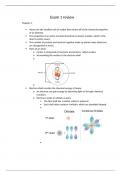
Parts of an atom:
o Center is composed of neutrons and protons, called nucleus
o Surrounding the nucleus is the electron shell
o
o
Electron shells contain the chemical energy of atoms
o An electron can gain energy by absorbing light or through chemical
reactions
o Electrons reside in orbitals as pairs
The first shell has 1 orbital, which is spherical
Each shell after contains 4 orbitals, which are dumbbell shaped
, o Valence shell is the outermost shell. The electrons in this layer are called
valence electrons
o “Noble gases” are elements whose valence shell is completely filled, they
are the rightmost column on the periodic table
All elements within a row has the same amount of electron shells.
Ions are atoms that become more stable by losing or gaining one or more
electrons.
o Cations are positively charged ions
o Anions are negative charged ions
o Ionic bonds form between opposite charged atoms
Covalent bonds are the bonds created when electrons are shared between
atoms
o Polar covalent bonds form from the unequal sharing of electrons
between atoms
Chemical bonded atoms become molecules
o Molecules with two or more elements are called compounds (ex: H2O)
The hybridization of orbitals happens when orbitals form covalent bonds and
form a tetrahedral shape.
o This gives water a bent shape, which leads to its polarity.
Polar and non-polar substances
o Polar substances that interact readily with or dissolves in water are
known as hydrophilic
o Non-polar substances that does not interact with water are called
hydrophobic
Hydrogen bonds
o Hydrogen bonding is the reason ice floats on water; hydrogen bonds
forming between water molecules in ice creates a crystal lattice structure
that keeps the atoms further apart
o Hydrogen bonds are created between electronegative atoms and
electropositive hydrogen bonds
Molecular shape
o
Chapter 2:
Atoms are the smallest unit of matter that retains all of the chemical properties
of an element.
The properties of an atom are determined by its atomic number, which is the
atom’s proton count.
The number of protons and neutron together make up atomic mass (electrons
are disregarded in mass)
Parts of an atom:
o Center is composed of neutrons and protons, called nucleus
o Surrounding the nucleus is the electron shell
o
o
Electron shells contain the chemical energy of atoms
o An electron can gain energy by absorbing light or through chemical
reactions
o Electrons reside in orbitals as pairs
The first shell has 1 orbital, which is spherical
Each shell after contains 4 orbitals, which are dumbbell shaped
, o Valence shell is the outermost shell. The electrons in this layer are called
valence electrons
o “Noble gases” are elements whose valence shell is completely filled, they
are the rightmost column on the periodic table
All elements within a row has the same amount of electron shells.
Ions are atoms that become more stable by losing or gaining one or more
electrons.
o Cations are positively charged ions
o Anions are negative charged ions
o Ionic bonds form between opposite charged atoms
Covalent bonds are the bonds created when electrons are shared between
atoms
o Polar covalent bonds form from the unequal sharing of electrons
between atoms
Chemical bonded atoms become molecules
o Molecules with two or more elements are called compounds (ex: H2O)
The hybridization of orbitals happens when orbitals form covalent bonds and
form a tetrahedral shape.
o This gives water a bent shape, which leads to its polarity.
Polar and non-polar substances
o Polar substances that interact readily with or dissolves in water are
known as hydrophilic
o Non-polar substances that does not interact with water are called
hydrophobic
Hydrogen bonds
o Hydrogen bonding is the reason ice floats on water; hydrogen bonds
forming between water molecules in ice creates a crystal lattice structure
that keeps the atoms further apart
o Hydrogen bonds are created between electronegative atoms and
electropositive hydrogen bonds
Molecular shape
o