NSG 5003 MID TERM FINAL EXAM
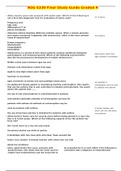
Question : What two types of hearing loss are associated with noise? Student Answer: Acoustic trauma and noise induced High frequency and low frequency High frequency and acoustic trauma Noise induced and low frequency Instructor Explanation: Two types of hearing loss are associated with noise: (1) acoustic trauma or instantaneous damage caused by a single sharply rising wave of sound (e.g., gunfire), and (2) noise-induced hearing loss, the more common type, which is the result of prolonged exposure to intense sound (e.g., noise associated with the workplace and leisure-time activities). The remaining options are not related to noise but rather to the amplitude of the sound. Question 7 . Question : A hypersensitivity reaction that produces an allergic response is called: Student Answer: Hemolytic shock Anaphylaxis Necrotizing vasculitis Systemic erythematosus Instructor Explanation: Examples of systemic anaphylaxis are allergic reactions to beestings, peanuts, and fish. The other options are not accurate examples of hypersensitivity. Question 8 . Question : Which cytokine is produced and released from virally infected host cells? Student Answer: IL-1 IL-10 Tumor necrosis factor–alpha (TNF-α) Interferon-alpha (IFN-α) Instructor Explanation: Only interferons are produced and released by virally infected cells in response to viral double-stranded ribonucleic acid (RNA). IFN-α and IFN-β induce the production of antiviral proteins, thereby conferring protection on uninfected cells. IFN-α or IFN-β is released from virally infected cells and attaches to a receptor on a neighboring cell. IFNs also enhance the efficiency of developing an acquired immune response. Question 10 . Question : Which T-lymphocyte phenotype is the key determinant of childhood asthma? Student Answer: CD4 helper T 1 (Th1) lymphocytes CD4 helper T 2 (Th2) lymphocytes CD8 cytotoxic T (Tc) lymphocytes Memory T lymphocytes Instructor Explanation: Asthma develops because the Th2 response (in which CD4 helper T cells produce specific cytokines, such as IL-4, IL-5, and IL-13) promotes an atopic and allergic response in the airways. This selection is the only option that accurately identifies the appropriate T-lymphocyte phenotype. Question 12 . Question : Some older adults have impaired inflammation and wound healing because of which problem? Student Answer: The circulatory system cannot adequately perfuse tissues. Complement and chemotaxis are deficient. Underlying chronic illnesses exist. The number of mast cells is insufficient. Instructor Explanation: In some cases, impaired healing is not directly associated with aging, in general, but can instead be linked to a chronic illness such as cardiovascular disease or diabetes mellitus. The other problems are not related to the aging process. Question 13 . Question : The role of cytokines in cell reproduction is that they: Student Answer: Provide growth factor for tissue growth and development. Block the progress of cell reproduction through the cell cycle. Restrain cell growth and development. Provide nutrients for cell growth and development. Instructor Explanation: Growth factors, also called cytokines, are peptides that transmit signals within and among cells. They have a major role in the regulation of tissue growth and development. The remaining options do not correctly describe the role of cytokines in cell reproduction. Question 15 . Question : Which characteristic is the most important determinant of immunogenicity when considering the antigen? Student Answer: Size Foreignness Complexity Quantity Instructor Explanation: Foremost among the criteria for immunogenicity is the antigen’s foreignness. A self- antigen that fulfills all of these criteria except foreignness does not normally elicit an immune response. Thus most individuals are tolerant of their own antigens. The immune system has an exquisite ability to distinguish self (self-antigens) from nonself (foreign antigens). The other options are considered when determining immunogenicity. Question 16 . Question : How do cells receive communication from the extracellular fluid surrounding them? Student Answer: Through the protein channel (gap junction) Via the plasma membrane–bound signaling molecules (involving receptors) Through hormone secretion such as neurotransmitters By chemical messengers such as ligands Instructor Explanation: Cellular communication can occur by the binding of a chemical massager (a ligand) to a specific membrane receptor that is closely associated with the channel (e.g., G proteins). The other options do not correctly describe how cells communicate. Question 17 . Question : In a normal, nonmutant state, an oncogene is referred to as a: Student Answer: Basal cell Target cell Caretaker gene Proto-oncogene Instructor Explanation: In its normal nonmutant state, an oncogene is referred to as a proto-oncogene. The other options are not terms used to identify a nonmutant oncogene. Question 19 . Question : What is the primary cause of respiratory distress syndrome (RDS) of the newborn? Student Answer: Immature immune system Small alveoli Surfactant deficiency Anemia Instructor Explanation: RDS is primarily caused by surfactant deficiency and secondarily by a deficiency in alveolar surface area for gas exchange. None of the other options are related to the cause of RDS. Question 20 . Question : Which mode of chemical signaling uses blood to transport communication to cells some distance away? Student Answer: Paracrine Autocrine Neurotransmitter Hormonal Instructor Explanation: Chemical signaling can be classified into three categories: (1) local-chemical mediator, (2) hormone, and (3) neurotransmitter. In the local-chemical mediator model, the secreted chemical acts on the cells in the immediate environment. Hormones are used for communication with distant target cells. For example, cells can secrete a chemical and rely on the blood system to deliver the signal to a distant cell. Finally, neurotransmitters are secreted by neurons to stimulate an adjoining cell. For example, a neuron might secrete acetylcholine to stimulate the movement of a muscle cell. Question 22 . Question : Which component of the plasma protein system tags pathogenic microorganisms for destruction by neutrophils and macrophages? Student Answer: Complement cascade Coagulation system Kinin system Immune system Instructor Explanation: C3b (a component of the complement cascade) adheres to the surface of a pathogenic microorganism and serves as an efficient opsonin. Opsonins are molecules that tag microorganisms for destruction by cells of the inflammatory system, primarily neutrophils and macrophages. The other options do not accurately identify a component capable of tagging pathogenic microorganisms. Question 23 . Question : In a type III hypersensitivity reaction, the harmful effects after the immune complexes are deposited in tissues are a result of: Student Answer: Cytotoxic T (Tc) cells Natural killer (NK) cells Complement activation Degranulation of mast cells Instructor Explanation: Complement activation, particularly through the generation of chemotactic factors for neutrophils, causes the harmful effects of immune complex deposition. The neutrophils bind to antibody and C3b contained in the complexes and attempt to ingest the immune complexes. Type III hypersensitivity reactions as described are not the result of any of the other options. Question 24 . Question : Which statement about exotoxins is true? Student Answer: Exotoxins are contained in cell walls of gram-negative bacteria. Exotoxins are released during the lysis of bacteria. Exotoxins are able to initiate the complement and coagulation cascades. Exotoxins are released during bacterial growth. Instructor Explanation: Exotoxins are proteins released during bacterial growth. The other options are not true of exotoxins. Question 25 . Question : Which intracardiac pressure is generated by atrial contraction? Student Answer: A wave C wave Y descent X descent Instructor Explanation: Atrial pressure curves are made up of only the A wave, which is generated by atrial contraction. Question 28 . Question : Research supports the premise that exercise has a probable impact on reducing the risk of: Student Answer: Liver cancer Endometrial cancer Stomach cancer Colon cancer Instructor Explanation: The World Cancer Research Fund summarizes the effects as convincing for cancers of the colon and probable for postmenopausal breast cancer and endometrial cancer. The relationship is not supported for the remaining options. Question 33 . Question : Increased capillary hydrostatic pressure results in edema because of: Student Answer: Losses or diminished production of plasma albumin Inflammation resulting from an immune response Blockage within the lymphatic channel system Sodium and water retention Instructor Explanation: Increased capillary hydrostatic pressure can result from venous obstruction or sodium and water retention. The other options do not accurately describe the cause of edema related to increased capillary hydrostatic pressure.
Written for
- Institution
-
Chamberlain College Of Nursng
- Course
-
NSG 5003
Document information
- Uploaded on
- April 2, 2025
- Number of pages
- 15
- Written in
- 2024/2025
- Type
- Exam (elaborations)
- Contains
- Questions & answers
Subjects
- nsg 5003
- nsg 5003 mid term
-
nsg 5003 mid term final exam