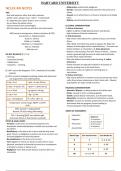
HARVARD UNIVERSITY
- Malpractice: professional negligence.
NCLEX-RN NOTES - Slander: character attacked and uttered in the presence of
TIPS: others.
- Deal with patients rather than with machines. - Assault: act in which there is a threat or attempt to do bodily
- AVOID: never, always, must, “why?”, “I understand”. harm.
- If 2 opposites (e.g. hyper-/hypo-), one is correct. - Battery: unauthorized physical contact.
- Do not leave the patient alone.
- Choose physical over psychological. CULTURAL CONSIDERATIONS
- IDK the answer: pick the one with the most information. 1. African Americans
- Higher incidence of high blood pressure and obesity;
ABC (except in emergencies, distress situations & CPR) - High incidence of lactose intolerance.
Assessment vs. Implementation 2. Arab Americans
Acute vs. Chronic - May remain silent about STIs, substance abuse, and mental
Stable vs. Unstable illness;
Expected vs. Unexpected - After death, the family may want to prepare the body and
Real vs. Potential autopsy is discouraged unless required by law; - Use same-sex
Odd man out family members as interpreters. 3. Asian Americans
- Believe in the yin/yang “hot-cold” theory of illness; - Sodium
DO NOT DELEGATE (PACET): intake is generally high because of salted and dried foods;
- Planning; - Usually refuse organ donation;
- Assessment (initial); - May nod without necessarily understanding. 4. Latino
- Collaboration; Americans
- Evaluation; - Teaching. - Family members are typically involved in all aspects of
decision making such as terminal illness;
UAP’s cannot be delegated: “EAT”, medication & unstable - May see no reason to submit to mammograms or
patients. vaccinations.
5. Native Americans
LPN’s cannot be delegated anything related with blood and
- Diet may be deficient in vitamin D and calcium because many
are assigned the most stable patients.
suffer from lactose intolerance or don’t drink milk; - Obesity
1 tsp = 5 ml 1 pint = 2 cups (16 oz) and diabetes are major health concerns.
1 tbsp = 3 tsp (15 ml) 1 quart = 2 pints (32 oz)
RELIGIOUS CONSIDERATIONS
1 oz = 30 ml 1 gr (grain) = 60 mg - Jehovah’s Witness: no blood products should be used.
- Hindu: no beef or items containing gelatin.
1 cup = 8 oz 1 kg = 2,2 lbs
- Jewish: special dietary restrictions, use of kosher foods.
1 g = 1 ml (diapers) ºF = (ºC x 1,8) + 32 - Adventists: no pork nor alcohol and sometimes no meat. -
Muslims: no pork nor alcohol; people with chronic illnesses
Temperature normal range: 98,6ºF ±1 (37ºC and women that are pregnant, breast-feeding or
±0,5) menstruating don’t fast during Ramadan.
MAP: (systolic + 2xdyastolic)/3
Normal: 70-105 mmHg (>60 mmHg) ORDER OF ASSESSMENT:
CVP: 2-8 mmHg ( CVP can indicate right Inspection
Abdomen:
ventricular failure or fluid volume overload)
Palpation 1º Inspection
ETHICS & LEGAL ISSUES 2º Auscultation
- Veracity is truth and is an essential component of a Percussion 3º Percussion
therapeutic relationship between a health care provider and 4º Palpation
his patient. Auscultation
- Beneficence is the duty to do no harm and the duty to do
good. There’s an obligation in patient care to do no harm and
Blood Type Can receive from: Can donate to:
an equal obligation to assist the patient.
- Nonmaleficence is the duty to do no harm. O O O, A, B, AB
- Tort: litigation in which one person asserts that an injury
(physical, emotional or financial) occurred as a consequence A A, O A, AB
of another’s actions or failure to act.
- Negligence: harm that results because a person didn’t act B B, O B, AB
reasonably.
AB O, A, B, AB AB
, TRACTIONS CRANIAL NERVES (Sensory=S |Motor=M |Both=B)
- Buck’s traction: knee immobility Oh (Olfactory I) Some
- Russell traction: femur or lower leg - Dunlap traction: skeletal Oh (Optic II) Say
or skin Oh (Oculomotor III) Marry
- Bryant’s traction: children <3y, <35 lbs with femur fracture. To (Trochlear IV) Money
Touch (Trigeminal V) But
INFANT’S DEVELOPMENT: And (Abducens VI) My
2-3 months: turns head side to side Feel (Facial VII) Brother
4-5 months: grasps, switch & roll A (Auditory VIII) Says
6-7 months: sit at 6 and waves bye-bye Girls (Glossopharyngeal IX) Big
8-9 months: stands straight at eight Vagina (Vagus X) Bras
10-11 months: belly to butt (phrase has 10 letters) And (Accessory XI) Matter
12-13 months: twelve and up, drink from a cup Hymen (Hypoglossal XII) More
PPE (Personal Protective Equipment)
ERIKSON’S STAGES OF PSYCHOSOCIAL DEVELOPMENT
AGE STAGES CHARACTERISTICS Cranial nerve What it controls
Infancy (0- Trust vs. Development of trust I Olfactory Smell test
18m) Mistrust based on caregivers
II Optic Visual acuity and visual fields
Autonomy vs. Development of
Early childhood Pupil constriction and extraocular
Shame & sense of personal III Oculomotor
(18m-3yrs) movements
doubt control
Extraocular movements: inferior
Development of sense IV Trochlear
Preschool Initiative vs. adduction
of
(3-5yrs) Guilt
purpose and directive V Trigeminal Clench teeth and light touch
School age Industry vs. Development of pride Extraocular movements: lateral
VI Abducens
(611yrs) Inferiority in accomplishments abduction
Exploration of VII Facial Facial movement: close eyes, smile
Adolescence Identity vs.
independence and VIII Auditory Hearing and Romberg test
(12-18yrs) Role confusion
development of self
IX Glossopharyngeal Gag reflex
Early Development of
Intimacy vs. Say “ah” – uvular and palate
adulthood personal relationships X Vagus
Isolation movement
(1840yrs) and love
Fulfilling goals and Turn head and lift shoulders to
Adulthood Generativity XI Accessory
building career resistance
(4065yrs) vs. Stagnation
and family XII Hypoglossal Stick out tongue
Older adult Integrity vs. Looking back on life
(>65yrs) Despair with acceptance
BURNS
Parkland formula:
4ml/kg/%body burned
- 1st 8h: ½ total volume
- 2nd/ 8h: ¼ total volume
- 3rd 8h: ¼ total volume
- Malpractice: professional negligence.
NCLEX-RN NOTES - Slander: character attacked and uttered in the presence of
TIPS: others.
- Deal with patients rather than with machines. - Assault: act in which there is a threat or attempt to do bodily
- AVOID: never, always, must, “why?”, “I understand”. harm.
- If 2 opposites (e.g. hyper-/hypo-), one is correct. - Battery: unauthorized physical contact.
- Do not leave the patient alone.
- Choose physical over psychological. CULTURAL CONSIDERATIONS
- IDK the answer: pick the one with the most information. 1. African Americans
- Higher incidence of high blood pressure and obesity;
ABC (except in emergencies, distress situations & CPR) - High incidence of lactose intolerance.
Assessment vs. Implementation 2. Arab Americans
Acute vs. Chronic - May remain silent about STIs, substance abuse, and mental
Stable vs. Unstable illness;
Expected vs. Unexpected - After death, the family may want to prepare the body and
Real vs. Potential autopsy is discouraged unless required by law; - Use same-sex
Odd man out family members as interpreters. 3. Asian Americans
- Believe in the yin/yang “hot-cold” theory of illness; - Sodium
DO NOT DELEGATE (PACET): intake is generally high because of salted and dried foods;
- Planning; - Usually refuse organ donation;
- Assessment (initial); - May nod without necessarily understanding. 4. Latino
- Collaboration; Americans
- Evaluation; - Teaching. - Family members are typically involved in all aspects of
decision making such as terminal illness;
UAP’s cannot be delegated: “EAT”, medication & unstable - May see no reason to submit to mammograms or
patients. vaccinations.
5. Native Americans
LPN’s cannot be delegated anything related with blood and
- Diet may be deficient in vitamin D and calcium because many
are assigned the most stable patients.
suffer from lactose intolerance or don’t drink milk; - Obesity
1 tsp = 5 ml 1 pint = 2 cups (16 oz) and diabetes are major health concerns.
1 tbsp = 3 tsp (15 ml) 1 quart = 2 pints (32 oz)
RELIGIOUS CONSIDERATIONS
1 oz = 30 ml 1 gr (grain) = 60 mg - Jehovah’s Witness: no blood products should be used.
- Hindu: no beef or items containing gelatin.
1 cup = 8 oz 1 kg = 2,2 lbs
- Jewish: special dietary restrictions, use of kosher foods.
1 g = 1 ml (diapers) ºF = (ºC x 1,8) + 32 - Adventists: no pork nor alcohol and sometimes no meat. -
Muslims: no pork nor alcohol; people with chronic illnesses
Temperature normal range: 98,6ºF ±1 (37ºC and women that are pregnant, breast-feeding or
±0,5) menstruating don’t fast during Ramadan.
MAP: (systolic + 2xdyastolic)/3
Normal: 70-105 mmHg (>60 mmHg) ORDER OF ASSESSMENT:
CVP: 2-8 mmHg ( CVP can indicate right Inspection
Abdomen:
ventricular failure or fluid volume overload)
Palpation 1º Inspection
ETHICS & LEGAL ISSUES 2º Auscultation
- Veracity is truth and is an essential component of a Percussion 3º Percussion
therapeutic relationship between a health care provider and 4º Palpation
his patient. Auscultation
- Beneficence is the duty to do no harm and the duty to do
good. There’s an obligation in patient care to do no harm and
Blood Type Can receive from: Can donate to:
an equal obligation to assist the patient.
- Nonmaleficence is the duty to do no harm. O O O, A, B, AB
- Tort: litigation in which one person asserts that an injury
(physical, emotional or financial) occurred as a consequence A A, O A, AB
of another’s actions or failure to act.
- Negligence: harm that results because a person didn’t act B B, O B, AB
reasonably.
AB O, A, B, AB AB
, TRACTIONS CRANIAL NERVES (Sensory=S |Motor=M |Both=B)
- Buck’s traction: knee immobility Oh (Olfactory I) Some
- Russell traction: femur or lower leg - Dunlap traction: skeletal Oh (Optic II) Say
or skin Oh (Oculomotor III) Marry
- Bryant’s traction: children <3y, <35 lbs with femur fracture. To (Trochlear IV) Money
Touch (Trigeminal V) But
INFANT’S DEVELOPMENT: And (Abducens VI) My
2-3 months: turns head side to side Feel (Facial VII) Brother
4-5 months: grasps, switch & roll A (Auditory VIII) Says
6-7 months: sit at 6 and waves bye-bye Girls (Glossopharyngeal IX) Big
8-9 months: stands straight at eight Vagina (Vagus X) Bras
10-11 months: belly to butt (phrase has 10 letters) And (Accessory XI) Matter
12-13 months: twelve and up, drink from a cup Hymen (Hypoglossal XII) More
PPE (Personal Protective Equipment)
ERIKSON’S STAGES OF PSYCHOSOCIAL DEVELOPMENT
AGE STAGES CHARACTERISTICS Cranial nerve What it controls
Infancy (0- Trust vs. Development of trust I Olfactory Smell test
18m) Mistrust based on caregivers
II Optic Visual acuity and visual fields
Autonomy vs. Development of
Early childhood Pupil constriction and extraocular
Shame & sense of personal III Oculomotor
(18m-3yrs) movements
doubt control
Extraocular movements: inferior
Development of sense IV Trochlear
Preschool Initiative vs. adduction
of
(3-5yrs) Guilt
purpose and directive V Trigeminal Clench teeth and light touch
School age Industry vs. Development of pride Extraocular movements: lateral
VI Abducens
(611yrs) Inferiority in accomplishments abduction
Exploration of VII Facial Facial movement: close eyes, smile
Adolescence Identity vs.
independence and VIII Auditory Hearing and Romberg test
(12-18yrs) Role confusion
development of self
IX Glossopharyngeal Gag reflex
Early Development of
Intimacy vs. Say “ah” – uvular and palate
adulthood personal relationships X Vagus
Isolation movement
(1840yrs) and love
Fulfilling goals and Turn head and lift shoulders to
Adulthood Generativity XI Accessory
building career resistance
(4065yrs) vs. Stagnation
and family XII Hypoglossal Stick out tongue
Older adult Integrity vs. Looking back on life
(>65yrs) Despair with acceptance
BURNS
Parkland formula:
4ml/kg/%body burned
- 1st 8h: ½ total volume
- 2nd/ 8h: ¼ total volume
- 3rd 8h: ¼ total volume