
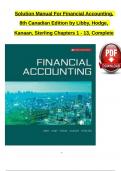
Solution Manual For Financial Accounting,
8th Canadian Edition by Libby, Hodge,
Kanaan, Sterling Chapters 1 - 13, Complete
1-
,TABLE OF CONTENTS
CHAPTER ONE
Financial Statements and Business Decisions
CHAPTER TWO
Investing and Financing Decisions and the Accounting System
CHAPTER THREE
Operating Decisions and the Accounting System
CHAPTER FOUR
Adjustments, Financial Statements, and the Closing Process
CHAPTER FIVE
Reporting and Interpreting Sales Revenue, Receivables, and Cash
CHAPTER SIX
Reporting and Interpreting Cost of Sales and Inventory
CHAPTER SEVEN
Reporting and Interpreting Long-Lived Assets
CHAPTER EIGHT
Reporting and Interpreting Current Liabilities
CHAPTER NINE
Reporting and Interpreting Non-current Liabilities
CHAPTER TEN
Reporting and Interpreting Shareholders' Equity
CHAPTER ELEVEN
Statement of Cash Flows
CHAPTER TWELVE
Communicating Accounting Information and Analyzing Financial
Statements
CHAPTER THIRTEEN
Reporting and Interpreting Investments in Other Corporations
1-
,CHAPTER ONE
Financial Statements and Business
Decisions
ANSWERS TO QUESTIONS
1. Accounting is a system that collects and processes (analyzes,
measures, and records) financial information about an organization
and reports that information to decision makers.
2. Financial accounting involves preparation of the four basic financial
statements and related disclosures for external decision makers.
Managerial accounting involves the preparation of detailed plans,
budgets, forecasts, and performance reports for internal decision
makers.
3. Financial reports are used by both internal and external groups and
individuals. The internal groups are comprised of the various managers
of the entity. The external groups include the owners, investors,
creditors, governmental agencies, other interested parties, and the
public at large.
4. Investors purchase all or part of a business and hope to gain by
receiving part of what the company earns and/or selling the company
in the future at a higher price than they paid. Creditors lend money to a
company for a specific length of time and hope to gain by
charging interest on the loan.
5. In a society each organization can be defined as a separate accounting
entity. An accounting entity is the organization for which financial data
are to be collected. Typical accounting entities are a business, a
church, a governmental unit, a university and other nonprofit
organizations such as a hospital and a welfare organization. A business
typically is defined and treated as a separate entity because the
owners, creditors, investors, and other interested parties need to
evaluate its performance and its potential
1- separately from other entities
and from its owners.
, 6 Name of Statement Alternative Title
. (a) Income (a) Statement of Earnings;
Statement Statement of Income;
(b) Balance Statement of Operations
Sheet (b)Statement of Financial Position
(c) Audit Report (c) Report of Independent
Accountants
1-
8th Canadian Edition by Libby, Hodge,
Kanaan, Sterling Chapters 1 - 13, Complete
1-
,TABLE OF CONTENTS
CHAPTER ONE
Financial Statements and Business Decisions
CHAPTER TWO
Investing and Financing Decisions and the Accounting System
CHAPTER THREE
Operating Decisions and the Accounting System
CHAPTER FOUR
Adjustments, Financial Statements, and the Closing Process
CHAPTER FIVE
Reporting and Interpreting Sales Revenue, Receivables, and Cash
CHAPTER SIX
Reporting and Interpreting Cost of Sales and Inventory
CHAPTER SEVEN
Reporting and Interpreting Long-Lived Assets
CHAPTER EIGHT
Reporting and Interpreting Current Liabilities
CHAPTER NINE
Reporting and Interpreting Non-current Liabilities
CHAPTER TEN
Reporting and Interpreting Shareholders' Equity
CHAPTER ELEVEN
Statement of Cash Flows
CHAPTER TWELVE
Communicating Accounting Information and Analyzing Financial
Statements
CHAPTER THIRTEEN
Reporting and Interpreting Investments in Other Corporations
1-
,CHAPTER ONE
Financial Statements and Business
Decisions
ANSWERS TO QUESTIONS
1. Accounting is a system that collects and processes (analyzes,
measures, and records) financial information about an organization
and reports that information to decision makers.
2. Financial accounting involves preparation of the four basic financial
statements and related disclosures for external decision makers.
Managerial accounting involves the preparation of detailed plans,
budgets, forecasts, and performance reports for internal decision
makers.
3. Financial reports are used by both internal and external groups and
individuals. The internal groups are comprised of the various managers
of the entity. The external groups include the owners, investors,
creditors, governmental agencies, other interested parties, and the
public at large.
4. Investors purchase all or part of a business and hope to gain by
receiving part of what the company earns and/or selling the company
in the future at a higher price than they paid. Creditors lend money to a
company for a specific length of time and hope to gain by
charging interest on the loan.
5. In a society each organization can be defined as a separate accounting
entity. An accounting entity is the organization for which financial data
are to be collected. Typical accounting entities are a business, a
church, a governmental unit, a university and other nonprofit
organizations such as a hospital and a welfare organization. A business
typically is defined and treated as a separate entity because the
owners, creditors, investors, and other interested parties need to
evaluate its performance and its potential
1- separately from other entities
and from its owners.
, 6 Name of Statement Alternative Title
. (a) Income (a) Statement of Earnings;
Statement Statement of Income;
(b) Balance Statement of Operations
Sheet (b)Statement of Financial Position
(c) Audit Report (c) Report of Independent
Accountants
1-


