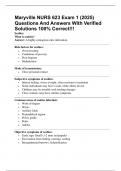
Maryville NURS 623 Exam 1 (2025)
Questions And Answers With Verified
Solutions 100% Correct!!!
Scabies
What is scabies?
Answer: A highly contagious mite infestation.
Risk factors for scabies:
Overcrowding
Conditions of poverty
Poor hygiene
Malnutrition
Mode of transmission:
Close personal contact
Subjective symptoms of scabies:
Intense itching, worse at night, often resistant to treatment
Some individuals may have a rash, while others do not
Children may be irritable with feeding changes
Close contacts may have similar symptoms
Common areas of scabies infection:
Webs of fingers
Wrists
Axillary folds
Periumbilical region
Pelvic girdle
Penis
Ankles
Objective symptoms of scabies:
Early sign: Small (1-2 mm) red papules
Excoriation from itching, crusting, scaling
Intraepidermal burrows, lichenification
, Burrows appear white with black specks
Diagnostic tests for scabies:
Burrow Ink Test: Excess ink accumulates in mite tunnels
Burrow scraping
Management of scabies:
Treat the entire household
First-line treatment: Permethrin 5% cream (apply, leave for 8-12 hours,
rinse off, repeat in 1 week)
Alternative treatment: Ivermectin 200 mcg/kg (single dose, repeat in 1-2
weeks, used with topical treatment)
Antihistamines and topical steroids (Triamcinolone 0.1% BID x 7 days) for
itching
If bacterial infection is present, use Dicloxacillin or Cephalexin (7-10 days)
Follow-up for scabies:
1 week after initial treatment
Dermatology referral if persistent nodules or crusted scabies (Scabies
Crustosa)
Patient education for scabies:
Trim fingernails to prevent re-infestation
Do not exceed recommended exposure time for creams
Itching can persist for up to 1 week after treatment
Wash bed sheets and clothing in hot soapy water
Lice (Pediculosis)
Risk factors for lice:
School-age children
Homeless individuals, crowded living conditions
Mode of transmission:
Close personal contact
Subjective symptoms of lice:
Intense itching, especially in affected areas
, Worse at night
Children may be restless, irritable, or have difficulty concentrating
Objective findings of lice:
Small (2-3 mm) red macules or papules causing itchiness
Some patients may have a hive-like reaction
Excoriation on the scalp from itching
Nits (lice eggs) attached to hair shafts
Adult lice: 6-legged, wingless insects
Management of lice:
Treat both the patient and close contacts
Common treatments:
o Shampoo/creams/rinses containing benzyl alcohol, ivermectin,
permethrin, spinosad
o Manual delousing and nit removal using a fine-toothed comb
o Home remedies: Petroleum jelly, tea tree oil, mayo, or olive oil left
overnight with a shower cap
o If bacterial infection is present, use Dicloxacillin or Cephalexin (7-
10 days)
Follow-up for lice:
Uncomplicated cases do not require follow-up
If symptoms persist, follow up in 1 week
Patient education for lice:
Do not share hats, combs, scarves, towels, or bedding
Wash combs/brushes in hot, soapy water and air dry
When using lice shampoo:
o Do not exceed exposure time
o Rinse over the sink (not in the shower)
Itching may persist for up to 1 week
No need to treat pets
Wash bed linens and clothing in hot, soapy water and dry on high heat
Vacuum carpets and upholstery
Children can return to school after treatment, but should be screened weekly
Risk factors for candidiasis - ANSWER✔✔-Any age/gender
Questions And Answers With Verified
Solutions 100% Correct!!!
Scabies
What is scabies?
Answer: A highly contagious mite infestation.
Risk factors for scabies:
Overcrowding
Conditions of poverty
Poor hygiene
Malnutrition
Mode of transmission:
Close personal contact
Subjective symptoms of scabies:
Intense itching, worse at night, often resistant to treatment
Some individuals may have a rash, while others do not
Children may be irritable with feeding changes
Close contacts may have similar symptoms
Common areas of scabies infection:
Webs of fingers
Wrists
Axillary folds
Periumbilical region
Pelvic girdle
Penis
Ankles
Objective symptoms of scabies:
Early sign: Small (1-2 mm) red papules
Excoriation from itching, crusting, scaling
Intraepidermal burrows, lichenification
, Burrows appear white with black specks
Diagnostic tests for scabies:
Burrow Ink Test: Excess ink accumulates in mite tunnels
Burrow scraping
Management of scabies:
Treat the entire household
First-line treatment: Permethrin 5% cream (apply, leave for 8-12 hours,
rinse off, repeat in 1 week)
Alternative treatment: Ivermectin 200 mcg/kg (single dose, repeat in 1-2
weeks, used with topical treatment)
Antihistamines and topical steroids (Triamcinolone 0.1% BID x 7 days) for
itching
If bacterial infection is present, use Dicloxacillin or Cephalexin (7-10 days)
Follow-up for scabies:
1 week after initial treatment
Dermatology referral if persistent nodules or crusted scabies (Scabies
Crustosa)
Patient education for scabies:
Trim fingernails to prevent re-infestation
Do not exceed recommended exposure time for creams
Itching can persist for up to 1 week after treatment
Wash bed sheets and clothing in hot soapy water
Lice (Pediculosis)
Risk factors for lice:
School-age children
Homeless individuals, crowded living conditions
Mode of transmission:
Close personal contact
Subjective symptoms of lice:
Intense itching, especially in affected areas
, Worse at night
Children may be restless, irritable, or have difficulty concentrating
Objective findings of lice:
Small (2-3 mm) red macules or papules causing itchiness
Some patients may have a hive-like reaction
Excoriation on the scalp from itching
Nits (lice eggs) attached to hair shafts
Adult lice: 6-legged, wingless insects
Management of lice:
Treat both the patient and close contacts
Common treatments:
o Shampoo/creams/rinses containing benzyl alcohol, ivermectin,
permethrin, spinosad
o Manual delousing and nit removal using a fine-toothed comb
o Home remedies: Petroleum jelly, tea tree oil, mayo, or olive oil left
overnight with a shower cap
o If bacterial infection is present, use Dicloxacillin or Cephalexin (7-
10 days)
Follow-up for lice:
Uncomplicated cases do not require follow-up
If symptoms persist, follow up in 1 week
Patient education for lice:
Do not share hats, combs, scarves, towels, or bedding
Wash combs/brushes in hot, soapy water and air dry
When using lice shampoo:
o Do not exceed exposure time
o Rinse over the sink (not in the shower)
Itching may persist for up to 1 week
No need to treat pets
Wash bed linens and clothing in hot, soapy water and dry on high heat
Vacuum carpets and upholstery
Children can return to school after treatment, but should be screened weekly
Risk factors for candidiasis - ANSWER✔✔-Any age/gender