WEEK 1 VIDEO NOTES:
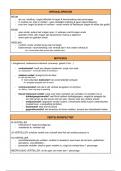
Strategy: set of actions that managers take to increase their
company’s performance relative to its rivals
Sustained competitive advantage: competitive advantage
achieved when a company is able to maintain above-average
profitability for a number of years
Providing superior value compared to rivals over an
extended period of time
VUCA: volatile, uncertain, complex, ambiguous
Principles and models: planned or deliberate strategic
planning
Scenario planning: address uncertainty
Emergent strategy: build in feedback loop, bottom-up, lower
in org, collaborative approach
Planned/deliberate strategy: top-down, seniors/executives
develop it then communicate it
Focus on cost or differentiation, mass, or niche market
Data driven vs. hypothesis driven
o Data – do not learn, no framework
, o Hypothesis – learn, develop framework, need data
to use
Mix of deliberate and emergent
WEEK 2 VIDEO NOTES:
Tribology: science and engineering of interacting surfaces in
relative motion. It includes the study and application of the
principles of friction, lubrication, and wear.
Life Scan vision statement: “creating a world without limits for
people with diabetes”
Wedevan Associates vision statement: “to revolutionize the
way tribology technology is created and applied”
Mission: what the company exists to do
Customer, customer needs, satisfying customer’s needs
Wedevan Associates
Customer: oil companies
Need: qualify oils for jet engine use
Solution: patented equipment & services to perform
qualifications
WEEK 3 VIDEO NOTES:
,Ethics: “process of deciding what should be done” – Marvin
B
“Ethics and morality… refer to our efforts to figure out and
then carry out the right thing in business and other areas of
life” - David G
“Ethical process is concerned with assessing the rightness
and wrongness of a particular set of ideas of actions and
then implementing the right action”- Scott P
Business Ethics: “making decisions that are consistent with
the principles, norms, and standards of business practice that
have been agreed upon by society, recognizing that society
sometimes gets it wrong and that further analysis may be
needed.” – Linda T & Katherine N
Developing Ethical Solutions Process:
1. Define the problem
a. Facts, current situation, context, relevant history,
current choice/dilemma
b. Ethical issues: violation of laws, regulations,
company policies/codes, societal norms, personal
values
c. Red face test: what would happen if this was made
public?
2. Develop solutions – right, good, fitting
a. Right decisions
, i. Addressees overreaching moral principles
ii. Follow universal truths that apply to all
situations all the time
iii. Universal Declaration of Human Rights
iv. QUESTION: what moral principles or universal
truths apply?
1. Potential solutions that address these
principles and truths
b. Good decisions
i. Related to goals and outcomes
ii. Most net good is always sought
iii. QUESTION: who are the stakeholders and how
many people are in each group?
1. Potential outcomes that would result in
most net happiness for entire population
of stakeholders
c. Fitting decisions
i. Everybody has equal rights; inequalities are
only accepted when they provide greatest
benefit to least advantaged
ii. Human flourishing common good is sought
iii. “Golden rule”
iv. QUESTIONS:
1. Which stakeholder groups are
disadvantaged or marginalized compared
to others?
2. What would “living well” look like for each
stakeholder group?
Strategy: set of actions that managers take to increase their
company’s performance relative to its rivals
Sustained competitive advantage: competitive advantage
achieved when a company is able to maintain above-average
profitability for a number of years
Providing superior value compared to rivals over an
extended period of time
VUCA: volatile, uncertain, complex, ambiguous
Principles and models: planned or deliberate strategic
planning
Scenario planning: address uncertainty
Emergent strategy: build in feedback loop, bottom-up, lower
in org, collaborative approach
Planned/deliberate strategy: top-down, seniors/executives
develop it then communicate it
Focus on cost or differentiation, mass, or niche market
Data driven vs. hypothesis driven
o Data – do not learn, no framework
, o Hypothesis – learn, develop framework, need data
to use
Mix of deliberate and emergent
WEEK 2 VIDEO NOTES:
Tribology: science and engineering of interacting surfaces in
relative motion. It includes the study and application of the
principles of friction, lubrication, and wear.
Life Scan vision statement: “creating a world without limits for
people with diabetes”
Wedevan Associates vision statement: “to revolutionize the
way tribology technology is created and applied”
Mission: what the company exists to do
Customer, customer needs, satisfying customer’s needs
Wedevan Associates
Customer: oil companies
Need: qualify oils for jet engine use
Solution: patented equipment & services to perform
qualifications
WEEK 3 VIDEO NOTES:
,Ethics: “process of deciding what should be done” – Marvin
B
“Ethics and morality… refer to our efforts to figure out and
then carry out the right thing in business and other areas of
life” - David G
“Ethical process is concerned with assessing the rightness
and wrongness of a particular set of ideas of actions and
then implementing the right action”- Scott P
Business Ethics: “making decisions that are consistent with
the principles, norms, and standards of business practice that
have been agreed upon by society, recognizing that society
sometimes gets it wrong and that further analysis may be
needed.” – Linda T & Katherine N
Developing Ethical Solutions Process:
1. Define the problem
a. Facts, current situation, context, relevant history,
current choice/dilemma
b. Ethical issues: violation of laws, regulations,
company policies/codes, societal norms, personal
values
c. Red face test: what would happen if this was made
public?
2. Develop solutions – right, good, fitting
a. Right decisions
, i. Addressees overreaching moral principles
ii. Follow universal truths that apply to all
situations all the time
iii. Universal Declaration of Human Rights
iv. QUESTION: what moral principles or universal
truths apply?
1. Potential solutions that address these
principles and truths
b. Good decisions
i. Related to goals and outcomes
ii. Most net good is always sought
iii. QUESTION: who are the stakeholders and how
many people are in each group?
1. Potential outcomes that would result in
most net happiness for entire population
of stakeholders
c. Fitting decisions
i. Everybody has equal rights; inequalities are
only accepted when they provide greatest
benefit to least advantaged
ii. Human flourishing common good is sought
iii. “Golden rule”
iv. QUESTIONS:
1. Which stakeholder groups are
disadvantaged or marginalized compared
to others?
2. What would “living well” look like for each
stakeholder group?