TMC Actual Exam Questions With Reviewed 100% Correct
Detailed Answers Guaranteed Pass!!
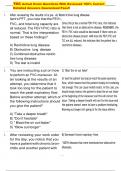
1. After reviewing the results of a pa- A) Restrictive lung disease.
tient's PFT, you note that the FEV1,
FVC, and total lung capacity are (Since this pt has a normal FEV1/FVC ratio, this indicates
all reduced. The FEV1/FVC ratio is that there is not an obstructive disease. REMEMBER, the
normal. That is the interpretation FEV1/ FVC ratio would be decreased if there were an
based on these findings? obstructive disease present. AND since the FEV1,FVC and
TLC are ALL reduced, this indicates that the patient has a
A) Restrictive lung disease restrictive disease).
B) Obstructive lung disease
C) Combined obstructive-restric-
tive lung disease
D) The test is invalid
2. You are instructing a pt on how C) "Blast the air out faster"
to perform an FVC maneuver. Af-
ter looking at the results of an (It took the patient too long to reach the peak expiratory
attempt, you determine that it flow, which means that the patient simply isn't exhaling
took too long for the patient to fast enough. This can cause invalid results. In this case, you
reach the peak expiratory flow. should simply instruct the patient to blast the air out faster
Before another attempt, which of at the beginning of the maneuver and this will correct the
the following instructions should issue. Taking a deeper breath will not fix the issue and
you give the patient? the patient doesn't seem to have a problem hesitating.
Blowing out longer isn't going to fix the issue either).
A) "Take a deeper breath"
B) "Don't hesitate"
C) " Blast the sir out faster"
D) "Blow out longer"
3. After reviewing your work order B) Decreased forced expiratory flows
for the day, you notice that you
have a patient with chronic bron- * BOTH diseases that were mentioned are obstructive
chitis and another patient with diseases.
, TMC Actual Exam Questions With Reviewed 100% Correct
Detailed Answers Guaranteed Pass!!
emphysema. Which of the follow- (We know that with obstructive diseases, the patient will
ing PFT findings would you expect have decreases expiratory flow rates. Their FEV1% will be
for these patients? less than 70%. Air trapping is also common in obstructive
diseases which will cause the TLC to be increased. A de-
A) Increased lung compliance creased dittusing capacity tends to occur only in emphy-
B) Decreased forced expiratory sema).
flows
C) Decreased total lung capacity
D) Decreased diffusing capacity
4. Simple spirometry can be used to D) Residual Volume
measure any of the following EX-
CEPT: (A spirometer is a device that measures exhaled flow rates
and volumes. It can be used to obtain measurements such
A) Tidal Volume as tidal volume, vital capacity, and FEV1. To get this one
B) Vital Capacity right, you have to know what Residual Volume is. It is the
C) Inspiratory reserve volume amount of air that is left in the lungs after a full exhalation.
D) Residual Volume The residual volume cannot be exhaled. And because that
is the case, it cannot be measured by simple spirometry).
(Tidal volume, vital capacity, and IRV all can be measured
with a spirometer. You would need a Plethysmography,
aka a body box, in order to measure the residual volume).
5. You are assessing a patient with D) Air trapping during a forced expiration
chronic asthma. She has a SVC of
3,500mL and a FVC of 2,500mL. ( The first thing that should stand out is that the patient
Which of the following best ex- has asthma, which is an obstructive disease. And we know
plains this difference? that air trapping is a commonality in obstructive diseases.
If a patient has a significant ditterence between their slow
A) Increased compliance during a vital capacity and forced vital capacity, this also indicates
forced expiration that air is trapped in the lungs when the patient exhales
B) Poor instruction by the previ- forcefully).
Detailed Answers Guaranteed Pass!!
1. After reviewing the results of a pa- A) Restrictive lung disease.
tient's PFT, you note that the FEV1,
FVC, and total lung capacity are (Since this pt has a normal FEV1/FVC ratio, this indicates
all reduced. The FEV1/FVC ratio is that there is not an obstructive disease. REMEMBER, the
normal. That is the interpretation FEV1/ FVC ratio would be decreased if there were an
based on these findings? obstructive disease present. AND since the FEV1,FVC and
TLC are ALL reduced, this indicates that the patient has a
A) Restrictive lung disease restrictive disease).
B) Obstructive lung disease
C) Combined obstructive-restric-
tive lung disease
D) The test is invalid
2. You are instructing a pt on how C) "Blast the air out faster"
to perform an FVC maneuver. Af-
ter looking at the results of an (It took the patient too long to reach the peak expiratory
attempt, you determine that it flow, which means that the patient simply isn't exhaling
took too long for the patient to fast enough. This can cause invalid results. In this case, you
reach the peak expiratory flow. should simply instruct the patient to blast the air out faster
Before another attempt, which of at the beginning of the maneuver and this will correct the
the following instructions should issue. Taking a deeper breath will not fix the issue and
you give the patient? the patient doesn't seem to have a problem hesitating.
Blowing out longer isn't going to fix the issue either).
A) "Take a deeper breath"
B) "Don't hesitate"
C) " Blast the sir out faster"
D) "Blow out longer"
3. After reviewing your work order B) Decreased forced expiratory flows
for the day, you notice that you
have a patient with chronic bron- * BOTH diseases that were mentioned are obstructive
chitis and another patient with diseases.
, TMC Actual Exam Questions With Reviewed 100% Correct
Detailed Answers Guaranteed Pass!!
emphysema. Which of the follow- (We know that with obstructive diseases, the patient will
ing PFT findings would you expect have decreases expiratory flow rates. Their FEV1% will be
for these patients? less than 70%. Air trapping is also common in obstructive
diseases which will cause the TLC to be increased. A de-
A) Increased lung compliance creased dittusing capacity tends to occur only in emphy-
B) Decreased forced expiratory sema).
flows
C) Decreased total lung capacity
D) Decreased diffusing capacity
4. Simple spirometry can be used to D) Residual Volume
measure any of the following EX-
CEPT: (A spirometer is a device that measures exhaled flow rates
and volumes. It can be used to obtain measurements such
A) Tidal Volume as tidal volume, vital capacity, and FEV1. To get this one
B) Vital Capacity right, you have to know what Residual Volume is. It is the
C) Inspiratory reserve volume amount of air that is left in the lungs after a full exhalation.
D) Residual Volume The residual volume cannot be exhaled. And because that
is the case, it cannot be measured by simple spirometry).
(Tidal volume, vital capacity, and IRV all can be measured
with a spirometer. You would need a Plethysmography,
aka a body box, in order to measure the residual volume).
5. You are assessing a patient with D) Air trapping during a forced expiration
chronic asthma. She has a SVC of
3,500mL and a FVC of 2,500mL. ( The first thing that should stand out is that the patient
Which of the following best ex- has asthma, which is an obstructive disease. And we know
plains this difference? that air trapping is a commonality in obstructive diseases.
If a patient has a significant ditterence between their slow
A) Increased compliance during a vital capacity and forced vital capacity, this also indicates
forced expiration that air is trapped in the lungs when the patient exhales
B) Poor instruction by the previ- forcefully).