100% satisfaction guarantee Immediately available after payment Both online and in PDF No strings attached 4,6 TrustPilot
logo-home
Exam (elaborations)

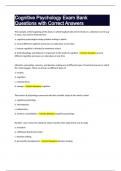
Cognitive Psychology Exam Bank Questions with Correct Answers.

Rating
-
Sold
-
Pages
13
Grade
A+
Uploaded on
27-03-2025
Written in
2024/2025

Cognitive Psychology Exam Bank Questions with Correct Answers The example at the beginning of the book, in which Raphael talks to his friend on a cell phone on his way to class, was used to illustrate how a. cognitive psychologists study problem solving in adults. b. several different cognitive processes can take place at one time. c. human cognition is affected by emotional events. d. both physiology and behavior is important to the study of cognition. - Correct Answers: several different cognitive processes can take place at one time Attention, perception, memory, and decision making are all different types of mental processes in which the mind engages. These are known as different types of a. models. b. cognition. c. reaction times. d. savings. - Correct Answers: cognition The branch of psychology concerned with the scientific study of the mind is called a. cognitive psychology. b. introspection. c. behaviorism. d. memory consolidation. - Correct Answers: cognitive psychology Donders' main reason for doing his choice reaction time experiment was to study a. sensation. b. childhood attachment styles. c. decision making. d. personality development. - Correct Answers: decision making By comparing reaction times across different tasks, Donders was able to conclude how long the mind needs to perform a certain cognitive task. Donders interpreted the difference in reaction time between the simple and choice conditions of his experiment as indicating how long it took to a. perceive the stimulus. b. process the stimulus. c. attend to the stimulus. d. make a decision about the stimulus. - Correct Answers: make a decision about the stimulus The main point of the Donders' reaction time experiments was to a. show that reaction times can be measured accurately. b. measure the amount of time it takes to make a decision. c. determine differences in the way people react to stimuli. d. show that our cognitions are often based on unconscious inferences. - Correct Answers: measure the amount of time it takes to make a decision In Donders' experiment on decision making, when participants were asked to press a button upon presentation of a light, they were engaged in a a. reaction time task. b. simple reaction time task. c. choice reaction time task. d. presentation task. - Correct Answers: simple reaction time task Reaction time refers to the time between the of a stimulus and a person's response to it. a. sensation b. transduction c. change in intensity d. presentation - Correct Answers: presentation In Donders' experiment on decision making, when participants were asked to press one button if the light on the left was illuminated and another button if the light on the right was illuminated, they were engaged in a a. reaction time task. b. simple reaction time task. c. choice reaction time task. d. presentation task. - Correct Answers: choice reaction time task Donders' reaction time experiment was performed using stimuli in which of the following sensory modalities? a. Touch b. Hearing c. Smell d. Vision - Correct Answers: Vision Donders' measurement of reaction time is particularly important because it demonstrated the "time course" on which the mind operates. Donders found that it took to decide which of two buttons to push in response to a stimulus. a. less than one second b. between one and two seconds c. two to five seconds d. more than five seconds - Correct Answers: less than one second The first experiments in cognitive psychology were based on the idea that mental responses can be a. measured directly. b. inferred from the participant's behavior. c. measured by comparing the presentation of the stimulus and the participant's response. d. measured by comparing responses among different participants. - Correct Answers: inferred from the participant's behavior The relationship between the ___ is NOT measured directly by cognitive psychologists. a. physiological response and the behavioral outcome b. cognitive task and the behavioral outcome c. cognitive task and the physiological response d. cognitive task and the mental response - Correct Answers: cognitive task and the mental response Which of the following stimuli were used in Ebbinghaus's "memory" experiment discussed in your text? a. Common words b. Light illuminated on the left or the right of a computer screen c. Grey rectangles in front of light rectangles d. Three-letter nonsense words - Correct Answers: Three-letter nonsense words According to Ebbinghaus's savings curve, savings is a function of a. word familiarity. b. sensory modality. c. elapsed time. d. reaction time. - Correct Answers: elapsed time Ebbinghaus's "memory" experiments were important because they a. described complex decision-making. b. plotted functions that described the operation of the mind. c. were the first to combine basic elements of experience called sensations. d. showed how positive reinforcers strengthen behavior. - Correct Answers: plotted functions that described the operation of the mind The first formal laboratory of psychology, where the approach of structuralism was created, was founded in which city? a. Madrid, Spain b. Baltimore, Maryland, USA c. Paris, France d. Leipzig, Germany - Correct Answers: Leipzig, Germany The founder of the first laboratory of scientific psychology was a. Franciscus Donders. b. Hermann von Helmholtz. c. Wilhelm Wundt. d. Hermann Ebbinghaus. - Correct Answers: Wilhelm Wundt Which of the following methods, often associated with structuralism, was used in the psychology laboratory established by Wilhelm Wundt? a. Analytic introspection b. Measuring reaction times c. Operant conditioning d. Classical conditioning - Correct Answers: Analytic introspection The procedure in which trained participants describe their experiences and thought processes in response to stimuli presented under controlled conditions is known as a. information processing. b. analytic introspection. c. functional analysis. d. behavioral analysis. - Correct Answers: analytic introspection An important contribution to the field of psychology resulting from Wilhelm Wundt founding his laboratory at the University of Leipzig in 1879 was a. the rise of behaviorism's popularity and the decline of both structuralism and functionalism. b. recognizing 1879 as "the birthday of cognitive science." c. producing PhDs who later established psychology departments at other schools, including some in the United States. d. the first demonstration of the forgetting curve and the introduction of the reaction time paradigm. - Correct Answers: producing PhDs who later established psychology departments at other schools, including some in the United States Which of the following is a criticism of analytic introspection? a. It infers mental processes based on objective data. b. It produces results that are too easy to verify. c. It produces variable results from person to person. d. It requires no training. - Correct Answers: It produces variable results from person to person John Watson believed that psychology should focus on the study of a. observable behavior. b. mental processes. c. consciousness. d. attention. - Correct Answers: observable behavior 24. According to the behaviorists, only the study of should be the emphasis of the science of psychology. a. observable behavior b. consciousness c. introspection d. the mind - Correct Answers: observable behavior The "Little Albert" experiment involving the rat and the loud noise is an example of which of the following types of experiments? a. Reaction time b. Unconscious inference c. Classical conditioning d. Operant conditioning - Correct Answers: Classical conditioning Behaviorists believe that the presentation of increases the frequency of behavior. a. positive reinforcers b. discriminative stimuli c. backward conditioning d. inhibitory neurotransmitters - Correct Answers: positive reinforcers Which of the following psychologists is known for research on operant conditioning? a. Franciscus Donders b. Wilhelm Wundt c. John Watson d. B.F. Skinner - Correct Answers: B.F. Skinner The investigation of how behavior is strengthened by presentation of positive reinforcers (e.g., food) or withdrawal of negative reinforcers (e.g., shock) is best known as a. classical conditioning. b. the method of savings. c. choice reaction time. d. operant conditioning. - Correct Answers: operant conditioning Who developed the concept of the cognitive map? a. Raynor b. Sanders c. James d. Tolman - Correct Answers: Tolman A mental conception of the layout of a physical space is known as a(n) a. cognitive map. b. mental model. c. artificial intelligence. d. memory consolidation. - Correct Answers: cognitive map Regarding children's language development, Noam Chomsky noted that children generate many sentences they have never heard before. From this, he concluded that language development is driven largely by a. an inborn biological program. b. cultural influences. c. classical conditioning. d. operant conditioning. - Correct Answers: an inborn biological program Who proposed that children's language development was caused by imitation and reinforcement? a. Noam Chomsky b. John Watson c. Keller Breland d. B.F. Skinner - Correct Answers: B.F. Skinner Which of the following events is most closely associated with a resurgence in interest in the mind within the study of psychology? a. Watson's "Little Albert" experiment b. Skinner's publication of the book, Verbal Behavior c. Development of the technique of analytic introspection d. The proposal of cognitive maps - Correct Answers: Skinner's publication of the book, Verbal Behavior Which of the following does NOT characterize the information processing (IP) approach to the study of cognition? a. IP depicts the mind as processing information in a sequence of stages. b. IP supports the principle of behaviorism that behavior is a stimulus-response relationship. c. IP involves the use of computers as a metaphor to understand human cognition. d. IP traces the sequence of mental operations involved in cognition. - Correct Answers: IP supports the principle of behaviorism that behavior is a stimulus-response relationship Your text describes the occurrence of a "cognitive revolution" during which dramatic changes took place in the way psychology was studied. This so-called "revolution" occurred parallel to (and, in part, because of) the introduction of a. cognitive psychology textbooks. b. analytic introspection. c. Skinner boxes. d. computers. - Correct Answers: computers The scene of a human sitting at a computer terminal, responding to stimuli flashed on the computer screen, would most likely be described as depicting a(n) experiment. a. information processing b. analytic introspection c. operant conditioning d. behaviorist - Correct Answers: information processing Colin Cherry's experiment in which participants listen to two messages simultaneously, one in each ear, found all but which of the following? a. people can focus on one message and ignore the other one. b. people can focus on the message they were repeating. c. people take in very little information about the ignored message. d. even deaf individuals process auditory information, even on a non-conscious level. - Correct Answers: even deaf individuals process auditory information, even on a non-conscious level Donald Broadbent was the first person to develop which of the following? a. A flow diagram depicting the mind as processing information in a sequence of stages b. A computer program for solving logic problems c. An experimental procedure for studying the way people process information d. The first textbook of cognitive psychology - Correct Answers: A flow diagram depicting the mind as processing information in a sequence of stages 39. Who introduced the flow diagram to represent what is happening in the mind? a. Donald Broadbent b. Colin Cherry c. Newell and Simon d. Wilhelm Wundt - Correct Answers: Donald Broadbent ___ notion that the mind could be represented as operating in a sequence of stages, often represented by boxes, allows cognitive psychologists to develop models that can be tested by further experiments. a. Broadbent's b. Chomsky's c. Cherry's d. Skinner's - Correct Answers: Broadbent's The field that studies how to make machines behave in ways that are intelligent if a human were so behaving is known as a. cognitive psychology. b. behaviorism. c. artificial intelligence. d. flow diagramming. - Correct Answers: artificial intelligence The use of the term "artificial intelligence" was coined by a. B.F. Skinner. b. Colin Cherry. c. Edward Tolman. d. John McCarthy. - Correct Answers: John McCarthy Newell and Simon were among the first to use computers in cognitive psychology. Their computer program a. simulated human attention. b. created proofs for problems in logic. c. controlled presentation of visual stimuli during cognitive psychology experiments. d. introduced the first flow diagram. - Correct Answers: created proofs for problems in logic At the Massachusetts Institute of Technology Symposium on Information Theory, George Miller presented a paper suggesting that a. the human ability to process information is unlimited. b. there are limits to the human ability to process information. c. intelligent machines can be successfully created. d. memory consolidation is enhanced by REM sleep. - Correct Answers: here are limits to the human ability to process information What year is usually cited as the "birthday" of cognitive science (pick the closest year)? a. 1879 b. 1945 c. 1956 d. 1967 - Correct Answers: 1956 The "cognitive revolution" a. occurred rapidly, within a period of a few years, in response to the attacks on Skinner and the development of computers. b. extended over a long period of time, beginning in the early part of the century, in reaction to Wundt's introspection experiments. c. was a gradual process that occurred over a few decades. d. was not really necessary because the study of the mind has been a constant part of experimental psychology since the founding of the first psychology laboratory. - Correct Answers: was a gradual process that occurred over a few decades Which of the following analogies would provide the best description for how research progresses in cognitive psychology? a. A pair of railroad tracks where two things move in a parallel fashion. b. An octopus where every leg comes from a singular body. c. A trail from which one thing leads to another. d. A pyramid, where all questions lead to a singular answer, or "tip." - Correct Answers: A trail from which one thing leads to another Using behavior to infer mental processes is the basic principle of a. behaviorism. b. humanism. c. cognitive psychology. d. operant conditioning. - Correct Answers: cognitive psychology Which of the following are the two primary categories of models in cognitive psychology? a. Structural models and process models b. Biological models and psychological models c. Interpersonal models and intrapersonal models d. Psychodynamic models and behavioral models - Correct Answers: Structural models and process models Douglas is working on a project for his cognitive psychology class. He builds a plastic model of the human brain, paints each major structure a different color, and constructs a "map" that shows which functions are controlled by which brain component. Douglas's project is working from a(n) ___ model of cognitive psychology. a. analytic b. structural c. consolidative d. process - Correct Answers: structural An early model of memory indicates that incoming information is first handled by "sensory" memory, is then moved to "short term" memory, and finally is pushed into "long-term" memory. This model, proposed by Atkinson and Shiffrin in 1968, is an example of a(n) model. a. process b. nomothetic c. structural d. idiographic - Correct Answers: process Explain how Donders' and Ebbinghaus's pioneering methods, though very different from each other, allowed for behavior to determine a property of the mind. - Correct Answers: Short Answer Question Describe analytic introspection. Give an experimental example. Also, describe two limitations to this method. - Correct Answers: Short Answer Question Describe operant conditioning. How did B.F. Skinner explain language development in terms of operant conditioning? What were Noam Chomsky's criticisms of Skinner's account? - Correct Answers: Short Answer Question Define flow diagram. Describe its importance to the information processing approach. Draw Broadbent's filter model of memory as a flow diagram. - Correct Answers: Short Answer Question Distinguish between structural models and process models in cognitive psychology. Provide an example of each type of model. - Correct Answers: Short Answer Question

Show more Read less
Institution
Abnormal Psychology
Course
Abnormal Psychology


Whoops! We can’t load your doc right now. Try again or contact support.

Written for

Institution
Abnormal Psychology
Course
Abnormal Psychology

Document information

Uploaded on
March 27, 2025
Number of pages
13
Written in
2024/2025
Type
Exam (elaborations)
Contains
Questions & answers

Subjects

Content preview

Cognitive Psychology Exam Bank
Questions with Correct Answers
The example at the beginning of the book, in which Raphael talks to his friend on a cell phone on his way
to class, was used to illustrate how

a. cognitive psychologists study problem solving in adults.

b. several different cognitive processes can take place at one time.

c. human cognition is affected by emotional events.

d. both physiology and behavior is important to the study of cognition. - Correct Answers: several
different cognitive processes can take place at one time


Attention, perception, memory, and decision making are all different types of mental processes in which
the mind engages. These are known as different types of

a. models.

b. cognition.

c. reaction times.

d. savings. - Correct Answers: cognition


The branch of psychology concerned with the scientific study of the mind is called

a. cognitive psychology.

b. introspection.

c. behaviorism.

d. memory consolidation. - Correct Answers: cognitive psychology


Donders' main reason for doing his choice reaction time experiment was to study

a. sensation.

b. childhood attachment styles.

c. decision making.

d. personality development. - Correct Answers: decision making

, By comparing reaction times across different tasks, Donders was able to conclude how long the mind
needs to perform a certain cognitive task. Donders interpreted the difference in reaction time between
the simple and choice conditions of his experiment as indicating how long it took to

a. perceive the stimulus.

b. process the stimulus.

c. attend to the stimulus.

d. make a decision about the stimulus. - Correct Answers: make a decision about the stimulus


The main point of the Donders' reaction time experiments was to

a. show that reaction times can be measured accurately.

b. measure the amount of time it takes to make a decision.

c. determine differences in the way people react to stimuli.

d. show that our cognitions are often based on unconscious inferences. - Correct Answers: measure the
amount of time it takes to make a decision


In Donders' experiment on decision making, when participants were asked to press a button upon
presentation of a light, they were engaged in a

a. reaction time task.

b. simple reaction time task.

c. choice reaction time task.

d. presentation task. - Correct Answers: simple reaction time task


Reaction time refers to the time between the of a stimulus and a person's response to it.

a. sensation

b. transduction

c. change in intensity

d. presentation - Correct Answers: presentation
$18.49
Get access to the full document:

100% satisfaction guarantee
Immediately available after payment
Both online and in PDF
No strings attached

Get to know the seller
Seller avatar
EXAMSTUVIA

Document also available in package deal

Thumbnail
Package deal
Test bank for psychology 12th edition
-
11 2025
$ 199.99 More info

Get to know the seller

Seller avatar
EXAMSTUVIA stuvia
View profile
Follow You need to be logged in order to follow users or courses
Sold
2
Member since
1 year
Number of followers
2
Documents
1120
Last sold
5 months ago
Stuvia Exam

Assignments, Case Studies, Research, Essay writing service, Questions and Answers, Discussions etc. for students who want to see results twice as fast. I have done papers of various topics and complexities. I am punctual and always submit work on-deadline. I write engaging and informative content on all subjects. Send me your research papers, case studies, psychology papers, etc, and I’ll do them to the best of my abilities. Writing is my passion when it comes to academic work. I’ve got a good sense of structure and enjoy finding interesting ways to deliver information in any given paper. I love impressing clients with my work, and I am very punctual about deadlines. Send me your assignment and I’ll take it to the next level. I strive for my content to be of the highest quality. Your wishes come first— send me your requirements and I’ll make a piece of work with fresh ideas, consistent structure, and following the academic formatting rules. For every student you refer to me with an order that is completed and paid transparently, I will do one assignment for you, free of charge!!!!!!!!!!!!

Read more Read less
0.0

0 reviews

5
0
4
0
3
0
2
0
1
0

Recently viewed by you

Why students choose Stuvia

Created by fellow students, verified by reviews

Quality you can trust: written by students who passed their exams and reviewed by others who've used these notes.

Didn't get what you expected? Choose another document

No worries! You can immediately select a different document that better matches what you need.

Pay how you prefer, start learning right away

No subscription, no commitments. Pay the way you're used to via credit card or EFT and download your PDF document instantly.

Student with book image

“Bought, downloaded, and aced it. It really can be that simple.”

Alisha Student

Frequently asked questions