
Lecture 12: Cardiovascular System
Blood flow:
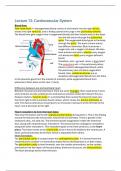
Post-natal heart => deoxygenated blood comes in and travels into the right atrium,
moves into right ventricle, and is finally pushed into lungs in the pulmonary arteries.
The blood then gets oxygen here (=oxygenated blood) and then travels back to the heart
into the left atrium through the pulmonary
veins. The oxygenated blood goes to the body
through the aorta. The aorta (=main artery)
has different branches. Blue in pictures =
oxygen low, red = oxygen rich blood. We also
have arteries and veins; arteries carry oxygen
rich blood and veins carry oxygen deficient
blood.
Therefore, vein = to heart, artery = from heart
The exceptions are => the pulmonary artery
(these contains deoxygenated blood, while
the pulmonary vein contains oxygenated
blood). Also, umbilical arteries are an
exception (deoxygenated blood from the fetus
to the placenta goes from the arteries (2 arteries), while oxygenated blood from
placenta to fetus does via the vein (1 vein))
Difference between pre and postnatal heart:
Between the post and prenatal heart, there are some changes; there used to be 2 veins
and 2 arteries, but the umbilical vein and ductus venosus closes (if it doesn’t this is a
disease marker), foramen ovale (= a window/flap that causes the blood to travel very
fast from right to left in prenatal heart) closes, which closes the ductus arteriosus as
well. The ductus arteriosus closed due to an increase in pressure at the left side of the
heart, and a decrease at the right.
Heart mesoderm to form the heart tube:
They heart formation starts with cephalocaudal folding during week 3. This is the folding
around formed axis (the neural tube, notochord and somites). There is growth of the
embryonic disc, not yolk sac. The primitive streak invagination makes the trilaminar
disc, along with intraembryonic mesoderm. This becomes the cardiogenic mesoderm
along with other mesoderm. This mesoderm goes to the front (anterior), to the heart
place. The heart moves to the cranial side since it has to be folded to the ventral part. A
heart cavity should also be formed, which is separated from others.
Heart Formation:
The pericardial cavity is located under the cardiogenetic plate. It is formed from the
intraembryonic coelom in a horseshoe shape (hence development is on both sides).
The pericardiac cavity is bent forwards, over the cardiac primordium, so the cardiac
primordium has two layers of the pericardiac bilaminar structure, the mesocardium.
The heart develops earlier than the brain.
,The cranial folding brings the heart into the primitive thoracic region.
The mesoderm at the most cranial part generates cardiac progenitors and moves to the
cranial region (heart fields). Within the cranial lateral plate mesoderm, these two
progenitor regions form the cardiac crescent.
From this, two thin-walled endocardial tubes emerge, and fuse to the anterior side.
,The tubes then begin to fuse to form a single tube, the primitive heart tube. The aorta
will already have been formed.
- There is a cardiac jelly between the epimyocardium and the endocardial tubes,
which consists of collagens and glycoproteins.
- The mycocardium (muscles) is made up of splanchnic/visceral mesoderm
- The surrounding mesenchyme (secondary heart field) thickens to form
epicardium (forms over the myocardium): serves as a progenitor source (a lot of
blood cells, veins and arteries must be made).
Development so far in summary:
1. 2 Heart tubes are present at 18 days
2. At day 21, the heart tubes move below the head region
3. Day 22, the tubes have fused together and moved into the chest cavity. The heart
also starts to beat at this point (the fused tubes will wiggle)
, 4. At day 30, the fused tube will start bending and twisting, and by 2 months the
heart is done (only on the outside). On the inside, the heart of a fetus vs the heart
of a baby are very different (as mentioned before).
The coronary vasculature forms between the myocardium and epicardium.
There are tubular heart elongations and develop dilations or sacculations; in which the
cardiac jelly helps with the looping structure. Coincident with the initiation of epicardial
EMT.
Arterial System:
- The yolk sac provides blood flow to dorsal aorta via blood islands.
- The aorta = outflow (is symmetrical despite fused tube), and sinus horn = inflow
to heart, which also start to develop. The aorta also bends, called the first aortic
arch. The folding creates a ventral and a dorsal part of an aorta.
- The cardiac tube consists of 3 layers:
epicardium, myocardium and endocardium. The outermost layer and boundary
of the pericardial cavity is the epicardium. The myocardial mantle follows as the
next inner layer. Together they form the myoepicardium. The considerable
distance from the myocardial mantle to the endocardial tube is filled with
cardiac jelly and the cardiac lumen is coated with endocardial cells.
- Development if the main blood vessels: these appear as solid cell clusters
(angioblasts) that acquire a lumen and form a pair of longitudinal vessels.
Angioblasts arise from mesoderm (splanchnic and chorionic), mesenchyme
(from yolk sac and the umbilical cord). They make blood islands of the yolk sac,
as well as perform vasculogenesis (=making of blood vessels), where they
differentiate and create endothelial cells, which connect to form a vasculogenic
cord. This process is closely linked with teratogens, as drugs such as
thiabendazole break down blood vessels.
- Aortas form in the pharyngeal arches => 5 pairs in total, but #5 never fully forms.
The arches become part of the pharynx. The dorsal aorta is where the blood is
needed, while the ventral aorta is where the output for the blood is from the
heart.
- The angiogenic cluster = the heart
- In adults this system is rearranged by removal of arches; called the snowman
principal (a snow man should be built by forming one big ball and carving away
the things you don’t need, rather than stacking 3 balls of snow). Arches 1 & 2
disappear by 29 days, arch 3 stays as they are the carotid arteries (supply blood
to head region), arch 4 Is the aortic arch, and arch 5 never forms, and arch 6 is
the pulmonary arch (important as well).
Blood flow:
Post-natal heart => deoxygenated blood comes in and travels into the right atrium,
moves into right ventricle, and is finally pushed into lungs in the pulmonary arteries.
The blood then gets oxygen here (=oxygenated blood) and then travels back to the heart
into the left atrium through the pulmonary
veins. The oxygenated blood goes to the body
through the aorta. The aorta (=main artery)
has different branches. Blue in pictures =
oxygen low, red = oxygen rich blood. We also
have arteries and veins; arteries carry oxygen
rich blood and veins carry oxygen deficient
blood.
Therefore, vein = to heart, artery = from heart
The exceptions are => the pulmonary artery
(these contains deoxygenated blood, while
the pulmonary vein contains oxygenated
blood). Also, umbilical arteries are an
exception (deoxygenated blood from the fetus
to the placenta goes from the arteries (2 arteries), while oxygenated blood from
placenta to fetus does via the vein (1 vein))
Difference between pre and postnatal heart:
Between the post and prenatal heart, there are some changes; there used to be 2 veins
and 2 arteries, but the umbilical vein and ductus venosus closes (if it doesn’t this is a
disease marker), foramen ovale (= a window/flap that causes the blood to travel very
fast from right to left in prenatal heart) closes, which closes the ductus arteriosus as
well. The ductus arteriosus closed due to an increase in pressure at the left side of the
heart, and a decrease at the right.
Heart mesoderm to form the heart tube:
They heart formation starts with cephalocaudal folding during week 3. This is the folding
around formed axis (the neural tube, notochord and somites). There is growth of the
embryonic disc, not yolk sac. The primitive streak invagination makes the trilaminar
disc, along with intraembryonic mesoderm. This becomes the cardiogenic mesoderm
along with other mesoderm. This mesoderm goes to the front (anterior), to the heart
place. The heart moves to the cranial side since it has to be folded to the ventral part. A
heart cavity should also be formed, which is separated from others.
Heart Formation:
The pericardial cavity is located under the cardiogenetic plate. It is formed from the
intraembryonic coelom in a horseshoe shape (hence development is on both sides).
The pericardiac cavity is bent forwards, over the cardiac primordium, so the cardiac
primordium has two layers of the pericardiac bilaminar structure, the mesocardium.
The heart develops earlier than the brain.
,The cranial folding brings the heart into the primitive thoracic region.
The mesoderm at the most cranial part generates cardiac progenitors and moves to the
cranial region (heart fields). Within the cranial lateral plate mesoderm, these two
progenitor regions form the cardiac crescent.
From this, two thin-walled endocardial tubes emerge, and fuse to the anterior side.
,The tubes then begin to fuse to form a single tube, the primitive heart tube. The aorta
will already have been formed.
- There is a cardiac jelly between the epimyocardium and the endocardial tubes,
which consists of collagens and glycoproteins.
- The mycocardium (muscles) is made up of splanchnic/visceral mesoderm
- The surrounding mesenchyme (secondary heart field) thickens to form
epicardium (forms over the myocardium): serves as a progenitor source (a lot of
blood cells, veins and arteries must be made).
Development so far in summary:
1. 2 Heart tubes are present at 18 days
2. At day 21, the heart tubes move below the head region
3. Day 22, the tubes have fused together and moved into the chest cavity. The heart
also starts to beat at this point (the fused tubes will wiggle)
, 4. At day 30, the fused tube will start bending and twisting, and by 2 months the
heart is done (only on the outside). On the inside, the heart of a fetus vs the heart
of a baby are very different (as mentioned before).
The coronary vasculature forms between the myocardium and epicardium.
There are tubular heart elongations and develop dilations or sacculations; in which the
cardiac jelly helps with the looping structure. Coincident with the initiation of epicardial
EMT.
Arterial System:
- The yolk sac provides blood flow to dorsal aorta via blood islands.
- The aorta = outflow (is symmetrical despite fused tube), and sinus horn = inflow
to heart, which also start to develop. The aorta also bends, called the first aortic
arch. The folding creates a ventral and a dorsal part of an aorta.
- The cardiac tube consists of 3 layers:
epicardium, myocardium and endocardium. The outermost layer and boundary
of the pericardial cavity is the epicardium. The myocardial mantle follows as the
next inner layer. Together they form the myoepicardium. The considerable
distance from the myocardial mantle to the endocardial tube is filled with
cardiac jelly and the cardiac lumen is coated with endocardial cells.
- Development if the main blood vessels: these appear as solid cell clusters
(angioblasts) that acquire a lumen and form a pair of longitudinal vessels.
Angioblasts arise from mesoderm (splanchnic and chorionic), mesenchyme
(from yolk sac and the umbilical cord). They make blood islands of the yolk sac,
as well as perform vasculogenesis (=making of blood vessels), where they
differentiate and create endothelial cells, which connect to form a vasculogenic
cord. This process is closely linked with teratogens, as drugs such as
thiabendazole break down blood vessels.
- Aortas form in the pharyngeal arches => 5 pairs in total, but #5 never fully forms.
The arches become part of the pharynx. The dorsal aorta is where the blood is
needed, while the ventral aorta is where the output for the blood is from the
heart.
- The angiogenic cluster = the heart
- In adults this system is rearranged by removal of arches; called the snowman
principal (a snow man should be built by forming one big ball and carving away
the things you don’t need, rather than stacking 3 balls of snow). Arches 1 & 2
disappear by 29 days, arch 3 stays as they are the carotid arteries (supply blood
to head region), arch 4 Is the aortic arch, and arch 5 never forms, and arch 6 is
the pulmonary arch (important as well).


