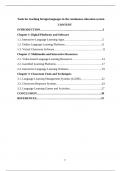
Tools for teaching foreign languages in the continuous education system
CONTENT
INTRODUCTION………………………………………………………....3
Chapter 1: Digital Platforms and Software
1.1. Interactive Language Learning Apps…………………………………..5
1.2. Online Language Learning Platforms………………………………….8
1.3. Virtual Classroom Software……………………………………………11
Chapter 2: Multimedia and Interactive Resources
2.1. Video-based Language Learning Resources…………………………..14
2.2. Gamified Learning Platforms………………………………………….17
2.3. Interactive Language Learning Websites……………………………...19
Chapter 3: Classroom Tools and Techniques
3.1. Language Learning Management Systems (LLMS)…………………..22
3.2. Classroom Response Systems…………………………………………24
3.3. Language Learning Games and Activities…………………………….27
CONCLUSION…………………………………………………………...30
REFERENCES…………………………………………………………...32
2
, INTRODUCTION
In the realm of education, particularly in the domain of language
learning, understanding the relevance of coursework is paramount. It serves as the
foundational pillar upon which the entire educational edifice stands. As we delve
into the intricacies of language education, it becomes imperative to grasp the
significance of coursework, the purpose of scientific research, the tasks inherent in
the theme, and the theoretical underpinnings that guide our exploration. Through
this introductory discourse, we embark on a journey to elucidate the
methodological framework and tools employed in teaching foreign languages
within the continuous education system. The following basic concepts are applied
in this Law state accreditation — process of state recognition of the compliance of
the activities of state educational institutions and organizations, non-state
educational organizations (hereinafter - educational organizations) with state
educational standards, state educational requirements and curricula, as well as
granting the right to issue their graduates with educational documen1
The Relevance of Coursework Coursework, within the context of language
education, embodies a multifaceted significance. It serves as the conduit through
which learners assimilate knowledge, hone their skills, and cultivate a deeper
understanding of linguistic nuances. Moreover, coursework facilitates the
integration of theoretical concepts with practical applications, fostering a holistic
learning experience. By engaging with coursework, learners traverse a structured
path that not only enhances their linguistic proficiency but also instills critical
thinking, problem-solving, and communication skills essential for navigating
today's globalized world. The decision of the President of the Republic of
Uzbekistan "On provision of information and communication technologies and
personal education with highly qualified personnel of Uzbekistan, additional
1
Law of the Republic of Uzbekistan on Education.23.09.2020y.№ LRU-637
3
,support for the development of information technologies, development of scientific
technologies and their integration with information and communication
technologies2"
The Purpose of Scientific Research Scientific research in language
education is imbued with a twofold purpose: to elucidate existing paradigms and to
pave the way for innovative methodologies. Through rigorous inquiry and
empirical investigation, researchers unravel the intricacies of language acquisition,
pedagogical strategies, and learner psychology. Moreover, scientific research
serves as the bedrock upon which evidence-based practices are built, guiding
educators in the design and implementation of effective teaching methodologies.
By interrogating existing assumptions and pushing the boundaries of knowledge,
scientific research propels the field of language education forward, ensuring its
relevance and efficacy in an ever-evolving landscape.
The Tasks of the Theme Within the context of teaching foreign languages
in the continuous education system, the theme encompasses a myriad of tasks
aimed at fostering comprehensive language proficiency and cultural literacy. These
tasks include curriculum development, instructional design, assessment strategies,
and teacher training initiatives. Central to the theme is the cultivation of
communicative competence, wherein learners acquire the linguistic skills
necessary to navigate real-world interactions with fluency and confidence.
Additionally, the theme entails the integration of technology-enhanced learning
tools, authentic materials, and cultural immersion experiences to enrich the
language learning journey. By addressing these tasks holistically, educators can
create dynamic learning environments conducive to fostering language proficiency
and intercultural competence.
2
President Of The Republic Of Uzbekistan Sh. MIRZIYOYEV Tashkent,August 22, 2022, PQ-357
4
, The Theory of Course Paper At the heart of the course paper lies a robust
theoretical framework that underpins its empirical inquiry. Drawing upon theories
from linguistics, psychology, education, and cultural studies, the course paper
seeks to provide a comprehensive understanding of language learning processes
and instructional methodologies. Key theoretical perspectives include
communicative language teaching, socio-cultural theory, cognitive psychology,
and task-based learning, among others. These theoretical underpinnings serve as
the scaffolding upon which empirical investigations are conducted, guiding the
interpretation of findings and the formulation of pedagogical recommendations.
The Methodological Framework Embedded within the continuous
education system is a methodological framework designed to optimize the teaching
and learning of foreign languages. This framework encompasses a diverse array of
pedagogical approaches, instructional strategies, and assessment techniques
tailored to meet the diverse needs of learners. Central to this framework is the
principle of communicative language teaching, wherein language is taught as a tool
for real-life communication rather than as a subject of study in isolation.
5
CONTENT
INTRODUCTION………………………………………………………....3
Chapter 1: Digital Platforms and Software
1.1. Interactive Language Learning Apps…………………………………..5
1.2. Online Language Learning Platforms………………………………….8
1.3. Virtual Classroom Software……………………………………………11
Chapter 2: Multimedia and Interactive Resources
2.1. Video-based Language Learning Resources…………………………..14
2.2. Gamified Learning Platforms………………………………………….17
2.3. Interactive Language Learning Websites……………………………...19
Chapter 3: Classroom Tools and Techniques
3.1. Language Learning Management Systems (LLMS)…………………..22
3.2. Classroom Response Systems…………………………………………24
3.3. Language Learning Games and Activities…………………………….27
CONCLUSION…………………………………………………………...30
REFERENCES…………………………………………………………...32
2
, INTRODUCTION
In the realm of education, particularly in the domain of language
learning, understanding the relevance of coursework is paramount. It serves as the
foundational pillar upon which the entire educational edifice stands. As we delve
into the intricacies of language education, it becomes imperative to grasp the
significance of coursework, the purpose of scientific research, the tasks inherent in
the theme, and the theoretical underpinnings that guide our exploration. Through
this introductory discourse, we embark on a journey to elucidate the
methodological framework and tools employed in teaching foreign languages
within the continuous education system. The following basic concepts are applied
in this Law state accreditation — process of state recognition of the compliance of
the activities of state educational institutions and organizations, non-state
educational organizations (hereinafter - educational organizations) with state
educational standards, state educational requirements and curricula, as well as
granting the right to issue their graduates with educational documen1
The Relevance of Coursework Coursework, within the context of language
education, embodies a multifaceted significance. It serves as the conduit through
which learners assimilate knowledge, hone their skills, and cultivate a deeper
understanding of linguistic nuances. Moreover, coursework facilitates the
integration of theoretical concepts with practical applications, fostering a holistic
learning experience. By engaging with coursework, learners traverse a structured
path that not only enhances their linguistic proficiency but also instills critical
thinking, problem-solving, and communication skills essential for navigating
today's globalized world. The decision of the President of the Republic of
Uzbekistan "On provision of information and communication technologies and
personal education with highly qualified personnel of Uzbekistan, additional
1
Law of the Republic of Uzbekistan on Education.23.09.2020y.№ LRU-637
3
,support for the development of information technologies, development of scientific
technologies and their integration with information and communication
technologies2"
The Purpose of Scientific Research Scientific research in language
education is imbued with a twofold purpose: to elucidate existing paradigms and to
pave the way for innovative methodologies. Through rigorous inquiry and
empirical investigation, researchers unravel the intricacies of language acquisition,
pedagogical strategies, and learner psychology. Moreover, scientific research
serves as the bedrock upon which evidence-based practices are built, guiding
educators in the design and implementation of effective teaching methodologies.
By interrogating existing assumptions and pushing the boundaries of knowledge,
scientific research propels the field of language education forward, ensuring its
relevance and efficacy in an ever-evolving landscape.
The Tasks of the Theme Within the context of teaching foreign languages
in the continuous education system, the theme encompasses a myriad of tasks
aimed at fostering comprehensive language proficiency and cultural literacy. These
tasks include curriculum development, instructional design, assessment strategies,
and teacher training initiatives. Central to the theme is the cultivation of
communicative competence, wherein learners acquire the linguistic skills
necessary to navigate real-world interactions with fluency and confidence.
Additionally, the theme entails the integration of technology-enhanced learning
tools, authentic materials, and cultural immersion experiences to enrich the
language learning journey. By addressing these tasks holistically, educators can
create dynamic learning environments conducive to fostering language proficiency
and intercultural competence.
2
President Of The Republic Of Uzbekistan Sh. MIRZIYOYEV Tashkent,August 22, 2022, PQ-357
4
, The Theory of Course Paper At the heart of the course paper lies a robust
theoretical framework that underpins its empirical inquiry. Drawing upon theories
from linguistics, psychology, education, and cultural studies, the course paper
seeks to provide a comprehensive understanding of language learning processes
and instructional methodologies. Key theoretical perspectives include
communicative language teaching, socio-cultural theory, cognitive psychology,
and task-based learning, among others. These theoretical underpinnings serve as
the scaffolding upon which empirical investigations are conducted, guiding the
interpretation of findings and the formulation of pedagogical recommendations.
The Methodological Framework Embedded within the continuous
education system is a methodological framework designed to optimize the teaching
and learning of foreign languages. This framework encompasses a diverse array of
pedagogical approaches, instructional strategies, and assessment techniques
tailored to meet the diverse needs of learners. Central to this framework is the
principle of communicative language teaching, wherein language is taught as a tool
for real-life communication rather than as a subject of study in isolation.
5