100% satisfaction guarantee Immediately available after payment Both online and in PDF No strings attached 4.2 TrustPilot
logo-home
Exam (elaborations)

IPC Final Exam Questions and Complete Solutions Graded A+

Rating
-
Sold
-
Pages
7
Grade
A+
Uploaded on
24-03-2025
Written in
2024/2025

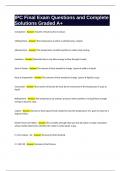
IPC Final Exam Questions and Complete Solutions Graded A+ Conduction - Answer: Transfer of heat by direct contact. Melting Point - Answer: The temperature at which a solid becomes a liquid. Absolute Zero - Answer: The temperature at which particles in matter stop moving. Insulators - Answer: Materials that so not allow energy to flow through it easily. Heat of Fusion - Answer: The amount of heat needed to change 1 gram of solid to a liquid. Heat at Evaporation - Answer: The amount of heat needed to change 1 gram of liquid to a gas. Convection - Answer: The transfer of heat by the heat by the movement of the heated part of a gas or liquid. Boiling Point - Answer: The temperature (at ordinary pressure) when particles of a liquid have enough energy to become a gas. Calorie - Answer: Amount of heat equal to that needed to raise the temperature of 1 gram of water by 1 degree Celcius. Kinetic Theory of Matter - Answer: The scientific principle that says that all matter is made of particles whose motion determines whether the matter is solid, liquid, or gas. F=1.8 x Celcius + 32 - Answer: Formula to find Farenheit. C=.55(F-32) - Answer: Formula to find Celcius. K=C + 273 - Answer: Formula to find Kelvin. Acid - Answer: Contains Hydrogen. Base - Answer: Contains Hydrogen ion OH-. Base - Answer: When placed in water, it is a proton acceptor. Acid - Answer: When placed in water, quickly combines with H2O to make hydronium ion H3O+. Neutralization - Answer: Occurs when you combine an acid and a base and it produces water and a salt. Emulsify - Answer: Dissolving of fats and oils by cutting it. Isomers - Answer: Compounds with the same molecular formula but different structures. Aromatics - Answer: Alternates single and double bonds. Alkanes - Answer: All are named at the end with ---ane. Alkenes - Answer: All are named at the end with ---ene. Alkenes - Answer: All are double bonds so all are unsaturated. Alkenes - Answer: Cn H2n Alkynes - Answer: All are named at the end with ---yne. Alkanes - Answer: All single bonds, so all are saturated. Alkanes - Answer: Cn H2n+2 Alkanes - Answer: Straight or branched chains. Alkynes - Answer: All are triple bonds so all are saturated. Alkynes - Answer: Cn H2n-2 Alcohols - Answer: Add ---ol to the end. Halogen Derivatives - Answer: Halogen replaces one or more of the hydrogen atoms. Organic Acids - Answer: Add ---oic to the end. Esters - Answer: Alcohols and Organic Acids combine. Heat Energy - Answer: This type of energy deals with the internal motion of atoms. Chemical Energy - Answer: Energy that bonds or breaks atoms or ions together or apart. Nuclear Energy - Answer: This is the most concentrated form of energy. Mechanical Energy - Answer: Energy associated with motion. Electromagnetic Energy - Answer: This energy is created by moving electrical particles. Mechanical Energy - Answer: Examples of this type of energy are water, wind, sound, blood flow, and walking. Heat Energy - Answer: This type of energy causes changes in temperature and phase. Kinetic Energy - Answer: Energy of Motion. Potential Energy - Answer: Energy of Position. Potential Energy - Answer: This type of energy is stored when work is done to it. Potential Energy - Answer: At the top of the arch, the ball has this maximum type of energy. Kinetic Energy - Answer: As the ball falls it gains this maximum type of energy. Volt - Answer: The amount of work done in moving electrons between two points. How fast. Electrical Charges - Answer: The result of something being given an amount of electrical energy. Alternating Circuit - Answer: An electric current that changes direction in an electric circuit. AC Charging - Answer: A neutral object acquires an electrical charge when it either gains or loses electrons. Electric Discharge - Answer: Loss of static electricity as changes move off an object. Magnetic Force - Answer: The force that causes two magnets to push or pull each other when their ends are brought together. Series Circuit - Answer: A circuit in which all the parts are connected one after another. Electrical Field - Answer: A region of space around an electrically charged object in which electrical forces on other charged particles are noticeable. Electric Circuit - Answer: A complete path, whicha allows electrons to move from high to low. Static Electricity - Answer: The build up of electrical charges on an object and they do not flow. Direct Circuit - Answer: An electric current that flows in one direction in an electric circuit. DC Resistance - Answer: All conditions which limit the flow of electrons inan electric circuit. Wave - Answer: A disturbance caused by energy moving from one place to another in a substance. Longitudinal Wave - Answer: A wave in which particles vibrate back and forth in the direction of the wave. Transverse Wave - Answer: A wave in which the molecules vibrate at right angles to the direction of the wave. Speed - Answer: How fast a wave travels. Refraction - Answer: The bending of a wave due to the change in its speed. Reflection - Answer: The bouncing of a wave off a barrier that does not absorb all the energy of the wave. Frequency - Answer: The number of complete waves thar pass a given point in one second. Hertz - Answer: Unit of measurement that is one complete wave passing a given point each second. Speeds up - Answer: If a wave passes from high density to low density it Slows down - Answer: If a wave passes from low density to high density it Products - Answer: As a result of an endothermic reaction, what has more energy? The products or the reactants? Stored in one of the products - Answer: In an endothermic reaction, energy is Single Replacement - Answer: What type of replacement? 2Al + Fe2O3 --> Al2O3 + 2Fe released - Answer: In an exothermic reaction, energy is reactants - Answer: As a result of an exothermic reaction what has more energy? The products or the reactants? Double Replacement - Answer: What type of replacement? PbI2 + OH ---> PbO + HI2 Synthesis - Answer: What type of replacement? 2H2 + O2 ---> 2H2O Concentration - Answer: The measurement of the amount of a substance in a given unit of volume. Temperature - Answer: The measure of the energy of their molecules. Surface Area - Answer: How much of a material is exposed. Catalysts - Answer: A substance that increases the rate of reaction. Double Replacement - Answer: Different atoms in two different compounds replace each other. Decomposition - Answer: A complex substance breaks down into two or more simpler substances. Synthesis - Answer: Two or more simple substances combining to form a new, more complex substance. Single Replacement - Answer: An uncombined element replaces an element that is part of a complex compound.

Show more Read less
Institution
A-IPC
Course
A-IPC


Whoops! We can’t load your doc right now. Try again or contact support.

Written for

Institution
A-IPC
Course
A-IPC

Document information

Uploaded on
March 24, 2025
Number of pages
7
Written in
2024/2025
Type
Exam (elaborations)
Contains
Questions & answers

Subjects

Content preview

IPC Final Exam Questions and Complete
Solutions Graded A+
Conduction - Answer: Transfer of heat by direct contact.


Melting Point - Answer: The temperature at which a solid becomes a liquid.


Absolute Zero - Answer: The temperature at which particles in matter stop moving.


Insulators - Answer: Materials that so not allow energy to flow through it easily.


Heat of Fusion - Answer: The amount of heat needed to change 1 gram of solid to a liquid.


Heat at Evaporation - Answer: The amount of heat needed to change 1 gram of liquid to a gas.


Convection - Answer: The transfer of heat by the heat by the movement of the heated part of a gas or
liquid.


Boiling Point - Answer: The temperature (at ordinary pressure) when particles of a liquid have enough
energy to become a gas.


Calorie - Answer: Amount of heat equal to that needed to raise the temperature of 1 gram of water by 1
degree Celcius.


Kinetic Theory of Matter - Answer: The scientific principle that says that all matter is made of particles
whose motion determines whether the matter is solid, liquid, or gas.


F=1.8 x Celcius + 32 - Answer: Formula to find Farenheit.


C=.55(F-32) - Answer: Formula to find Celcius.

, K=C + 273 - Answer: Formula to find Kelvin.


Acid - Answer: Contains Hydrogen.


Base - Answer: Contains Hydrogen ion OH-.


Base - Answer: When placed in water, it is a proton acceptor.


Acid - Answer: When placed in water, quickly combines with H2O to make hydronium ion H3O+.


Neutralization - Answer: Occurs when you combine an acid and a base and it produces water and a salt.


Emulsify - Answer: Dissolving of fats and oils by cutting it.


Isomers - Answer: Compounds with the same molecular formula but different structures.


Aromatics - Answer: Alternates single and double bonds.


Alkanes - Answer: All are named at the end with ---ane.


Alkenes - Answer: All are named at the end with ---ene.


Alkenes - Answer: All are double bonds so all are unsaturated.


Alkenes - Answer: Cn H2n


Alkynes - Answer: All are named at the end with ---yne.
Get to know the seller

Seller avatar
Reputation scores are based on the amount of documents a seller has sold for a fee and the reviews they have received for those documents. There are three levels: Bronze, Silver and Gold. The better the reputation, the more your can rely on the quality of the sellers work.
YourExamplug Grand Canyon University
View profile
Follow You need to be logged in order to follow users or courses
Sold
171
Member since
1 year
Number of followers
26
Documents
14332
Last sold
4 days ago
Your Exm Plug

Assignments, Case Studies, Research, Essay writing service, Questions and Answers, Discussions etc. for students who want to see results twice as fast. I have done papers of various topics and complexities. I am punctual and always submit work on-deadline. I write engaging and informative content on all subjects. Send me your research papers, case studies, psychology papers, etc, and I’ll do them to the best of my abilities. Writing is my passion when it comes to academic work. I’ve got a good sense of structure and enjoy finding interesting ways to deliver information in any given paper. I love impressing clients with my work, and I am very punctual about deadlines. Send me your assignment and I’ll take it to the next level. I strive for my content to be of the highest quality. Your wishes come first— send me your requirements and I’ll make a piece of work with fresh ideas, consistent structure, and following the academic formatting rules. For every student you refer to me with an order that is completed and paid transparently, I will do one assignment for you, free of charge!!!!!!!!!!!!

Read more Read less
4.3

67 reviews

5
38
4
16
3
7
2
4
1
2

Recently viewed by you

Why students choose Stuvia

Created by fellow students, verified by reviews

Quality you can trust: written by students who passed their tests and reviewed by others who've used these notes.

Didn't get what you expected? Choose another document

No worries! You can instantly pick a different document that better fits what you're looking for.

Pay as you like, start learning right away

No subscription, no commitments. Pay the way you're used to via credit card and download your PDF document instantly.

Student with book image

“Bought, downloaded, and aced it. It really can be that simple.”

Alisha Student

Frequently asked questions