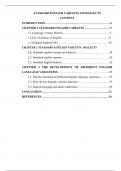
STANDARD ENGLISH VARIANTS AND DIALECTS
CONTENT
INTRODUCTION……………………………………………..……………..3
CHAPTER 1 STANDARD ENGLISH VARIANTS…………….…………5
1.1.Language variants Dialects…………………………………………..5
1.2.List of dialects of English……………………………….…………..9
1.3.Standard English (SE)………………………………………..……..16
CHAPTER 2 STANDARD ENGLISH VARIANTS DIALECTS
2.1. Standard english variants and dialects………………….…………..18
2.2. Standard english variants…………………………………..……….20
2.3. Standard English dialects…………………………………….……..22
CHAPTER 3 THE DEVELOPMENT OF DIFFERENT ENGLISH
LANGUAGE VARIATIONS………………………………………...……..25
3.1. The Development of Different English language variations…….....25
3.2. How do new English varieties function………………………...…..27
3.3. English language and dialect difference……………………………29
CONCLUSION……………………………………………………………...31
REFERENCES…………………………………………………………...…34
1
, INTRODUCTION
The English language is renowned for its diversity, spanning continents,
cultures, and centuries. From the rolling hills of rural England to the bustling
streets of New York City, the variations in how English is spoken reflect a rich
tapestry of history, geography, and social dynamics. In this exploration of
standard English variants and dialects, we delve into the fascinating array of
linguistic flavors that contribute to the global tapestry of the English language.
English, as a global lingua franca, has spread far beyond its origins in
medieval England, evolving into numerous distinct dialects and variants across
the globe. Each of these variations carries its own unique characteristics,
shaped by factors such as historical settlement patterns, colonization,
immigration, and cultural exchange.
At the heart of the discussion lie the concepts of standardization and
variation. While standard forms of English, such as Received Pronunciation
(RP) in the United Kingdom or General American (GA) in the United States,
provide a common framework for formal communication in areas such as
education, media, and governance, they coexist alongside a vast array of
regional and social dialects. These dialects, ranging from the lilting brogue of
Ireland to the melodic cadences of the Caribbean, not only reflect geographic
origins but also serve as markers of identity, culture, and social belonging.
Moreover, the study of English variants and dialects offers profound
insights into the dynamic nature of language itself. Language is not static but
rather a living entity, subject to continual evolution and adaptation. As
societies change, so too does their language, influenced by factors such as
migration, globalization, technological advancements, and cultural trends.
Thus, the English spoken today is not the same as that spoken a century ago,
and it will continue to evolve in the centuries to come.
In this exploration, we will journey through the diverse landscapes of
English dialects and variants, examining their origins, characteristics, and
social significance. We will explore the tensions between standardization and
2
,linguistic diversity, the challenges and opportunities posed by communication
across dialectal boundaries, and the efforts to preserve and revitalize
endangered dialects and minority language varieties.
Ultimately, our inquiry into standard English variants and dialects serves
not only to deepen our understanding of language but also to celebrate the rich
tapestry of human expression that lies at the heart of linguistic diversity.
Through this exploration, we embark on a journey of discovery, uncovering
the myriad voices and stories that enrich the global conversation of the
English-speaking world.
3
, CHAPTER 1 STANDARD ENGLISH VARIANTS.
1.1.Language variants Dialects.
The word language contains a multiplicity of different designations. Two
senses have already been distinguished: language as a universal species-
specific capability of the human race and languages as the
various manifestations of that capability, as with English, French, Latin,
Swahili, Malay, and so on. There is, of course, no observable universal
language over and above the various languages that have been or are spoken or
written, but one may choose to concentrate on the general and even the
universal features, characteristics, and components of different languages and
on the ways in which the same sets of descriptive procedures and explanatory
theories may be applied to different languages. In so doing one may refer to
language (in general) as one’s object of study. This is what is done by
linguists, or linguistic scientists, persons devoting themselves to the scientific
study of languages (as opposed to the popular sense of linguists as polyglots,
persons having a command of several different languages).
Dialects
It has already been pointed out that no two persons speak exactly alike,
and, within the area of all but the smallest speech communities (groups of
people speaking the same language), there are subdivisions of recognizably
different types of language, called dialects, that do not, however, render
intercommunication impossible or markedly difficult.
Because intercomprehensibility lies along a scale, the degree required for
two or more forms of speech to qualify as dialects of a single language, instead
of being regarded as separate languages, is not easy to quantify or to lay down
in advance, and the actual cutoff point must in the last resort be arbitrary. In
practice, however, the terms dialect and language can be used with reasonable
agreement. One speaks of different dialects of English (Southern British
English, Northern British English, Scottish English, Midwest American
English, New England American English, Australian English, and so on, with,
4
CONTENT
INTRODUCTION……………………………………………..……………..3
CHAPTER 1 STANDARD ENGLISH VARIANTS…………….…………5
1.1.Language variants Dialects…………………………………………..5
1.2.List of dialects of English……………………………….…………..9
1.3.Standard English (SE)………………………………………..……..16
CHAPTER 2 STANDARD ENGLISH VARIANTS DIALECTS
2.1. Standard english variants and dialects………………….…………..18
2.2. Standard english variants…………………………………..……….20
2.3. Standard English dialects…………………………………….……..22
CHAPTER 3 THE DEVELOPMENT OF DIFFERENT ENGLISH
LANGUAGE VARIATIONS………………………………………...……..25
3.1. The Development of Different English language variations…….....25
3.2. How do new English varieties function………………………...…..27
3.3. English language and dialect difference……………………………29
CONCLUSION……………………………………………………………...31
REFERENCES…………………………………………………………...…34
1
, INTRODUCTION
The English language is renowned for its diversity, spanning continents,
cultures, and centuries. From the rolling hills of rural England to the bustling
streets of New York City, the variations in how English is spoken reflect a rich
tapestry of history, geography, and social dynamics. In this exploration of
standard English variants and dialects, we delve into the fascinating array of
linguistic flavors that contribute to the global tapestry of the English language.
English, as a global lingua franca, has spread far beyond its origins in
medieval England, evolving into numerous distinct dialects and variants across
the globe. Each of these variations carries its own unique characteristics,
shaped by factors such as historical settlement patterns, colonization,
immigration, and cultural exchange.
At the heart of the discussion lie the concepts of standardization and
variation. While standard forms of English, such as Received Pronunciation
(RP) in the United Kingdom or General American (GA) in the United States,
provide a common framework for formal communication in areas such as
education, media, and governance, they coexist alongside a vast array of
regional and social dialects. These dialects, ranging from the lilting brogue of
Ireland to the melodic cadences of the Caribbean, not only reflect geographic
origins but also serve as markers of identity, culture, and social belonging.
Moreover, the study of English variants and dialects offers profound
insights into the dynamic nature of language itself. Language is not static but
rather a living entity, subject to continual evolution and adaptation. As
societies change, so too does their language, influenced by factors such as
migration, globalization, technological advancements, and cultural trends.
Thus, the English spoken today is not the same as that spoken a century ago,
and it will continue to evolve in the centuries to come.
In this exploration, we will journey through the diverse landscapes of
English dialects and variants, examining their origins, characteristics, and
social significance. We will explore the tensions between standardization and
2
,linguistic diversity, the challenges and opportunities posed by communication
across dialectal boundaries, and the efforts to preserve and revitalize
endangered dialects and minority language varieties.
Ultimately, our inquiry into standard English variants and dialects serves
not only to deepen our understanding of language but also to celebrate the rich
tapestry of human expression that lies at the heart of linguistic diversity.
Through this exploration, we embark on a journey of discovery, uncovering
the myriad voices and stories that enrich the global conversation of the
English-speaking world.
3
, CHAPTER 1 STANDARD ENGLISH VARIANTS.
1.1.Language variants Dialects.
The word language contains a multiplicity of different designations. Two
senses have already been distinguished: language as a universal species-
specific capability of the human race and languages as the
various manifestations of that capability, as with English, French, Latin,
Swahili, Malay, and so on. There is, of course, no observable universal
language over and above the various languages that have been or are spoken or
written, but one may choose to concentrate on the general and even the
universal features, characteristics, and components of different languages and
on the ways in which the same sets of descriptive procedures and explanatory
theories may be applied to different languages. In so doing one may refer to
language (in general) as one’s object of study. This is what is done by
linguists, or linguistic scientists, persons devoting themselves to the scientific
study of languages (as opposed to the popular sense of linguists as polyglots,
persons having a command of several different languages).
Dialects
It has already been pointed out that no two persons speak exactly alike,
and, within the area of all but the smallest speech communities (groups of
people speaking the same language), there are subdivisions of recognizably
different types of language, called dialects, that do not, however, render
intercommunication impossible or markedly difficult.
Because intercomprehensibility lies along a scale, the degree required for
two or more forms of speech to qualify as dialects of a single language, instead
of being regarded as separate languages, is not easy to quantify or to lay down
in advance, and the actual cutoff point must in the last resort be arbitrary. In
practice, however, the terms dialect and language can be used with reasonable
agreement. One speaks of different dialects of English (Southern British
English, Northern British English, Scottish English, Midwest American
English, New England American English, Australian English, and so on, with,
4