Table of Contents
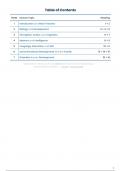
Week Lecture Topic Reading
1 Introduction and Main Theories 1+2
2 Biology and Development 3+4+5
3 Perception, Action, and Cognition 6+7
4 Memory and Intelligence 8+9
5 Language, Education, and Self 10 + 11
6 Social Emotional Development and the Family 13 + 14 + 15
7 Disorders Across Development 15 + 16
I appreciate and thank you for any donation; all this money will (probably) go
toward getting uni books :) → paypal / buymeacoffee
1
, paypal / buymeacoffee
Introduction - chapter 1
Defining Development
development → systematic changes and continuities that occur between one’s conception
and death
↳ changes are systematic (orderly, patterned, and relatively enduring)
- development implies continuities as well → remaining the same
- the changes and continuities fall into 3 broad domains
1. physical development → body and organs
2. cognitive development → perception, language, learning, memory, problem-solving
3. psychosocial development → emotions, personality, relationships, skills, roles
growth → physical changes that occur from conception to maturity
biological aging → deterioration of the organism that inevitably leads to death
- developmental change involves both gains and losses at any age
↳ not always improve or worsen, just become different
aging → a range of physical, cognitive, and psychosocial changes, positive or negative, in the
mature organism
Conceptualizing the Life-Span
- a new period of the life-span has been added recently:
emerging adulthood → transitional period between adolescence and full-fledged adulthood
↳ young adults spend years getting education and saving money to start a life
↳ distinct developmental period primarily in developed countries
period of life age range
prenatal conception → birth
- emerging adults:
infancy 0 → 2 years
→ explore their identities
preschool (toddler) 2 → 5 years → live unstable lives (lots of
changes)
middle childhood 6 → 10 years → are self-focused and
relatively free of
adolescence 10 → 18 years
obligations to others
emerging adulthood 18 → 25 years → feel in between
→ believe they have limitless
early adulthood 25 → 40 years possibilities
middle adulthood 40 → 65 years
late adulthood 65+ years
cultural differences
culture → the shared understandings and way of life of people including beliefs, values etc.
age grade → socially defined age group in society
↳ each age grade is assigned different roles, statuses, privileges, and responsibilities
2
, paypal / buymeacoffee
rite of passage → ritual marking the passage from one status to another (ex: quinceañera)
age norms → what people should and shouldn’t do at different age grades
↳ have been recently weakening
social clock → a person’s sense of when things should be done
subcultural differences
- age grade and norms differ from culture to culture and subculture to subculture
ethnicity → people’s affiliation with a group based on common heritage or traditions
socioeconomic status (SES) → rank in society based on education, income, and occupation
historical changes
- childhood as an age of innocence: since the 17th century
↳ before, kinds were seen as little adults
- adolescence: recognized as distinctive phase since late 19th century
- emerging adulthood: since the 21st century
- middle age as emptying of the nest: since the 20th century
- old age as retirement: since the 20th century (before people worked until they died)
projecting the future
life expectancy → the average number of years a newborn is expected to live
↳ generally greater for females than males
- wealth is associated with longer life
Framing the Nature-Nurture Issue
nature-nurture issue → the question of how biological and environmental forces act and
interact to make us who we are
nature
- on this side of the debate are those who emphasize the influence of heredity
maturation → the biological unfolding of the individual as sketched by genes
nurture
- on this side of the debate are those who emphasize change in response to environment
environment → all external physical and social conditions, stimuli, and events
learning → the process of permanently changing one’s thoughts, feelings, or emotions through
experience
Goals and Uses of Studying Development
- the goals driving the study of life-span are:
describing
predicting
explaining
optimizing development
Early Beginnings
- first scientific investigations of development: in the 19th century with baby biographies
3
, paypal / buymeacoffee
- G. Stanley Hall is considered to be the founder of developmental psychology
The Modern Life-Span Perspective
gerontology → the study of aging and old age
- in the 60s and 70s, the perspective shifted to a life-span perspective on human development
that laid out 7 key assumptions about development:
1. a lifelong process
2. multidirectional → different aspects change differently
3. involves both gain and loss
4. characterized by lifelong plasticity → neuroplasticity
5. shaped by historical-cultural context
6. multiply influenced → development is a product of nature and nurture
7. must be studied by multiple disciplines
Conducting Culturally Sensitive Research
- we need to study development in different contexts using culturally sensitive methods to
discover what is universal and what is culturally specific about human development
WEIRD people → people in Western, Educated, Industrialized, Rich, and Democratic societies
- to make their research more sensitive, researchers should involve community members
when designing and conducting studies
ethnocentrism → the belief that one’s group or culture is superior
4
Week Lecture Topic Reading
1 Introduction and Main Theories 1+2
2 Biology and Development 3+4+5
3 Perception, Action, and Cognition 6+7
4 Memory and Intelligence 8+9
5 Language, Education, and Self 10 + 11
6 Social Emotional Development and the Family 13 + 14 + 15
7 Disorders Across Development 15 + 16
I appreciate and thank you for any donation; all this money will (probably) go
toward getting uni books :) → paypal / buymeacoffee
1
, paypal / buymeacoffee
Introduction - chapter 1
Defining Development
development → systematic changes and continuities that occur between one’s conception
and death
↳ changes are systematic (orderly, patterned, and relatively enduring)
- development implies continuities as well → remaining the same
- the changes and continuities fall into 3 broad domains
1. physical development → body and organs
2. cognitive development → perception, language, learning, memory, problem-solving
3. psychosocial development → emotions, personality, relationships, skills, roles
growth → physical changes that occur from conception to maturity
biological aging → deterioration of the organism that inevitably leads to death
- developmental change involves both gains and losses at any age
↳ not always improve or worsen, just become different
aging → a range of physical, cognitive, and psychosocial changes, positive or negative, in the
mature organism
Conceptualizing the Life-Span
- a new period of the life-span has been added recently:
emerging adulthood → transitional period between adolescence and full-fledged adulthood
↳ young adults spend years getting education and saving money to start a life
↳ distinct developmental period primarily in developed countries
period of life age range
prenatal conception → birth
- emerging adults:
infancy 0 → 2 years
→ explore their identities
preschool (toddler) 2 → 5 years → live unstable lives (lots of
changes)
middle childhood 6 → 10 years → are self-focused and
relatively free of
adolescence 10 → 18 years
obligations to others
emerging adulthood 18 → 25 years → feel in between
→ believe they have limitless
early adulthood 25 → 40 years possibilities
middle adulthood 40 → 65 years
late adulthood 65+ years
cultural differences
culture → the shared understandings and way of life of people including beliefs, values etc.
age grade → socially defined age group in society
↳ each age grade is assigned different roles, statuses, privileges, and responsibilities
2
, paypal / buymeacoffee
rite of passage → ritual marking the passage from one status to another (ex: quinceañera)
age norms → what people should and shouldn’t do at different age grades
↳ have been recently weakening
social clock → a person’s sense of when things should be done
subcultural differences
- age grade and norms differ from culture to culture and subculture to subculture
ethnicity → people’s affiliation with a group based on common heritage or traditions
socioeconomic status (SES) → rank in society based on education, income, and occupation
historical changes
- childhood as an age of innocence: since the 17th century
↳ before, kinds were seen as little adults
- adolescence: recognized as distinctive phase since late 19th century
- emerging adulthood: since the 21st century
- middle age as emptying of the nest: since the 20th century
- old age as retirement: since the 20th century (before people worked until they died)
projecting the future
life expectancy → the average number of years a newborn is expected to live
↳ generally greater for females than males
- wealth is associated with longer life
Framing the Nature-Nurture Issue
nature-nurture issue → the question of how biological and environmental forces act and
interact to make us who we are
nature
- on this side of the debate are those who emphasize the influence of heredity
maturation → the biological unfolding of the individual as sketched by genes
nurture
- on this side of the debate are those who emphasize change in response to environment
environment → all external physical and social conditions, stimuli, and events
learning → the process of permanently changing one’s thoughts, feelings, or emotions through
experience
Goals and Uses of Studying Development
- the goals driving the study of life-span are:
describing
predicting
explaining
optimizing development
Early Beginnings
- first scientific investigations of development: in the 19th century with baby biographies
3
, paypal / buymeacoffee
- G. Stanley Hall is considered to be the founder of developmental psychology
The Modern Life-Span Perspective
gerontology → the study of aging and old age
- in the 60s and 70s, the perspective shifted to a life-span perspective on human development
that laid out 7 key assumptions about development:
1. a lifelong process
2. multidirectional → different aspects change differently
3. involves both gain and loss
4. characterized by lifelong plasticity → neuroplasticity
5. shaped by historical-cultural context
6. multiply influenced → development is a product of nature and nurture
7. must be studied by multiple disciplines
Conducting Culturally Sensitive Research
- we need to study development in different contexts using culturally sensitive methods to
discover what is universal and what is culturally specific about human development
WEIRD people → people in Western, Educated, Industrialized, Rich, and Democratic societies
- to make their research more sensitive, researchers should involve community members
when designing and conducting studies
ethnocentrism → the belief that one’s group or culture is superior
4