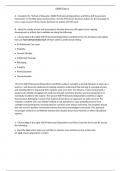
March et al 2004 question with correct
answers
Aim - answersInvestigate the effectiveness of fluoxetine, CBT, a combination of both
and a placebo condition on the treatment of depression in adolescents
Method - answers· Randomised controlled trial on 439 adolescent patients diagnosed
with major depressive disorder at 13 clinics across the USA
· The trial focused specifically on comparisons between an SSRI and CBT in the
treatment of adolescent depression.
· The study had four treatment conditions, to which the participants were assigned
randomly
fluoxetine (an SSRI) alone
CBT alone
fluoxetine and CBT combined
placebo.
· End of 12 weeks = placebo patients informed
· 3 indicators used in treatments to characterise effectiveness of treatment in terms of
reductions of symptoms of disorder
o Response rate: 50% decrease in scores on standardised depression scale (HAM-D)
o Remission rate: few or no symptoms of depression (score less than 7 on HAM-D)
Relapse rate: recurrence of past condition
Results - answers· 12 weeks = placebo (35%), fluoxentine (61%), CBT (44%), both
(71%)
· 18 weeks = placebo (dis.), fluoxentine (69%), CBT (65%), both (85%)
· 36 weeks = placebo (dis.), fluoxentine (81%), CBT (81%), both (86%)
· Fluoxentine + Cognitive Behavioural Therapy = most effective short-term and long-
term
· Placebo = least effective
CBT = short-term barely more effective than placebo but improves long-term
Conclusions - answersThe researchers concluded that the combination treatment
presented a more favourable risk-benefit ratio for adolescents
Critical Thinking - answersStrengths:
· Specific comparison of fluoxetine with CBT
o Many studies more generally compare second-generation antidepressants
The administration of CBT varies widely from practitioner to practitioner Terms of both
the specific techniques employed and the expertise of the practitioner Does not offer full
control over all of the variables that might have influenced the findings
Data triangulation
answers
Aim - answersInvestigate the effectiveness of fluoxetine, CBT, a combination of both
and a placebo condition on the treatment of depression in adolescents
Method - answers· Randomised controlled trial on 439 adolescent patients diagnosed
with major depressive disorder at 13 clinics across the USA
· The trial focused specifically on comparisons between an SSRI and CBT in the
treatment of adolescent depression.
· The study had four treatment conditions, to which the participants were assigned
randomly
fluoxetine (an SSRI) alone
CBT alone
fluoxetine and CBT combined
placebo.
· End of 12 weeks = placebo patients informed
· 3 indicators used in treatments to characterise effectiveness of treatment in terms of
reductions of symptoms of disorder
o Response rate: 50% decrease in scores on standardised depression scale (HAM-D)
o Remission rate: few or no symptoms of depression (score less than 7 on HAM-D)
Relapse rate: recurrence of past condition
Results - answers· 12 weeks = placebo (35%), fluoxentine (61%), CBT (44%), both
(71%)
· 18 weeks = placebo (dis.), fluoxentine (69%), CBT (65%), both (85%)
· 36 weeks = placebo (dis.), fluoxentine (81%), CBT (81%), both (86%)
· Fluoxentine + Cognitive Behavioural Therapy = most effective short-term and long-
term
· Placebo = least effective
CBT = short-term barely more effective than placebo but improves long-term
Conclusions - answersThe researchers concluded that the combination treatment
presented a more favourable risk-benefit ratio for adolescents
Critical Thinking - answersStrengths:
· Specific comparison of fluoxetine with CBT
o Many studies more generally compare second-generation antidepressants
The administration of CBT varies widely from practitioner to practitioner Terms of both
the specific techniques employed and the expertise of the practitioner Does not offer full
control over all of the variables that might have influenced the findings
Data triangulation