TRT3705 Assignment
2 (COMPLETE
ANSWERS) Semester
1 2025 - DUE 4 April
2025
[Type the document subtitle]
[Pick the date]
[Type the abstract of the document here. The abstract is typically a short summary of the contents of
the document. Type the abstract of the document here. The abstract is typically a short summary of
the contents of the document.]
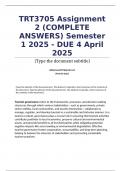
Tourism governance refers to the frameworks, processes, and decision-making
structures through which various stakeholders—such as governments, private
sector entities, local communities, and tourists themselves—collaborate to
manage, regulate, and develop tourism in a sustainable and inclusive manner. In a
tourism context, governance plays a crucial role in ensuring that tourism activities
contribute positively to local economies, preserve cultural and environmental
assets, and provide benefits to all involved parties while mitigating potential
negative impacts like overcrowding or environmental degradation. Effective
tourism governance fosters cooperation, accountability, and long-term planning,
helping to balance the interests of stakeholders and promoting sustainable
tourism practices.
, TRT3705 Assignment 2 (ANSWERS)
Semester 1 2025 - DISTINCTION
GUARANTEED
Course
Tourism Governance (TRT3705)
Institution
University Of South Africa (Unisa)
Book
Tourism Governance
Achieve a distinction with this comprehensive and well-organized set of
TRT3705 Assignment 2 (ANSWERS) Semester 1 2025 - DISTINCTION
GUARANTEED. Ensure accuracy and excellence in your submission!!!!
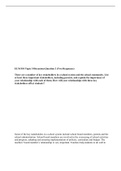
1. Create your own definition of “tourism governance” by referring to the
importance of governance in a tourism context. (5)
Tourism governance refers to the system of policies, regulations, and decision-
making processes that guide and manage the development, management, and
sustainability of tourism activities. It involves the participation of multiple
stakeholders, including government authorities, private sector businesses, local
communities, and tourists, working collaboratively to ensure that tourism
benefits all parties while minimizing negative impacts. Effective tourism
governance is crucial for balancing economic growth, environmental protection,
cultural preservation, and social equity, fostering a sustainable tourism industry
that benefits present and future generations.
Tourism governance, in my definition, refers to the framework of policies, regulations,
institutions, and stakeholder interactions that guide and manage tourism development and
operations to achieve sustainable, equitable, and beneficial outcomes. It acknowledges the
importance of governance in tourism by emphasizing:
Sustainability:
o Effective governance ensures that tourism activities are conducted in a way that
minimizes negative environmental and socio-cultural impacts, while maximizing
long-term benefits for host communities and the environment.
Stakeholder Coordination:
2 (COMPLETE
ANSWERS) Semester
1 2025 - DUE 4 April
2025
[Type the document subtitle]
[Pick the date]
[Type the abstract of the document here. The abstract is typically a short summary of the contents of
the document. Type the abstract of the document here. The abstract is typically a short summary of
the contents of the document.]
Tourism governance refers to the frameworks, processes, and decision-making
structures through which various stakeholders—such as governments, private
sector entities, local communities, and tourists themselves—collaborate to
manage, regulate, and develop tourism in a sustainable and inclusive manner. In a
tourism context, governance plays a crucial role in ensuring that tourism activities
contribute positively to local economies, preserve cultural and environmental
assets, and provide benefits to all involved parties while mitigating potential
negative impacts like overcrowding or environmental degradation. Effective
tourism governance fosters cooperation, accountability, and long-term planning,
helping to balance the interests of stakeholders and promoting sustainable
tourism practices.
, TRT3705 Assignment 2 (ANSWERS)
Semester 1 2025 - DISTINCTION
GUARANTEED
Course
Tourism Governance (TRT3705)
Institution
University Of South Africa (Unisa)
Book
Tourism Governance
Achieve a distinction with this comprehensive and well-organized set of
TRT3705 Assignment 2 (ANSWERS) Semester 1 2025 - DISTINCTION
GUARANTEED. Ensure accuracy and excellence in your submission!!!!
1. Create your own definition of “tourism governance” by referring to the
importance of governance in a tourism context. (5)
Tourism governance refers to the system of policies, regulations, and decision-
making processes that guide and manage the development, management, and
sustainability of tourism activities. It involves the participation of multiple
stakeholders, including government authorities, private sector businesses, local
communities, and tourists, working collaboratively to ensure that tourism
benefits all parties while minimizing negative impacts. Effective tourism
governance is crucial for balancing economic growth, environmental protection,
cultural preservation, and social equity, fostering a sustainable tourism industry
that benefits present and future generations.
Tourism governance, in my definition, refers to the framework of policies, regulations,
institutions, and stakeholder interactions that guide and manage tourism development and
operations to achieve sustainable, equitable, and beneficial outcomes. It acknowledges the
importance of governance in tourism by emphasizing:
Sustainability:
o Effective governance ensures that tourism activities are conducted in a way that
minimizes negative environmental and socio-cultural impacts, while maximizing
long-term benefits for host communities and the environment.
Stakeholder Coordination: